Is weight loss surgery covered by insurance?
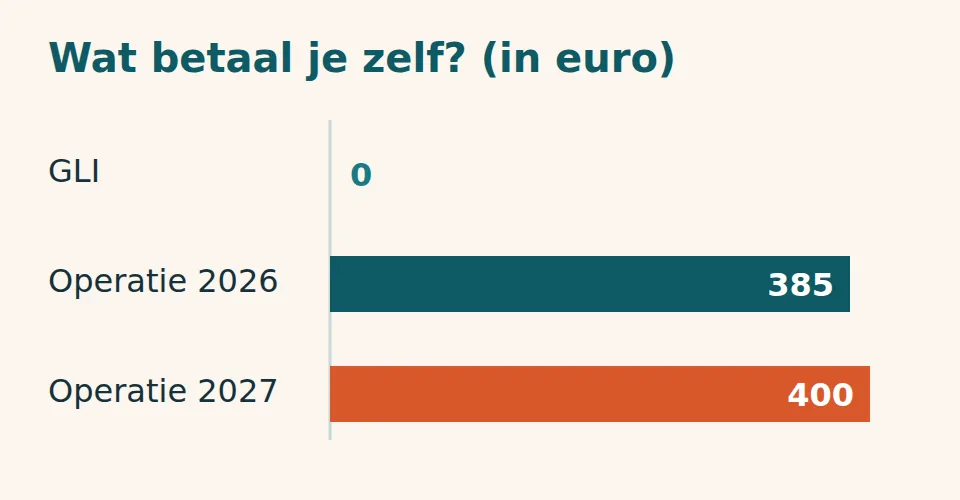
Yes, weight loss surgery is reimbursed from basic health insurance (basisverzekering) if you meet the medical criteria and your GP (huisarts) refers you. You do pay your compulsory excess (eigen risico): €385 in 2026 and €400 in 2027. Whether you pay anything else yourself depends mainly on the contract between your health insurer and the centre.
In brief
- With a medical indication, weight loss surgery is covered by basic health insurance (basisverzekering); you pay your compulsory excess (eigen risico) of €385 in 2026 (Kamerstuk 36679, 2025).
- In 2027 the compulsory excess (verplicht eigen risico) rises to €400 (Zilveren Kruis on Prinsjesdag, September 2026).
- If your insurer has no contract with the centre, part of the bill may be for you; some policies then reimburse 60 to 65% (Zorgwijzer, 25-11-2025).
- The GLI is reimbursed without compulsory excess (eigen risico) and without a personal contribution (eigen bijdrage) (Zorginstituut Nederland, 29-05-2026).
When does basic health insurance reimburse?
Basic health insurance (basisverzekering) reimburses weight loss surgery if it is medically necessary. That means: you meet the criteria and your GP (huisarts) or specialist refers you to a bariatric centre. In short, it concerns a BMI of 40 or higher, a BMI of 35 or higher with a serious condition related to your weight, or a BMI of 30 or higher with poorly controlled type 2 diabetes, if previous treatment helped too little (NHG-Standaard Obesitas, October 2025). The explanation and a check can be found at the criteria for being eligible for weight loss surgery.
The reimbursement applies to the whole standard pathway: the screening, the operation and the aftercare at the centre. You do not need supplementary insurance (aanvullende verzekering) for this. It can help with extras, though, such as more hours with a dietitian than basic health insurance reimburses. For a reimbursed operation you always need a referral (verwijzing). How to request one can be read at the conversation about your weight with the GP.
Your compulsory excess in 2026 and 2027
Everyone aged 18 and over pays part of their healthcare costs themselves each calendar year: the compulsory excess (verplicht eigen risico). In 2026 this is €385. That amount has been frozen for 2026 (Kamerstuk 36679, nr. 6, 2025). For 2027 an increase to €400 has been announced (Zilveren Kruis, September 2026). GP care (huisartsenzorg) is not included.
For reimbursed weight loss surgery, you therefore as a rule pay at most your compulsory excess (eigen risico) for that year. If you have already had other care that year, such as medicines or a hospital visit, part of it has already been used and you pay less.
| Situation | Reimbursed? | What you pay yourself |
|---|---|---|
| GLI (lifestyle programme) | Yes, basic health insurance | €0, no compulsory excess (Zorginstituut) |
| Weight loss surgery, centre with contract | Yes, basic health insurance | Your compulsory excess: €385 in 2026, €400 in 2027 |
| Weight loss surgery, centre without contract | Partly, according to your policy | Compulsory excess plus the part your policy does not reimburse |
| Weight loss medication | Limited, under certain conditions | Differs per medicine; ask your insurer |
| Operation without medical indication | No | The full amount |
Worked examples of the compulsory excess
- Already had care. Suppose you have an operation in 2026 and you have already paid €120 that year for medicines that count towards the compulsory excess (eigen risico). Of the €385, €385 − €120 = €265 then remains. That is what you still pay for the operation, at a centre with a contract.
- Voluntary excess. Suppose you have voluntarily increased your excess by €200 to save on your premium. This is possible in steps of €100 up to €500 (Rijksoverheid). Your excess in 2026 is then €385 + €200 = €585. If you are considering an operation, check when choosing your policy whether that discount is still worth it.
- Over the turn of the year. Suppose your screening is in December 2026 and your operation in February 2027. Then part of the care may fall in 2026 and part in 2027. In the worst case, you pay your compulsory excess in both years: €385 + €400 = €785. Ask your insurer how it works out for your pathway.
Can you not pay the amount in one go? Then you can ask your health insurer to let you pay the compulsory excess (eigen risico) in instalments (Rijksoverheid).
Contracted or non-contracted
Health insurers make agreements with hospitals and clinics. This is called contracted care (gecontracteerde zorg). If your insurer has a contract with the centre, the centre sends the bill directly to your insurer. You only pay your compulsory excess (eigen risico). If your insurer does not have a contract, you sometimes submit the bill yourself. You then get a percentage reimbursed. In-kind policies (natura-polissen) reimburse 75% of the average contracted rate as standard, some policies less (Zorgwijzer, 25-11-2025).
Suppose a centre without a contract charges €9,000 for the pathway. This amount is a worked example, not a real price. Your policy reimburses 60%. The insurer then pays 0.60 × €9,000 = €5,400. You pay €9,000 − €5,400 = €3,600, plus your compulsory excess (eigen risico). Because the percentage is often based on the average rate and not on the actual bill, the difference may be even bigger in reality. So check this before the screening, with your insurer and with the centre.
Example: how a centre arranges this
WeightWorks (partner of this site) has contracts with DSW, Salland, Stad Holland, a.s.r., ONVZ, Zorg en Zekerheid and VGZ. With other insurers you submit the bill yourself; WeightWorks says it covers the difference after an objection (source: weightworks.nl, September 2026). Other centres have other contracts and arrangements. So always compare for yourself, including with centres that are not partners of this site. Which centres there are and how long you wait there can be seen at the waiting times for weight loss surgery per centre.
Budget policy and policies with restrictions
For a long time, a cheap policy with little choice was called a budget policy (budgetpolis). That name disappears as of 1 January 2026, but the restrictions remain. In 38 of the more than 70 basic health insurance policies, forms of restriction still apply in 2026. Nine policies reimburse 60 or 65% for non-contracted care (Zorgwijzer, 25-11-2025). Some policies also only have a contract with a few specialised hospitals.
With such a policy, weight loss surgery at a centre without a contract can therefore cost you quite a lot. Do you already know which centre you want? Then check whether your insurer has a contract with it. If not, you could consider switching. This is possible every year as of 1 January (Rijksoverheid).
GLI and medication
The GLI: no compulsory excess
The combined lifestyle intervention (GLI) is a 24-month programme with support for eating, exercise and behaviour. It is covered by basic health insurance (basisverzekering), does not count towards the compulsory excess (eigen risico) and has no personal contribution (eigen bijdrage) (Zorginstituut Nederland, 29-05-2026). Your GP (huisarts) or practice nurse (POH) refers you. For many people, the GLI is the first step, even if an operation comes into the picture later. Read more about the GLI lifestyle programme without compulsory excess.
Medication: limited reimbursement
Weight loss medication is only reimbursed to a limited extent, and the rules are changing. Liraglutide and naltrexone/bupropion are reimbursed under certain conditions from basic health insurance (basisverzekering); semaglutide for obesity is not (Farmacotherapeutisch Kompas, accessed 25-09-2026). In 2026 the Dutch Health Care Institute (Zorginstituut Nederland) is assessing semaglutide and tirzepatide, with previous participation in the GLI as a condition (Zorginstituut Nederland, 03-02-2026). What that means for you is not yet known. Check with your insurer and your GP (huisarts). When medication is appropriate according to the guideline can be read at weight loss medication and when it is appropriate.
Paying for weight loss surgery yourself
If you do not meet the criteria, you can pay for weight loss surgery yourself at some clinics. At WeightWorks (partner of this site), an operation then costs €10,700, plus screening (€875) and aftercare (€875) (2026 rates, weightworks.nl). Other clinics use different prices and packages. Always ask exactly what is included in the price.
Think it over carefully. The criteria exist for a reason: they help to keep the operation for people who will benefit most. So discuss it with your GP (huisarts) first. Another treatment may suit you better; see all obesity treatments at a glance.
How to arrange it in advance
- Check whether you meet the criteria and discuss it with your GP (huisarts).
- Choose a centre together and ask whether your insurer has a contract with it.
- Check your policy to see how much you get reimbursed at a centre without a contract.
- Check whether you have a voluntary excess (vrijwillig eigen risico), and how much has already been used this year.
- Ask the centre which costs are not reimbursed, such as vitamins after the operation.
More about the operation itself and the years afterwards can be found at everything about weight loss surgery.
Not everything to do with weight loss is reimbursed. On this site you can also read what a coaching programme costs per day and why the gastric balloon is not in the basic package. If you do not know where you stand, start with the free check.
Frequently asked questions about insurance cover for weight loss surgery
Do I need supplementary insurance for weight loss surgery?
No, reimbursed weight loss surgery is covered by basic health insurance (basisverzekering). Supplementary insurance (aanvullende verzekering) can help with extras, such as more hours of dietetics or physiotherapy. Check your policy to see what it includes. For the reimbursement itself, what mainly counts is whether you meet the medical criteria for weight loss surgery and whether you have a referral (verwijzing).
How much compulsory excess do I pay for the operation?
At most your compulsory excess (eigen risico) for that year: €385 in 2026 and €400 in 2027, at a centre with a contract. If you have a voluntary excess, that is added on top. If you have already had other care that year, you pay less. See the worked examples under the compulsory excess on this page.
What is the difference between compulsory and voluntary excess?
Everyone aged 18 and over pays the compulsory excess (verplicht eigen risico): €385 in 2026. You choose the voluntary excess (vrijwillig eigen risico) yourself on top of that, in steps of €100 up to €500, in exchange for a lower premium (Rijksoverheid). For an operation, you pay both. The appointment with the GP (huisarts) is not included; tips can be found at discussing your weight with your GP.
What happens if my insurer does not have a contract with the centre?
Then your insurer reimburses a percentage, usually of the average contracted rate. You pay the remaining part yourself, in addition to your compulsory excess (eigen risico). With some policies, that percentage is 60 or 65% (Zorgwijzer, 25-11-2025). Ask your insurer and the centre beforehand how big the difference is. Also discuss it with your GP during the conversation about your weight.
Can I switch insurer to get reimbursed at a particular centre?
Yes, you can do that as of 1 January. Then choose an insurer that has a contract with the centre of your choice. Check this before you switch, because contracts differ from year to year. Which centres there are and how long you wait there can be seen at the waiting times for weight loss surgery.
Is the aftercare following the operation also reimbursed?
Yes, the standard aftercare at the centre is part of the reimbursed pathway. That aftercare is the responsibility of the centre and not your GP (huisarts) (NHG and LHV, 2025). How long the aftercare lasts differs per centre. You usually pay for vitamins yourself. Compare the aftercare at the waiting times per centre.
Do I have to pay for vitamins after weight loss surgery myself?
Usually, yes. After weight loss surgery you take special vitamins for life, and these are usually not reimbursed from basic health insurance (basisverzekering). Ask the centre which vitamins you need and roughly what they cost. Also check whether your supplementary insurance covers anything. More about life after the operation can be found at weight loss surgery.
Does dietary advice count towards the compulsory excess?
Yes, dietetics from basic health insurance (basisverzekering) does count towards the compulsory excess (eigen risico). Basic health insurance reimburses a maximum of 3 hours of dietary advice per year for a medical purpose, without a referral (Menzis, 2026). Within the GLI it is different: there you pay no compulsory excess. Read more about the GLI lifestyle programme.
Which weight loss medications does basic health insurance currently reimburse?
Only a few, and only under certain conditions. Liraglutide and naltrexone/bupropion can be reimbursed under certain conditions; semaglutide for obesity is not reimbursed (Farmacotherapeutisch Kompas, 2026). The Zorginstituut is assessing new medicines in 2026. Check with your insurer. An explanation can be found at weight loss medication.
What does weight loss surgery cost if I pay myself?
That differs per clinic. At WeightWorks (partner of this site), an operation costs €10,700, plus screening (€875) and aftercare (€875) (2026 rates, weightworks.nl). Other clinics charge different amounts. Compare what is included in the price. First check whether you might be eligible for reimbursement after all.
Can I pay my compulsory excess in instalments?
Yes. You can ask your health insurer to let you pay the compulsory excess (eigen risico) in instalments (Rijksoverheid). Apply in good time, preferably before the bill arrives. That way you prevent money becoming a reason to put off care. If you have questions about your situation, call your insurer.
Has the budget policy disappeared in 2026?
The name has, the restrictions have not. As of 1 January 2026 the term budget policy (budgetpolis) disappears, but restrictions still apply in 38 of the more than 70 basic health insurance policies, such as low reimbursement for non-contracted care (Zorgwijzer, 25-11-2025). Read your policy conditions carefully. See also policies with restrictions on this page.
Is skin removal surgery after major weight loss reimbursed?
Only in certain situations and under strict conditions, for example with serious physical complaints. You usually have to ask your insurer for permission in advance. A correction for appearance is not reimbursed. Discuss it with the centre and your GP (huisarts), and ask your insurer about the rules of your policy.
What if I have no contract and choose WeightWorks?
WeightWorks (partner of this site) says it covers the difference after an objection if your insurer has no contract (source: weightworks.nl, September 2026). Always check this yourself with the clinic and your insurer before you start. Also compare with other centres. How we deal with our partner can be read at about this site.
Will I get a bill if the pathway stops after the screening?
With a reimbursed pathway, the costs of the screening go to your insurer, and they count towards your compulsory excess (eigen risico). If the pathway stops because an operation is not suitable, you therefore in principle only pay what has been used of your compulsory excess. At a centre without a contract this may be different. Ask the centre beforehand.
Sources
- Zorginstituut Nederland – Zorg bij overgewicht en obesitas (accessed 25-09-2026)
- Zorginstituut Nederland – Gecombineerde leefstijlinterventie (GLI) (29-05-2026)
- Tweede Kamer – Kamerstuk 36679, nr. 6, eigen risico 2026 (31-03-2025)
- Zilveren Kruis – Prinsjesdag en je zorgverzekering in 2027 (September 2026)
- Rijksoverheid – Eigen risico zorgverzekering (accessed 25-09-2026)
- Rijksoverheid – Overstappen naar een andere zorgverzekeraar (accessed 25-09-2026)
- Zorgwijzer – Budgetpolis stopt, maar beperkingen blijven (25-11-2025)
- Farmacotherapeutisch Kompas – Indicatietekst obesitas, vergoeding (accessed 25-09-2026)
- Zorginstituut Nederland – Forse kostenstijging leefstijlprogramma en medicijnen voor obesitas (03-02-2026)
- VoedingOnline – Nazorg na bariatrie is geen huisartsenzorg (14-10-2025)
- Menzis – Vergoeding dieetadvisering (2026)
- Richtlijnendatabase – Bariatrische en contourherstellende chirurgie (accessed 25-09-2026)
- WeightWorks Clinics – Contracten en tarieven 2026 (September 2026)
Further reading: treatments
- Obesity treatmentsLifestyle, medication or surgery
- Combined lifestyle intervention (GLI)Two years of support, covered
- Weight loss medicationWhen it is an option
- Weight loss surgerySleeve, bypass and the process
- Am I eligible?The criteria in three questions
- Weight loss surgery waiting timesPer centre, updated monthly