Weight loss with PCOS
Losing weight with PCOS takes more patience than for many other women, but it is possible. The guideline calls 5 to 10% weight loss an achievable goal that already gives clinical improvement. On this page you can read, step by step, what you can do: choose your goal, adjust your eating, exercise, discuss medication and arrange help.
Good to know: the support is provided by Overgewicht Nederland B.V. (Amersfoort). If you fill in the form, your details go to that organisation. Amounts as stated by the provider on 21-10-2026. More about this site and the programme.
In brief
- 5 to 10% weight loss within six months is an achievable goal with clinical improvement for people with overweight (Richtlijn PCOS, 18-07-2023).
- There is no best diet: weight loss is equivalent across different types of diet (Richtlijn PCOS, 18-07-2023).
- For weight loss, the guideline advises eating 500 to 750 kcal per day less (Richtlijn PCOS, 18-07-2023).
- To lose weight: at least 250 minutes per week of moderate-intensity exercise and muscle-strengthening exercises on 2 days a week (Richtlijn PCOS, 18-07-2023).
- PCOS is now called PMOS: polyendocrine metabolic ovarian syndrome (Richtlijnendatabase, notice 3-6-2026).
Why weight loss with PCOS is harder
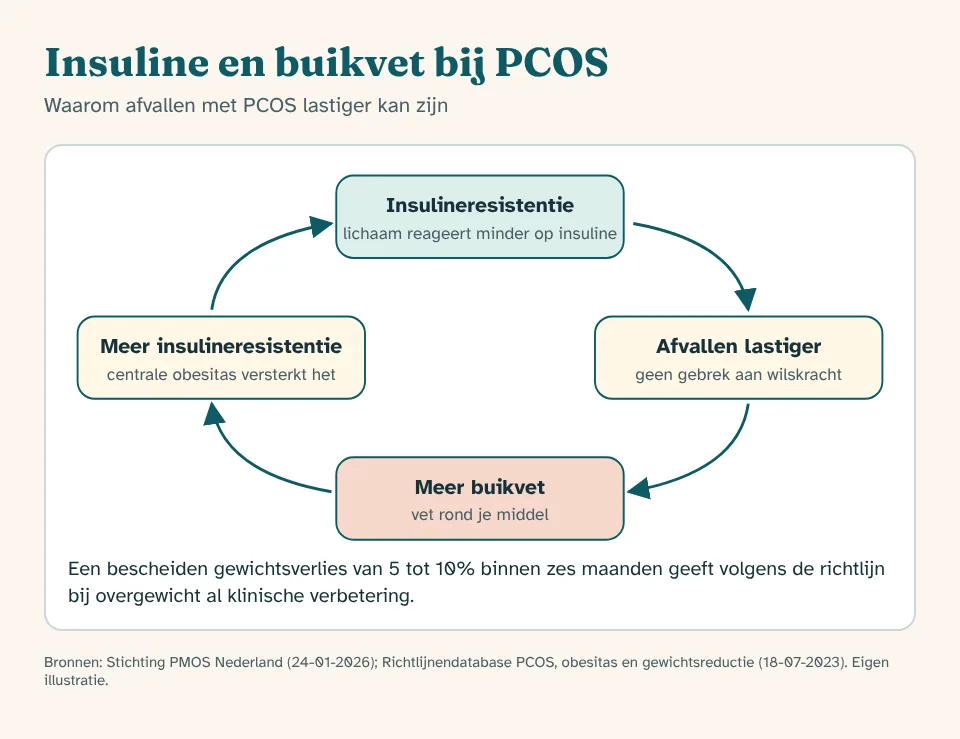
Maybe you already eat healthily and exercise more than your friends, and still the scales do not move. That is not your fault. Stichting PMOS Nederland writes that weight gain with PCOS is "not a lack of effort or willpower" (Stichting PMOS Nederland, updated 24-1-2026). Many women with PCOS have insulin resistance, which can make losing weight harder (same source).
Insulin resistance is common in PCOS, including in women of normal weight (Stepto et al., Human Reproduction, 2013). Your body then responds less well to insulin and produces more of it. In addition, women with PCOS gain more weight on average over ten years than women without PCOS. In the study the guideline cites, the difference was 2.6 kg on average (Richtlijn PCOS, module obesitas en gewichtsreductie, 18-07-2023).
The guideline is honest about this. Many women know they have overweight and want to lose weight, but find it a difficult task. Keeping it up also turns out to be hard. That is why, alongside weight loss, the guideline also asks for attention to preventing further weight gain (Richtlijn PCOS, 18-07-2023). For you, this means: not gaining weight is also a win. That counts, even if you lose nothing for a few weeks.
You can read in detail how PCOS and your weight are connected at the link between PCOS and overweight. This page is mainly about practice: what will you do differently tomorrow?
Realistic goals for weight loss with PCOS: 5 to 10 percent
Many women choose a target weight from a table or from years ago. That goal is often far away and feels unachievable after just a month. The guideline chooses a different starting point. For women with overweight, 5 to 10% weight reduction within six months is an achievable goal that gives significant clinical improvements (Richtlijn PCOS, module effectiviteit leefstijl, 18-07-2023).
Work it out for yourself. If you weigh 90 kilos, 5% equals 4.5 kilos and 10% equals 9 kilos. Those are goals you can keep in sight over half a year. According to the Maasstad Ziekenhuis, such a small weight loss of 5 to 10% can also increase the chance of ovulation and pregnancy (Maasstad Ziekenhuis, patient leaflet PMOS, 20-08-2026).
Do you want to have children? Then first discuss with your doctor how and when to lose weight. The guideline recommends weight loss for people with overweight, but also says that intensive weight loss just before a pregnancy is usually avoided (Richtlijn PCOS, module risicofactoren, 10-12-2021).
Want to know where you stand now? Start by calculating your BMI and also measure your waist circumference. The guideline advises SMART goals and self-monitoring (Richtlijn PCOS, 18-07-2023). That means: a concrete goal, a fixed moment to measure and writing down what you do. For example: "For the next four weeks I will walk for 30 minutes every working day and weigh myself every Monday morning."
Nutrition and calories for weight loss with PCOS
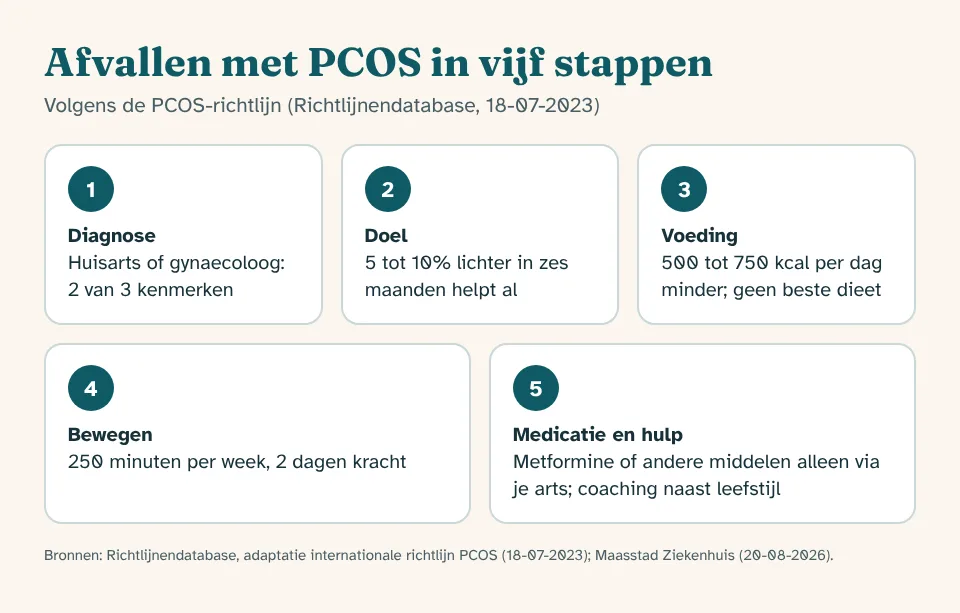
Online you will find countless PCOS diets, weekly menus and lists of forbidden foods. The guideline is down-to-earth about this. Weight loss is equivalent across different types of diet, and there is little or no evidence that a high-protein or low-carb diet achieves more in the long term (Richtlijn PCOS, module dieetinterventies, 18-07-2023). The international guideline puts it even more briefly: there is no evidence that one diet composition works better than another (Teede et al., international PCOS guideline, 01-09-2023).
So what does work? A calorie deficit. To lose weight, the guideline advises eating 500 to 750 kilocalories per day less than you burn, with a lower limit of 1200 to 1500 kcal per day, depending on your situation (Richtlijn PCOS, 18-07-2023). As a basis, the guideline names the Dutch dietary guidelines (Richtlijnen Goede Voeding) of the Health Council of the Netherlands (Gezondheidsraad), tailored to your preferences. Combine the diet with exercise advice or a combined lifestyle intervention (GLI), says the same module.
How to make it practical
- Choose your own eating style. Do you prefer three large meals or five small ones? Do you like breakfast or not? Because no diet is better, your preference can take the lead.
- Find your 500 kcal. Look at where the biggest items are: soft drinks, juice, alcohol, snacks, large portions or eating out.
- Don't go too low. You rarely keep up a very strict diet. The lower limit in the guideline is there for a reason.
- Pay attention to sleep. The Maasstad Ziekenhuis names enough sleep, alongside healthy eating and exercise, as part of lifestyle (Maasstad Ziekenhuis, 20-08-2026).
How much you burn exactly varies from person to person. A measurement of your resting metabolism gives you your own starting point, instead of an estimate from an app. If you notice that your thoughts revolve around food all day, also read about constant thoughts about food.
Exercise and strength training with PCOS
The guideline distinguishes between exercising to avoid gaining weight and exercising to lose weight. To prevent weight gain, the advice is at least 150 minutes per week of moderate-intensity or 75 minutes of vigorous-intensity exercise. If you want to lose weight and not regain it afterwards, the guideline advises at least 250 minutes per week of moderate-intensity or 150 minutes of vigorous-intensity exercise (Richtlijn PCOS, module beweeginterventies, 18-07-2023).
On top of that come muscle-strengthening exercises on 2 days a week. The guideline also advises limiting prolonged sitting, and 10,000 steps a day is preferred (same module).
250 minutes sounds like a lot. Spread over the week, it is just over half an hour a day. Cycle to work, walk after dinner, take the stairs. You can do two short strength sessions at home with your own body weight or at a gym. Start small if you move little, and build up. A step counter or phone helps you see how much you are already doing.
What helps with weight loss with PCOS according to the guideline
This table lists the lifestyle advice from the Dutch guideline. Use it as a checklist for your own plan or as a topic of conversation with your GP (huisarts) or dietitian.
| Component | What the guideline says | Source |
|---|---|---|
| Goal | 5 to 10% less weight within six months | Lifestyle module |
| Approach | Nutrition, exercise and behaviour together | Lifestyle module |
| Nutrition | No best diet; 500 to 750 kcal per day less | Diet module |
| Exercise | At least 250 minutes per week of moderate intensity | Exercise module |
| Strength | Muscle-strengthening exercises 2 days a week | Exercise module |
| Behaviour | SMART goals and self-monitoring | Lifestyle module |
What stands out: nowhere is there a miracle cure or special product. The core is a combined approach, preferably with nutrition, exercise and behaviour at the same time (Richtlijn PCOS, 18-07-2023). The guideline also asks healthcare providers to pay attention to anxiety, low mood, body image and eating problems, and to ask permission before weighing you (same guideline).
Belly fat with PCOS: your waist as a measuring point
"PCOS belly" is a commonly searched term. A medical definition of it does not appear in the sources we use. However, the guideline advises ideally also measuring the waist in addition to height and weight (Richtlijn PCOS, module hart- en vaatziekten, 18-07-2023). For women from Asian countries and other ethnic risk groups, waist circumference is especially important, according to the same module.
You cannot target belly fat with ab exercises. Belly fat decreases when you lose weight overall. That is why your waist circumference is a good measuring point alongside the scales: your weight may hardly change while your waist does shrink, for example because you build muscle through strength training. Always measure at the same place and at the same time of day.
If you want to see more precisely how your body is composed, an InBody measurement of your body fat percentage can help. Such a measurement is mainly useful for tracking your own progress, measured under the same conditions (Merrigan et al., 2022).
Medication for weight loss with PCOS
Medication does not replace healthy eating and exercise. In some situations it can be an addition. Your doctor always decides about medication. Below you can read what the sources say, so you go into the conversation well prepared.
Metformin
Alongside lifestyle advice, a doctor can consider metformin for adult women with PCOS and a BMI of 25 or higher. That is a weak recommendation with low certainty of evidence (Richtlijn PCOS, module metformine, 18-07-2023). In the pooled analysis there was no significant difference from placebo on weight; only in the group with a BMI above 25 did metformin do better. Its use is off-label and, for this reason, not routine in the Netherlands (same module). Side effects include diarrhoea, nausea, vomiting, abdominal pain and reduced appetite, usually mild and mainly at the start (same module; Apotheek.nl, 31-01-2024).
GLP-1 medication and other weight loss medicines
The Dutch PCOS module advises considering anti-obesity medication only after a combined lifestyle intervention (GLI) programme with insufficient results, with the same restrictions and reimbursement as for other people (Richtlijn PCOS, module anti-obesitasmedicatie, 18-07-2023). The international guideline names liraglutide, semaglutide and orlistat as medicines doctors can consider alongside an active lifestyle approach. If pregnancy is possible, reliable contraception is needed, because safety data for pregnancy are lacking. After stopping, weight gain is a risk (Teede et al., 01-09-2023). During fertility treatment you do not use anti-obesity medication (Richtlijn PCOS, 10-12-2021).
Be careful with semaglutide as a diabetes medicine (Ozempic, Rybelsus). These are registered in the Netherlands as medicines for diabetes, not as weight loss medicines (IGJ via NOS, 18-08-2026). You can only get GLP-1 medication through a doctor, after an assessment of your situation.
Insurance cover
Liraglutide (Saxenda) and naltrexone/bupropion (Mysimba) are reimbursed from the basic package (basispakket) under certain conditions, after at least 1 year of combined lifestyle intervention (GLI) (Zorginstituut Nederland, 03-02-2026). Semaglutide for obesity (Wegovy) and tirzepatide (Mounjaro) are not reimbursed for obesity. The Dutch Health Care Institute (Zorginstituut) discussed them on 5-10-2026; an advisory opinion is expected in early 2027 and nothing has been decided yet (Zorgkiezer, 20-10-2026). PCOS itself does not give a separate reimbursement route. Read more about medicines and conditions at the overview of weight loss medication. If you already use a medicine, lifestyle coaching alongside your GLP-1 medicine helps you manage eating, exercise and muscle preservation well.
Diagnosis: the three features of polycystic ovary syndrome
Weight loss with PCOS starts with knowing you have it. A doctor does not make the diagnosis with one test, but based on symptoms, physical examination, blood tests and sometimes an ultrasound (Maasstad Ziekenhuis, 20-08-2026). The guideline uses the Rotterdam criteria: you have at least 2 of these 3 features, and other causes have been ruled out (Richtlijn PCOS, startpagina, 18-07-2023):
- Irregular or absent ovulation. According to the guideline, a cycle is irregular if it is shorter than 21 or longer than 35 days, or if there are fewer than 8 cycles per year.
- Signs of too many male hormones, visible or in the blood.
- Polycystic ovaries on an ultrasound.
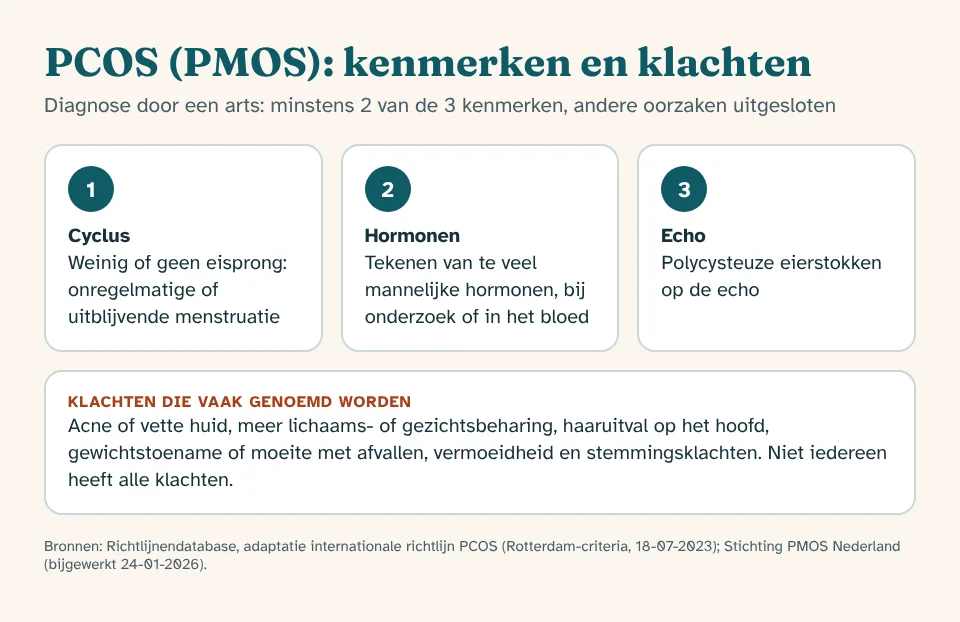
Symptoms named by Stichting PMOS Nederland include irregular or absent periods, acne or oily skin, more hair growth on the body or face, hair loss on the head, weight gain or difficulty losing weight, fatigue and mood problems (Stichting PMOS Nederland, 24-1-2026). According to the international guideline, PCOS affects 10 to 13% of women (Teede et al., 01-09-2023); the foundation mentions about 5 to 15%. If you recognise this, go to your GP (huisarts). An online questionnaire cannot make a diagnosis.
What is PMOS? PCOS is now called PMOS
Polycystic ovary syndrome is getting a new name. Since 3-6-2026, the Richtlijnendatabase (Dutch guidelines database) has stated that PCOS will now be called PMOS: polyendocrine metabolic ovarian syndrome. The modules of the guideline will adopt the new name as soon as they are revised (Richtlijnendatabase, notice 3-6-2026). The name change was announced in May 2026; it is being introduced worldwide over a transition period of three years (Medical News Today, 13-05-2026).
Why does that matter for weight loss? The new name emphasises that it is about more than the ovaries. The Maasstad Ziekenhuis names hormones, metabolism, skin, fertility and mental health (Maasstad Ziekenhuis, 20-08-2026). The word metabolic, meaning related to metabolism, is now literally in the name. If you look for information about PMOS and weight loss, it is about the same condition and the same advice applies. On this page we still mostly use PCOS, because most people still search for that.
Which hormone do you have too much of with PCOS?
PCOS involves too many male hormones (androgens). This is called hyperandrogenism and is one of the three features of the Rotterdam criteria: it can be clinically visible, for example through more hair growth or acne, or show up biochemically in blood tests (Richtlijnendatabase, PCOS start page). You do not need to have all three features; two is enough for the diagnosis, if other causes have been ruled out.
What causes PMOS?
The exact cause is unknown. PMOS probably develops from a combination of hereditary and environmental factors, and the chance is higher if your mother, sister or another close female relative has it (Maasstad Ziekenhuis, 20-08-2026). These sources do not give a percentage for heritability.
Which medicines are used in the treatment of PMOS?
The guideline has modules on metformin and anti-obesity medicines, among others (Richtlijnendatabase, PCOS start page). Which treatment suits you depends on your symptoms and whether you want to have children. Stichting PMOS Nederland names lifestyle support, hormonal treatment, treatment of insulin resistance and mental health support, always tailored to the individual. Prescribing is always done by your doctor; no medication is prescribed or sold through this site.
What is the relationship between PMOS and menopause?
According to the guideline, PMOS is associated with a later menopause: based on AMH, a difference of about two years is expected, so not an early menopause (Richtlijnendatabase, menopause module). After menopause, women with PMOS have higher androgen levels, but a separate post-menopausal picture cannot be described. Read more about weight and belly fat around menopause.
What happens if you have PCOS or PMOS?
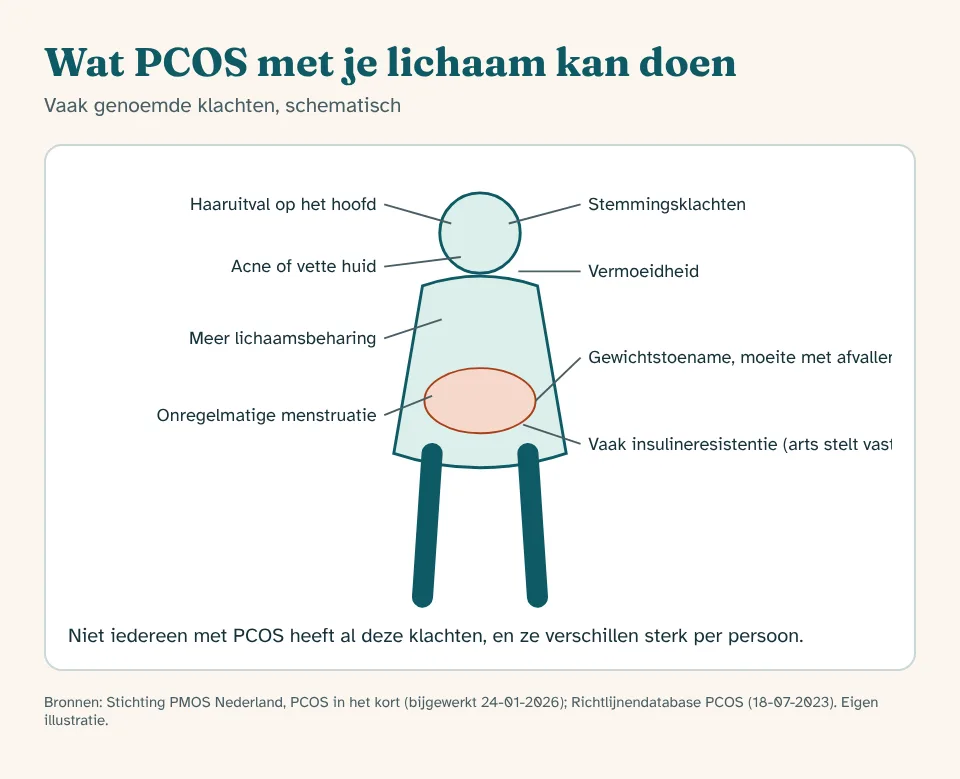
That varies greatly from person to person. Commonly mentioned symptoms are irregular or absent periods, acne or oily skin, more body or facial hair, hair loss on the head, weight gain or difficulty losing weight, fatigue and mood problems (Stichting PMOS Nederland, 24-01-2026). Not everyone has all the symptoms. In the long term, the risk of type 2 diabetes is higher, and women with PCOS more often have cardiovascular risk factors (Richtlijnendatabase). The guideline advises having your glucose checked at diagnosis and then every 1 to 3 years; discuss this with your GP (huisarts).
Weight loss with PCOS during menopause and later in life
According to the international guideline, PCOS is a lifelong diagnosis (Teede et al., 01-09-2023). It does not go away by itself, but symptoms are often very treatable (Maasstad Ziekenhuis, 20-08-2026). That is why it also plays a role as you get older.
A common concern is early menopause. The guideline says the opposite: PCOS is associated with a later age at menopause, based on AMH expected to be about two years later (Richtlijn PCOS, module menopauze, 18-07-2023). After menopause, women with PCOS have higher levels of male hormones, but a separate post-menopausal picture cannot be described (same module).
What does change: after menopause, energy expenditure at rest seems to decrease and fat is more often stored around the belly (Voedingscentrum, accessed 21-10-2026). In addition, the risk of type 2 diabetes is increased with PCOS, independently of weight, although obesity can make it worse; the guideline advises having your glucose checked at diagnosis and then every 1 to 3 years (Richtlijn PCOS, module diabetes, 18-07-2023). Read more about weight and weight loss during menopause.
Dietitian and GLI: reimbursed help with weight loss with PCOS
The guideline is co-authorised by the NHG and the Dutch Association of Dietitians (Nederlandse Vereniging van Diëtisten) (Richtlijnendatabase, start page, 18-07-2023). So your GP (huisarts) and dietitian work with the same advice.
Dietitian. The first three hours of treatment per calendar year are included in basic health insurance (basisverzekering) 2026, only for a medical purpose. Usually you do not need a referral, but your policy may require one. It counts towards the compulsory excess (eigen risico) of €385, except within chain care (ketenzorg) and under 18 (Zorgwijzer, 28-08-2026).
GLI. A combined lifestyle intervention (GLI) is a two-year programme covering nutrition, exercise and behaviour, fully reimbursed with no compulsory excess (eigen risico) (Overstappen.nl, 22-10-2026). How to get there and whether you are eligible can be read at the reimbursed combined lifestyle intervention and at the route via your GP. A GLI is also the step the guideline names before medication comes into play.
Support with weight loss with PCOS
Making a plan is one thing; keeping it up for months is something else. That is exactly where many women with PCOS get stuck, the guideline also says. Support helps you adjust your plan when things go less well, rather than starting all over again.
According to the provider, the team at Overgewicht Nederland B.V. is specially trained in PCOS and in support with GLP-1 medication. According to the provider, almost half of the coaching sessions are about hormones and the menopause in women. The standard programme lasts 12 months. According to the provider, in Amersfoort you can also go for measurements such as the REE measurement and InBody. How the sessions go is agreed in the introductory conversation (Overgewicht Nederland B.V., information provided 21-10-2026).
What you can ask in the introductory conversation
- How do you translate the guideline advice on calories and exercise into my week?
- How do you deal with a period in which my weight does not go down?
- Can I get support alongside metformin or another medicine from my doctor?
- How do we measure progress other than with the scales?
A diagnosis, medication or advice about your cycle and wish to have children belong with your GP (huisarts) or gynaecologist. Nobody can promise you a fixed number of kilos. If you want to know how the programme works in general, read about personal support for overweight, or see what Overgewicht Nederland does differently. If you are unsure which help suits you, first take the short weight loss test.
What does support for PCOS cost?
Works out at €3.55 per day (€108 per month or €1,295 per year). That is the price of the standard programme according to Overgewicht Nederland B.V. (information provided 21-10-2026). Monthly payment is by direct debit.
With doctor, coach and psychologist
Monthly
€3.55 per day
€108 per month
- 12 months of support
- Direct debit, no large lump sum
- Total €1,296 over 12 months
Yearly
€3.55 per day
€1,295 in one payment
- 12 months of support
- One payment in advance
- Equivalent to €107.92 per month
Research programme
€2.84 per day
€1,295 for 15 months
- 15 instead of 12 months of support
- Three extensive measurement sessions in Amersfoort
- Equivalent to €86.33 per month
Amounts according to Overgewicht Nederland B.V., reference date 21-10-2026. The price per day is a conversion (total divided by the number of days in the term); you pay per month or per year. Medication comes on top. You will receive the exact terms, such as the term and cancellation, in writing before you start.
Losing weight with PCOS near you
You can have measurements done in Amersfoort; how your sessions go is agreed in the introductory conversation. Just above the frequently asked questions is a list of towns, with a page for each town about losing weight with PCOS in your municipality.
Together, a plan that suits PCOS
Sign up for an introductory conversation. You discuss your goal, your eating pattern and what you have already tried.
Sign up Read about PCOS and weight
We value your privacy
Other forms of support
Weight loss during menopause
Your hormones change, and so does your body. Support that takes this into account.
PCOS and overweight
Insulin resistance and a cycle that does not cooperate: targeted support.
Support alongside weight loss injections
Semaglutide, tirzepatide or liraglutide: protein, muscles, side effects and stopping.
Support with GLP-1
Using semaglutide or tirzepatide? Coaching on nutrition, muscles and stopping.
Food noise and cravings
Always thinking about food? Psychological support alongside lifestyle.
Complex medical situation
Diabetes, heart problems, medicines or previous surgery: care that keeps an eye on things.
Extra personal support
More contact, a dedicated coach and quick availability. Let us know what you are looking for.
Take part in research
15 months of support with three extensive measurements in Amersfoort.
PCOS weight loss by town within 30 km of Amersfoort
For each town you will find the figures for your municipality, the distance to the measurement location in Amersfoort and the questions women with PCOS ask there.
- Losing weight with PCOS in Amersfoort
- Losing weight with PCOS in Hoogland
- Losing weight with PCOS in Hoevelaken
- Losing weight with PCOS in Leusden
- Losing weight with PCOS in Soest
- Losing weight with PCOS in Bunschoten
- Losing weight with PCOS in Nijkerk
- Losing weight with PCOS in Soesterberg
- Losing weight with PCOS in Baarn
- Losing weight with PCOS in Eemnes
- Losing weight with PCOS in Woudenberg
- Losing weight with PCOS in Scherpenzeel
- Losing weight with PCOS in Zeist
- Losing weight with PCOS in Bilthoven
- Losing weight with PCOS in Laren
- Losing weight with PCOS in Blaricum
- Losing weight with PCOS in De Bilt
- Losing weight with PCOS in Doorn
- Losing weight with PCOS in Driebergen-Rijsenburg
- Losing weight with PCOS in Renswoude
- Losing weight with PCOS in Utrechtse Heuvelrug
- Losing weight with PCOS in Hilversum
- Losing weight with PCOS in Putten
- Losing weight with PCOS in Voorthuizen
- Losing weight with PCOS in Huizen
- Losing weight with PCOS in Leersum
- Losing weight with PCOS in Barneveld
- Losing weight with PCOS in Lunteren
- Losing weight with PCOS in Bunnik
- Losing weight with PCOS in Bussum
- Losing weight with PCOS in Veenendaal
- Losing weight with PCOS in Zeewolde
- Losing weight with PCOS in Loosdrecht
- Losing weight with PCOS in Naarden
- Losing weight with PCOS in Wijdemeren
- Losing weight with PCOS in Wijk bij Duurstede
- Losing weight with PCOS in Gooise Meren
- Losing weight with PCOS in Almere
- Losing weight with PCOS in Ermelo
- Losing weight with PCOS in Houten
- Losing weight with PCOS in Maarssen
- Losing weight with PCOS in Utrecht
- Losing weight with PCOS in Nieuwegein
- Losing weight with PCOS in Rhenen
- Losing weight with PCOS in Stichtse Vecht
- Losing weight with PCOS in Breukelen
- Losing weight with PCOS in Buren
- Losing weight with PCOS in Ede
- Losing weight with PCOS in Harderwijk
- Losing weight with PCOS in Bennekom
- Losing weight with PCOS in De Meern
- Losing weight with PCOS in Vleuten
- Losing weight with PCOS in Culemborg
- Losing weight with PCOS in IJsselstein
- Losing weight with PCOS in Wageningen
PMOS weight loss in and around Amersfoort (up to 25 km)
Since 2026, PCOS has officially been called PMOS. For every town up to about 25 km from the measurement location in Amersfoort there is a separate page about losing weight with PMOS, with the figures for your municipality.
- PMOS weight loss in Amersfoort
- PMOS weight loss in Hoogland
- PMOS weight loss in Hoevelaken
- PMOS weight loss in Leusden
- PMOS weight loss in Soest
- PMOS weight loss in Bunschoten
- PMOS weight loss in Nijkerk
- PMOS weight loss in Soesterberg
- PMOS weight loss in Baarn
- PMOS weight loss in Eemnes
- PMOS weight loss in Woudenberg
- PMOS weight loss in Scherpenzeel
- PMOS weight loss in Zeist
- PMOS weight loss in Bilthoven
- PMOS weight loss in Laren
- PMOS weight loss in Blaricum
- PMOS weight loss in De Bilt
- PMOS weight loss in Doorn
- PMOS weight loss in Driebergen-Rijsenburg
- PMOS weight loss in Renswoude
- PMOS weight loss in Utrechtse Heuvelrug
- PMOS weight loss in Hilversum
- PMOS weight loss in Putten
- PMOS weight loss in Voorthuizen
- PMOS weight loss in Huizen
- PMOS weight loss in Leersum
- PMOS weight loss in Barneveld
- PMOS weight loss in Lunteren
- PMOS weight loss in Bunnik
- PMOS weight loss in Bussum
- PMOS weight loss in Veenendaal
- PMOS weight loss in Zeewolde
- PMOS weight loss in Loosdrecht
- PMOS weight loss in Naarden
- PMOS weight loss in Wijdemeren
- PMOS weight loss in Wijk bij Duurstede
- PMOS weight loss in Gooise Meren
- PMOS weight loss in Almere
- PMOS weight loss in Ermelo
- PMOS weight loss in Houten
- PMOS weight loss in Maarssen
- PMOS weight loss in Utrecht
- PMOS weight loss in Nieuwegein
- PMOS weight loss in Rhenen
- PMOS weight loss in Stichtse Vecht
What is included where? Four providers compared
| What do you get? | Overgewicht Nederland | Goodweigh | Wellis | Yazen |
|---|---|---|---|---|
| Consultation with a doctor by phone or video | Yes: | No: | Partly: | Not mentioned: |
| Psychologist in the team | Yes: | Not mentioned: | Not mentioned: | Yes: |
| Price of the coaching on the site | Yes: | Yes: | Not mentioned: | Yes: |
| Everything via chat, without phone calls | No: | Yes: | Yes: | Partly: |
yes no (according to the provider itself) partly not mentioned. Reference date 22-10-2026. Full comparison with sources
Frequently asked questions about losing weight with PCOS
What is the best diet for weight loss with PCOS?
There is no diet that works better than others for PCOS. According to the Dutch guideline, weight loss is equivalent across different types of diet, and there is little evidence that high-protein or low-carb diets achieve more in the long term. What counts is a calorie deficit you can sustain. The guideline names the Dutch dietary guidelines (Richtlijnen Goede Voeding) as the basis, tailored to what you enjoy. So choose an eating pattern that fits your day.
Does metformin help with weight loss with PCOS?
Metformin helps with weight loss to a limited extent at most, and only alongside a healthy lifestyle. The PCOS guideline gives a weak recommendation with low certainty of evidence. In the pooled studies there was no significant difference from placebo; only with a BMI above 25 did the medicine do better. Its use is off-label and not routine in the Netherlands. Side effects include nausea and diarrhoea. Your doctor decides whether it suits you.
Which medication can help with weight loss with PCOS?
Which medication suits you is decided by your doctor, and always as an addition to lifestyle. The international guideline mentions liraglutide, semaglutide and orlistat as medicines doctors can consider alongside an active lifestyle approach. The Dutch module only advises this after a combined lifestyle intervention (GLI) with insufficient results. Metformin is another option with a weak recommendation. Read more under weight loss medication and the conditions.
Is semaglutide reimbursed for PCOS?
No, semaglutide is not reimbursed for weight loss, not even with PCOS. Semaglutide as a diabetes medicine (Ozempic) is registered in the Netherlands for diabetes, not as a weight loss medicine. Semaglutide for obesity (Wegovy) is not reimbursed for obesity from basic health insurance (basisverzekering). The Dutch Health Care Institute (Zorginstituut) discussed this on 5-10-2026; an advisory opinion is expected in early 2027. Liraglutide (Saxenda) is reimbursed under certain conditions, after at least 1 year of combined lifestyle intervention (GLI).
What percentage of weight do you need to lose to reduce PCOS symptoms?
According to the guideline, 5 to 10% weight loss within six months already gives a significant clinical improvement in women with overweight. At 80 kilos, that is 4 to 8 kilos. The Maasstad Ziekenhuis writes that such a small loss can increase the chance of ovulation and pregnancy. So you do not need a target weight from a table to notice results. If you want to have children, first discuss with your doctor how you lose weight.
How many fewer calories should you eat to lose weight with PCOS?
The guideline advises 500 to 750 kilocalories per day less than you use. Do not go below 1200 to 1500 kcal per day, depending on your situation. How much you use differs from person to person. A REE measurement at rest gives a personal starting point instead of an estimate. A dietitian can help you turn that deficit into meals you enjoy.
How much exercise do you need to lose weight with PCOS?
To lose weight, the guideline advises at least 250 minutes per week of moderate-intensity exercise, or 150 minutes of vigorous-intensity exercise. On top of that come muscle-strengthening exercises on 2 days a week. Also limit prolonged sitting; according to the guideline, 10,000 steps a day is preferred. If you currently move little, build up gradually. Walking and cycling count too.
How do you lose belly fat with PCOS?
You lose belly fat by losing weight overall, not just by doing ab exercises. A calorie deficit, enough exercise and strength training in line with the guideline form the basis. Measure your waist circumference as well as your weight, because the guideline advises ideally also measuring the waist. That way you see progress the scales sometimes miss. An InBody measurement shows your progress in body fat percentage.
Can PCOS go away if you lose weight?
No, PCOS does not go away by losing weight, but symptoms can decrease. The international guideline sees PCOS as a lifelong diagnosis, and according to the Maasstad Ziekenhuis it does not go away by itself. Symptoms are often very treatable. According to the guideline, losing 5 to 10% gives clinical improvement in people with overweight. So even after losing weight, keep paying attention to eating, exercise and check-ups with your doctor.
What is the new name for polycystic ovary syndrome?
The new name is PMOS: polyendocrine metabolic ovarian syndrome. This has been on the Richtlijnendatabase (Dutch guidelines database) since 3-6-2026. The name emphasises that it is about hormones and metabolism, not just the ovaries. Worldwide introduction takes about three years, so you will see the old name PCOS for a long time yet. For weight loss nothing changes: the advice from the guideline still applies.
How do you know if you have PCOS?
Only a doctor can determine whether you have PCOS. The GP (huisarts) or gynaecologist looks at your symptoms, does a physical examination and blood tests, and sometimes an ultrasound. According to the Rotterdam criteria, at least 2 of 3 features must be present: irregular ovulation, signs of too many male hormones and polycystic ovaries, and other causes must have been ruled out. If you recognise the symptoms, make an appointment with your GP.
Can you test for PCOS online?
No, an online test cannot diagnose PCOS. According to the Maasstad Ziekenhuis, a doctor does not make the diagnosis with a single test, but on the basis of symptoms, examination, blood tests and sometimes an ultrasound. An online questionnaire can at most help you list your symptoms for your GP (huisarts). If you want to know which weight loss help suits you, our free weight loss test gives initial advice.
Does PCOS cause early menopause?
No, according to the guideline PCOS is actually associated with a later menopause. Based on the hormone AMH, a difference of about two years is expected. After menopause, women with PCOS do have higher levels of male hormones. Some women gain weight during menopause and find losing weight harder (Voedingscentrum). Discuss menopause symptoms with your GP (huisarts) and adjust your eating and exercise accordingly.
Is a dietitian covered by insurance for PCOS?
Yes, the first three hours of dietetic treatment per calendar year are included in basic health insurance (basisverzekering) 2026, for a medical purpose. Usually you do not need a referral, but check your policy. It counts towards the compulsory excess (eigen risico) of €385, except within chain care (ketenzorg) or under 18. The PCOS guideline is co-authorised by the Dutch Association of Dietitians (Nederlandse Vereniging van Diëtisten), so a dietitian works with the same advice.
Is PCOS hereditary?
PCOS probably develops from a combination of hereditary and environmental factors. According to the Maasstad Ziekenhuis, the exact cause is unknown. The chance is higher if your mother, sister or another close female relative has PCOS. We did not find a percentage for heritability in reliable sources. If you have symptoms and PCOS runs in your family, tell your GP (huisarts).
Sources
- Richtlijnendatabase: Richtlijn PCOS, startpagina en melding nieuwe naam PMOS (18-07-2023, notice 3-6-2026)
- Richtlijnendatabase: Richtlijn PCOS, Obesitas en gewichtsreductie (18-07-2023)
- Richtlijnendatabase: Richtlijn PCOS, Effectiviteit van leefstijlinterventies (18-07-2023)
- Richtlijnendatabase: Richtlijn PCOS, Dieetinterventies (18-07-2023)
- Richtlijnendatabase: Richtlijn PCOS, Beweeginterventies (18-07-2023)
- Richtlijnendatabase: Richtlijn PCOS, Hart- en vaatziekten (18-07-2023)
- Richtlijnendatabase: Richtlijn PCOS, Onregelmatige cycli en ovulatoire dysfunctie (18-07-2023)
- Richtlijnendatabase: Richtlijn PCOS, Menopauze (18-07-2023)
- Richtlijnendatabase: Richtlijn PCOS, Zwangerschapsdiabetes, gestoorde glucosetolerantie en diabetes type 2 (18-07-2023)
- Richtlijnendatabase: Richtlijn PCOS, Metformine (18-07-2023)
- Richtlijnendatabase: Richtlijn PCOS, Anti-obesitas medicijnen (18-07-2023)
- Richtlijnendatabase: Richtlijn PCOS, Risicofactoren en PCOS bij kinderwens (10-12-2021)
- Richtlijnendatabase: Richtlijn PCOS, Anti-obesitas medicatie bij fertiliteitsbehandeling (10-12-2021)
- Teede et al.: Recommendations from the 2023 International Evidence-based Guideline for PCOS, Human Reproduction (01-09-2023)
- Stichting PMOS Nederland: PCOS in het kort (7-2-2024, updated 24-1-2026)
- Maasstad Ziekenhuis: patiëntenfolder PMOS (20-08-2026)
- Stepto et al.: insulin resistance in PCOS, Human Reproduction (2013)
- Medical News Today: PCOS to PMOS, name change (13-05-2026)
- Apotheek.nl: Metformine (31-01-2024)
- NOS: IGJ over Ozempic en Rybelsus als diabetesmiddel (18-08-2026)
- Zorginstituut Nederland: kostenstijging medicijnen en leefstijlprogramma voor obesitas (03-02-2026)
- Zorgkiezer: vergoeding Mounjaro en Wegovy besproken (updated 20-10-2026)
- Voedingscentrum: Moet ik anders gaan eten tijdens de overgang? (accessed 21-10-2026)
- Zorgwijzer: vergoeding dieetadvies (updated 28-08-2026)
- Overstappen.nl: vergoeding afvallen en GLI (updated 22-10-2026)
- Merrigan et al.: InBody vergeleken met DXA, Journal of Exercise and Nutrition (2022)
- Overgewicht Nederland B.V.: programme and price statement (21-10-2026)
Read more: weight loss
- Take the weight loss testPersonal advice in 5 minutes
- Why Overgewicht NederlandDoctor, coach and measurements, honestly compared
- Support with overweight€3.55 per day (€108 per month)
- Gastric balloonSwallowed, 16 weeks, not reimbursed
- Medical weight lossInjection, pill, GLI or surgery
- Weight loss with injectionsSupport alongside weight loss injections
- Weight loss with pillsPrescription weight loss pills
- Support with weight loss injectionsProtein, muscles and stopping
- Food noiseConstantly thinking about food
- Complex obesity careCare that looks along with you
- Personal supportMore personal contact
- Weight loss research programme€2.84 per day, 15 months
- Sign up for supportWe will call you within one working day