GLI: the combined lifestyle intervention for overweight
The GLI (gecombineerde leefstijlinterventie, combined lifestyle intervention) is a recognised 24-month lifestyle programme in which a lifestyle coach helps you with eating, exercise, sleep and behaviour. You are eligible with a BMI of 25 to 35 with a large waist circumference or a weight-related condition, or with a BMI of 35 or higher. You pay nothing for it, and you start with a referral (verwijzing) from your GP (huisarts) or practice nurse (POH).
In brief
- The GLI is covered by basic health insurance (basisverzekering), does not count towards your compulsory excess (eigen risico) and has no personal contribution (Zorginstituut Nederland, 29-05-2026).
- The programme lasts 24 months: a maximum of 4 quarters of treatment phase and a maximum of 4 quarters of maintenance phase (NZa-regeling GLI, in force from 1-1-2026).
- There are nine recognised programmes for adults (RIVM Loket Gezond Leven, accessed 25-09-2026).
- Of those who started, 60% completed the programme; 41% stopped early (RIVM, 2025).
What a GLI is, and what it is not
"Combined" means that the programme does not tackle one thing, but several at once: what you eat, how much you move and the habits around that. Think of sleep, stress, grocery shopping and dealing with a bad week. You work with a lifestyle coach, sometimes together with a dietitian or physiotherapist. According to Thuisarts, you get about 12 group sessions plus individual consultations over two years (Thuisarts, 13-10-2025).
So a GLI is not a crash diet, nor a free gym. The aim is for you to find changes you can keep up for years. The NHG-Standaard of October 2025 still calls lifestyle the cornerstone of treatment, even if medication or surgery is added later (Obesitas Platform, 13-10-2025). For exercise, the advice is 150 to 200 minutes of moderate-intensity activity per week, plus strength training twice (NTvL, October 2025).
Obesity is a chronic disease with many causes. A programme does not remove those causes, but it does give you tools. How the GLI fits into the whole picture is shown in the stepped model for obesity treatments.
Who can take part?
The Dutch Health Care Institute (Zorginstituut Nederland) sets out when basic health insurance (basisverzekering) pays for a GLI. Your GP (huisarts) assesses whether you meet the criteria and then refers you.
| Your BMI | Additional condition | Risk according to the guideline |
|---|---|---|
| 25 to 35 | Waist circumference 88 cm or more (women) or 102 cm or more (men) | Moderately to greatly increased |
| 25 to 35 | One or more weight-related conditions, such as type 2 diabetes, high blood pressure or sleep apnoea | Moderately to greatly increased |
| 35 or higher | None | Greatly to extremely increased |
According to the Partnerschap Overgewicht Nederland, the programme is for adults, and for young people aged 16 and over if it suits them. There is no upper age limit (PON, factsheet January 2023). You can quickly calculate your BMI with the BMI calculator in your own browser.
Worked example
Say you are a woman of 1.65 metres and weigh 85 kilos. Your BMI is 85 divided by 2.72 (1.65 × 1.65) = 31.2. Your waist circumference is 95 centimetres, so more than 88. Then you are eligible. If you achieve 5% weight loss during the programme, that is 4.25 kilos: you then weigh 80.75 kilos and your BMI is 29.7. That may sound modest, but according to the NHG, 5 to 10% less weight already brings considerable health benefits (NHG-Standaard Obesitas, 2010).
Whether you can take part depends on your BMI and your waist circumference. Check it below: also enter your waist, because with a BMI from 25 and an enlarged waist you may already qualify. Your data stays on your own device.
Ondergewicht
Your BMI is low (underweight). Concerned about your health? Discuss it with your GP (huisarts).
Gezond gewicht
Your BMI is in the healthy range.
Overweight
You are overweight. Do you also have a large waist circumference, high blood pressure or diabetes? Then a combined lifestyle intervention (GLI) can help. Read about the GLI.
Obesity
You have obesity. Your GP (huisarts) can help you with a lifestyle programme. Do you have type 2 diabetes that is poorly controlled? Then surgery may also be an option. View the criteria.
Obesity
You have obesity. With conditions such as diabetes, high blood pressure or sleep apnoea, you may be eligible for medication or weight loss surgery (bariatric surgery). View the criteria.
Ernstige obesitas
You have severe obesity. You may be eligible for weight loss surgery (bariatric surgery). View the criteria.
You see the thresholds for an Asian, Hindustani, Middle Eastern, African or African-Caribbean background (NHG-Standaard Obesitas, 2025). The BMI thresholds for weight loss surgery (30 with poorly controlled type 2 diabetes, 35 and 40) apply to everyone.
Download the conversation card for your GP
BMI does not tell the whole story. Muscle strength, age and background play a part. Your GP looks at the whole picture.
24 months in two phases
The Dutch Healthcare Authority (NZa) regulation that has applied since 1 January 2026 describes the combined lifestyle intervention (GLI) as a programme of 24 consecutive months (NZa, Staatscourant 2025, 20724). It starts with an intake and then consists of two blocks.
- Intake. You get to know your lifestyle coach. Together you look at where you are and what you want to achieve.
- Treatment phase (year 1). A maximum of four quarters with more frequent contact. You learn new habits and try them out in your own life. The first year is the most intensive (PON, 2023).
- Maintenance phase (year 2). A maximum of four quarters with fewer appointments. You practise keeping it up, even when things go against you, such as a busy period or illness.
- Afterwards. The guideline then recommends an annual check-up with your GP (huisarts) (Richtlijn Overgewicht en obesitas, 2023).
Throughout the programme, the lifestyle coach stays in contact with your GP (huisarts).
The nine recognised programmes
Only a recognised programme is covered by insurance. RIVM Loket Gezond Leven lists nine for adults (accessed 25-09-2026):
- Samen Sportief in Beweging
- de BeweegKuur
- SLIMMER
- SLIMMER Powered by Ancora
- CooL (Coaching op Leefstijl)
- CooL-MiGuide
- X-Fittt GLI
- Keer Diabetes2 Om
- Keer Diabetes2 Om-GLI-Online
The programmes differ in their mix of group sessions and one-to-one conversations, in how much emphasis they place on exercise or nutrition, and in how much takes place online. Your GP (huisarts) or practice nurse (POH) knows which providers work in your area. This site does not recommend any programme or provider.
Results and drop-out
The RIVM has been monitoring the GLI since it started in 2019. Between January 2019 and July 2024, 137,000 people had an intake and around 125,000 started (RIVM, 2025). The number of participants grew quickly: from about 37,000 in 2022 to about 106,000 in 2024 (Zorginstituut Nederland, 03-02-2026).
| Outcome | Figure | Source |
|---|---|---|
| Average weight loss after about 9 months | 3,5% (n=923) | RIVM, 05-06-2023 |
| At least 5% lost after completing the whole programme | 47% of those who completed it | RIVM, June 2024 |
| Quality of life | On average 13 points higher (scale 0–100) | RIVM, annual report 2024 |
| Did not start after intake | 9% | RIVM, 2025 |
| Drop-out in year 1 / year 2 | 27% / 20% | RIVM, 2025 |
| Total drop-out / completed | 41% / 60% | RIVM, 2025 |
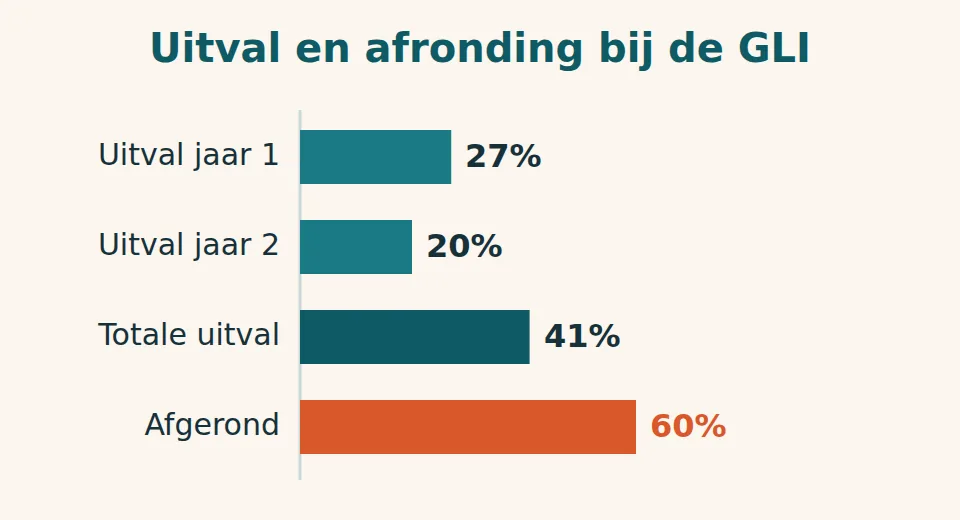
Drop-out did fall, though: from 50% among those who started in 2019 to 38% among those who started in 2022 (RIVM, 2025). The most frequently mentioned reasons for stopping or not starting are no longer having the motivation or desire (38%), no time (17%) and health or an injury (13%). Does that sound familiar? Discuss it with your coach before you stop. Sometimes a different time, an online version or a break helps.
It is also honest to say: with severe obesity, a GLI is often not enough to lose a lot of weight. That is not failure. Your body defends its weight, and a completed programme is actually a condition for a next step. After at least a year of GLI with less than 10% weight loss, the GP (huisarts) may consider weight loss medication alongside the GLI, with a BMI of 35 plus a condition or a BMI of 40 (NHG-Standaard Obesitas, October 2025).
What you pay for the GLI
In short: nothing. The GLI is included in basic health insurance (basisverzekering), does not come out of your compulsory excess (eigen risico) and has no personal contribution (eigen bijdrage) (Zorginstituut Nederland, 29-05-2026). So even if you have not yet used up your compulsory excess of €385 in 2026, you do not pay towards it.
Two things to watch out for:
- Choose a provider with a contract. Without a contract, your insurer may pay less. With DSW, that is 75% of the maximum rate (DSW, 2026). Check with your insurer before you start.
- A dietitian outside the GLI does count towards your compulsory excess (eigen risico). Basic health insurance (basisverzekering) pays for a maximum of 3 hours of dietary advice per year for a medical purpose, but those hours come out of your compulsory excess. Extra hours are only possible through supplementary insurance (aanvullende verzekering) (Menzis, 2026).
What the insurer pays is public. The NZa maximum rates for 2025 were €91.26 for the intake, €204.22 per quarter in the treatment phase and €106.41 per quarter in the maintenance phase (NZa, 02-01-2025). A gym membership is not covered. For the costs of an operation, see insurance cover for weight loss surgery from basic health insurance.
The specialised GLI
For some people, a regular GLI is not the best place to start. The guideline recommends referral to a specialised GLI or other help in cases including a BMI of 35 or higher, low literacy, a low income, a migration background, a psychiatric history or a suspected eating disorder (Richtlijn Overgewicht en obesitas, 2023). In the table of health risks, a specialised GLI belongs with an extremely increased risk, so with a BMI of 40 or higher, or of 35 to 40 with a large waist circumference or a condition.
What "specialised" means exactly differs by region. It often involves more contact moments, a team that includes, for example, a psychologist, or an approach that takes language and culture into account. If your BMI is 40 or higher, also ask whether you are eligible for weight loss surgery. That question does not rule out a GLI: a completed programme actually counts as previous treatment.
How to sign up
The GP (huisarts) and practice nurse (POH) are the standard referrers to the GLI (PON, 2023). Signing up with a coach yourself without a referral (verwijzing) does not get you any insurance cover.
- Know where you stand. Calculate your BMI and measure your waist circumference. Write down which symptoms or conditions you have.
- Make an appointment. Tell the assistant that you want to talk about your weight and a lifestyle programme. You can often see the practice nurse (POH). Tips for that conversation can be found at discussing your weight with your GP or practice nurse.
- Get a referral. If the GLI suits you, the practice refers you to a coach, often via ZorgDomein.
- Start with the intake. Your coach will contact you. Feel free to ask how often you will have appointments and whether there is a group or online version.
Still in doubt, or would you first like to hear how others experience it? Read the experiences of people with obesity or come to an information evening. And discuss it with your GP (huisarts).
Prepare for your GP visit Calculate your BMI
Is the GLI not an option, or would you like more support? Then you can also look at a paid twelve-month coaching programme or at all the routes to medical weight loss.
Frequently asked questions about the GLI
What does GLI stand for?
GLI stands for gecombineerde leefstijlinterventie, the combined lifestyle intervention. It is a recognised 24-month programme in which you work with a lifestyle coach on eating, exercise and behaviour at the same time. The word "combined" refers to that mix. The GLI is one of the first steps in the stepped treatment approach for overweight and obesity.
Can I follow a GLI online?
Yes, there are recognised programmes with an online version, such as Keer Diabetes2 Om-GLI-Online and CooL-MiGuide. You then work partly via an app or video calls with your coach. That often fits better with irregular working hours. Ask your GP (huisarts) which formats are available to you, and read beforehand how to approach the conversation with your GP.
Which GLI programme is the best?
There is no programme that is best for everyone. The nine recognised programmes differ mainly in group sessions or individual consultations, online or in person, and an emphasis on exercise or nutrition. Choose what suits your working hours, your health and how you like to learn. Your GP (huisarts) knows which providers are in your area.
How often do I have appointments during a GLI?
How often you have appointments depends on the programme. In the first year, contact is most intensive; in the second year, less so. Thuisarts mentions about 12 group sessions plus individual consultations over two years. Ask for a schedule at the intake, so you can plan it around your work or caring responsibilities.
Does a GLI count towards my compulsory excess?
No, a GLI does not come out of your compulsory excess (eigen risico) and you do not pay a personal contribution either. That is decided by the Zorginstituut. Do make sure your provider has a contract with your insurer. A separate dietitian does count towards the compulsory excess. How this works for an operation can be found at insurance cover for weight loss surgery.
Can I do a GLI a second time?
That is not a given. The scheme describes one programme of 24 consecutive months, and whether a new programme is reimbursed varies by situation and insurer. Check with your GP (huisarts) and your health insurer. If your risk has increased since last time, also ask about a specialised GLI.
What if I become ill or get injured during the GLI?
Tell your lifestyle coach, and together you will look for an adjustment. Health or an injury is the reason for stopping for 13% of those who stop, according to RIVM research. Often the programme can temporarily be made lighter or use different exercise. Do not quietly stop: you would lose support you may need later.
Can I combine a GLI with medication?
Yes, that is possible. According to the NHG-Standaard, the GLI simply continues if your GP (huisarts) prescribes weight loss medication. The RIVM monitor showed that about 12% of participants use medicines that lower weight, mostly for diabetes. More explanation can be found at the conditions for weight loss medication.
Is a GLI worthwhile if I have already tried many diets?
Yes, especially then. A GLI is not a diet, but a supported programme in which you work on habits, exercise, sleep and dealing with setbacks. The fact that you could not keep up diets before says nothing about willpower: your body defends its weight. Read why at obesity as a chronic disease.
Is a GLI also suitable with a BMI above 40?
Yes, with a BMI of 40 or higher the guideline recommends a specialised GLI. There is no upper BMI limit. A programme on its own usually does not give enough weight loss with severe obesity, but the habits are indispensable later on. Also read about the types of weight loss surgery and what they require.
Can my partner take part in the GLI?
Your partner cannot take part on your referral, but can often be involved. Cooking together, walking together or coming along to an appointment once makes it easier. If your partner meets the criteria themselves, they can also ask for their own referral (verwijzing). Tips for family and friends can be found at supporting someone with obesity.
Do I have to go to the gym during a GLI?
No, a gym is not compulsory and is not covered by the reimbursement either. The exercise advice is 150 to 200 minutes of moderate-intensity activity per week, plus strength training twice. That can also be done by walking, cycling or exercises at home. Your coach helps you choose a form you enjoy and can keep up.
How many people take part in the GLI?
In 2024 around 106,000 people took part, compared with around 37,000 in 2022, reports the Zorginstituut. Between 2019 and July 2024, 137,000 people had an intake. So you are certainly not the only one. GPs are also paying more attention: you can see this in the figures on overweight and obesity.
What do I take to the intake with the lifestyle coach?
Bring your referral, a list of your medicines and symptoms, and your questions. Also think about what you want to achieve, such as less pain, more energy or better blood sugar. A goal that suits you is easier to keep up. If you want to know where you stand beforehand, do the BMI calculation.
What happens after the 24 months?
After 24 months, the reimbursed support stops. The guideline then recommends an annual check-up with your GP (huisarts). Together you look at whether you are keeping up your new habits and whether a next step is needed, such as medication or a referral to a bariatric centre. Prepare for that appointment with your results and your questions.
Sources
- Zorginstituut Nederland – Gecombineerde leefstijlinterventie (GLI) (Zvw) (29-05-2026)
- NZa – Regeling gecombineerde leefstijlinterventie volwassenen, Staatscourant 2025, 20724 (19-06-2025)
- NZa – Welke tarieven gelden voor de GLI? (02-01-2025)
- RIVM Loket Gezond Leven – Gecombineerde leefstijlinterventie (accessed 25-09-2026)
- RIVM – Deelname en uitval bij de GLI. Wie en waarom? Rapport 2025-0085 (2025)
- RIVM – Jaarrapportage monitor GLI 2024 (11-12-2024)
- RIVM – Bijna de helft van de deelnemers verloor na afronden GLI minimaal 5% van het gewicht (June 2024)
- RIVM – Aantal deelnemers GLI verder gegroeid naar ruim 73.000 (05-06-2023)
- Zorginstituut Nederland – Forse kostenstijging leefstijlprogramma en medicijnen voor obesitas (03-02-2026)
- Thuisarts – Ik wil misschien meedoen aan het leefstijlprogramma GLI (13-10-2025)
- Partnerschap Overgewicht Nederland – Factsheet GLI voor huisartsen (January 2023)
- Richtlijnendatabase – Gecombineerde leefstijlinterventie (10-07-2023)
- Nederlands Tijdschrift voor Leefstijlgeneeskunde – Huisarts wordt spelverdeler bij aangescherpte NHG-richtlijn (October 2025)
- Obesitas Platform – NHG-Standaard Obesitas 2025 gepubliceerd (13-10-2025)
- VoedingOnline – NHG-Standaard Obesitas 2025 (13-10-2025)
- DSW – Gecombineerde leefstijlinterventie (2026)
- Menzis – Vergoeding dieetadvisering (2026)
- Huisarts en Wetenschap – NHG-Standaard Obesitas, eerste versie (November 2010)
Further reading: treatments
- Obesity treatmentsLifestyle, medication or surgery
- Weight loss medicationWhen it is an option
- Weight loss surgerySleeve, bypass and the process
- Am I eligible?The criteria in three questions
- Weight loss surgery waiting timesPer centre, updated monthly
- Insurance cover for weight loss surgeryBasic health insurance and compulsory excess