The best way to discuss your weight with your GP (huisarts) is in a double appointment, with a completed conversation card and three questions written down. That way you have enough time, you do not forget anything and together you choose which help suits you: a lifestyle programme, medication or a referral (verwijzing) to a bariatric centre.
In brief
A regular appointment with the GP (huisarts) lasts 10 minutes (Huisarts en Wetenschap, 2020). So ask for a double appointment.
A visit to the GP (huisarts) does not count towards your compulsory excess (eigen risico) (Rijksoverheid, 28-07-2026).
In 2025, 39% more people with overweight or obesity came into view at the GP than in 2024 (Nivel, 2026). So you are definitely not the only one.
You get the combined lifestyle intervention (GLI) through a referral (verwijzing) from your GP (huisarts) or practice nurse (POH), and it costs you nothing: no compulsory excess (eigen risico), no personal contribution (eigen bijdrage) (Zorginstituut Nederland, 2026).
Is your GP not open to your questions? You can ask for another GP in the practice or ask for a second opinion (Rijksoverheid, 25-05-2026).
Why you start with the GP
Many people find it difficult to bring up their weight. That is understandable. Still, your GP (huisarts) is the right place. All help paid for by basic health insurance (basisverzekering) starts with a referral (verwijzing): the combined lifestyle intervention (GLI) with a coach and dietitian, medication and surgery. The GP knows your medical history and your medication. That is important, because some medicines make you heavier.
Since the revised NHG Standard on Obesity (NHG-Standaard Obesitas) of October 2025, the agreement for GPs is clear. Obesity is a chronic disease with many causes. The GP looks not only at your BMI, but also at your waist circumference and your complaints. And the GP thinks along with you about the next step. However, the GP does not actively seek out adults (Ned Tijdschr Diabetol, 2025). That means you usually have to raise the subject yourself. This page helps you do that.
Before the appointment
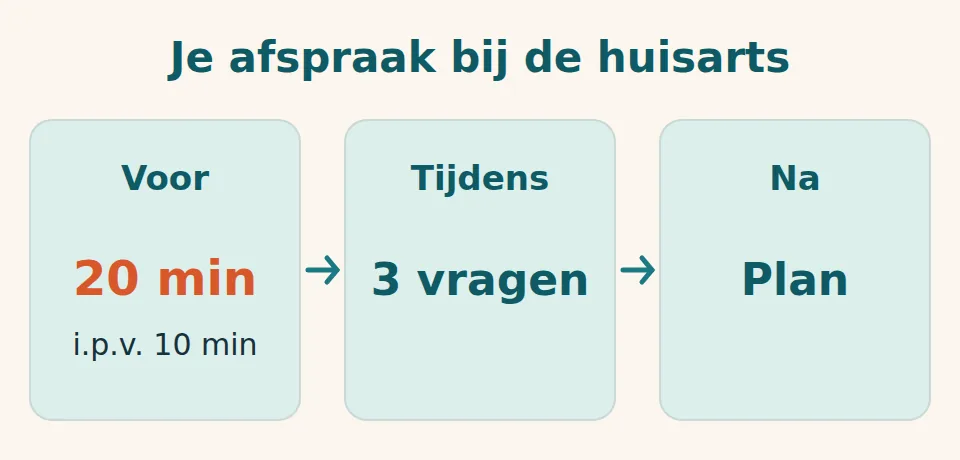
A double appointment gives you 20 instead of 10 minutes. Source: Huisarts en Wetenschap (2020), Patiëntenfederatie Nederland.
Call for a double appointment. Tell the doctor's assistant: "I want to talk about my weight, can I have a double appointment?" You do not need to explain any more on the phone.
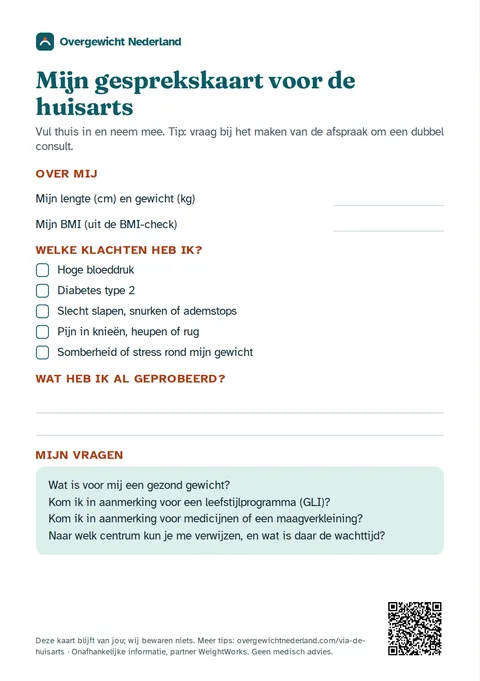
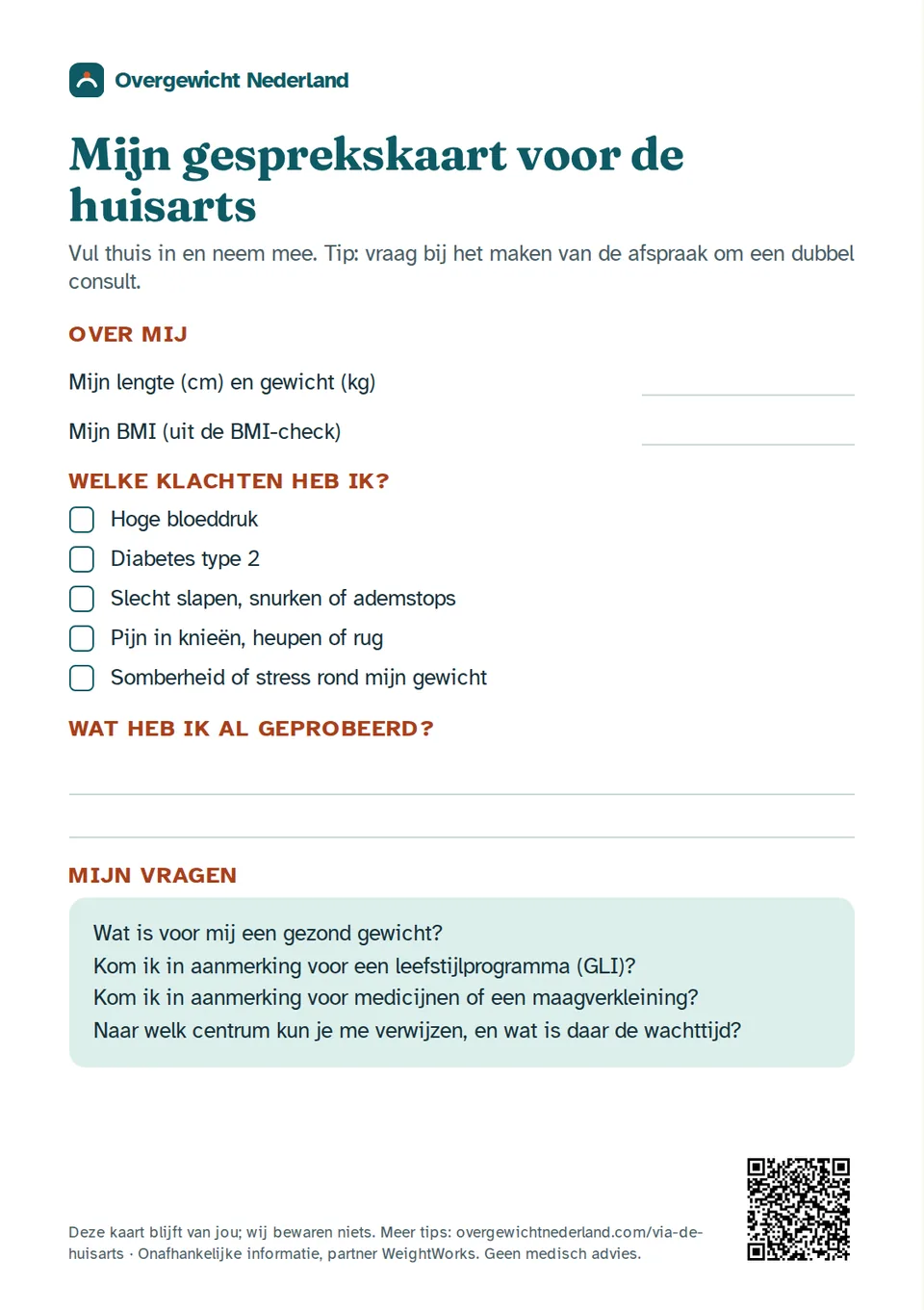
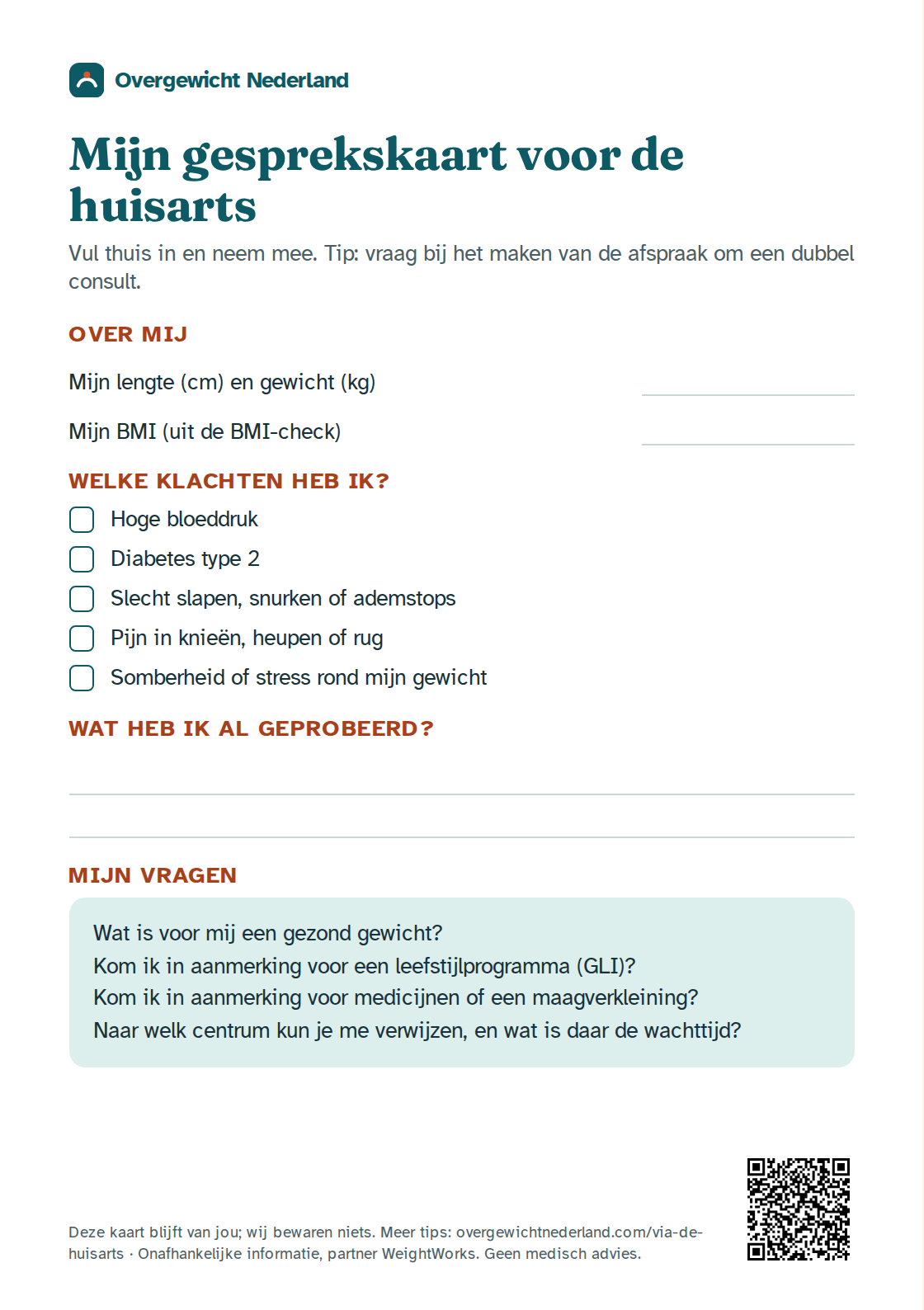
Fill in the conversation card. On it, you write your height, weight, complaints, what you have already tried and your questions.
Bring someone with you if you would like to. A partner, sister or friend can listen in and helps you remember later what was said.
The conversation card is an A5 card that you fill in at home. You can print it or open it on your phone. The card stays yours: we do not store anything you fill in. You can find the patient leaflet and the other materials under the conversation card and leaflets to download.
For you
Conversation card for your GP
Fill it in before your appointment: what you have already tried, your symptoms and your questions. Take it with you to your GP (huisarts) or practice nurse (POH).
You fill in the conversation card at home and take it with you to the GP. Source: Overgewicht Nederland (2026).
Worked example. Suppose you are 1.70 m tall and weigh 95 kilos. Your BMI is then 95 ÷ (1.70 × 1.70) = 95 ÷ 2.89 = 32.9. That is obesity class I (BMI 30 to 35). Suppose your waist circumference as a woman is 96 cm. That is more than the limit of 88 cm. With those two numbers, according to the Zorginstituut, you are eligible for the combined lifestyle intervention (GLI). Put them both on the card. Then the GP can think along with you more quickly.
During the appointment: what to ask
Start with one sentence: "I want to talk about my weight, because I am struggling with it." Then put the card on the table. For every important conversation with a doctor, the Patiëntenfederatie Nederland recommends the 3 good questions:
What are my options?
What are the advantages and disadvantages of those options?
What does that mean in my situation?
Those three questions fit well with overweight. There are several routes and not every route suits everyone. Below are questions you can ask as well, with the reason why.
What to ask and why
What to ask
Why this helps
What is a healthy weight for me?
A goal of 5 to 10% less weight already brings health benefits (NHG-Standaard 2010). You do not have to reach an "ideal" weight.
Am I eligible for the GLI?
The combined lifestyle intervention (GLI) is the first step with a BMI of 25 to 35 with a large waist circumference or a condition, and with a BMI of 35 or higher (Zorginstituut, 2026).
Could my medication or hormones play a role?
The guideline asks the doctor to look at weight-increasing medication, sleep, stress and thyroid (Richtlijnendatabase, 2023).
Is medication or surgery an option for me?
Separate criteria apply to these. This tells you whether you can discuss that route.
Which centre can you refer me to?
You can have a say. Waiting times differ per centre.
When will we see each other again?
Then you know it will not end with one conversation.
The guideline on overweight and obesity (2023) asks the doctor to measure your height, weight and waist circumference and to calculate your BMI. Waist circumference is measured standing, halfway between your lowest rib and the top of your pelvis. For women, 88 cm or more is increased; for men, 102 cm or more. Lower limits apply to people with, for example, an Asian background.
The GP also checks whether your weight is related to other complaints. Think of your blood pressure, diabetes, sleep apnoea or pain in your joints. If there is reason to, targeted blood tests follow, for example for your thyroid (Richtlijnendatabase, 2023). The consultation itself costs you nothing extra. Blood tests at a lab can, however, count towards your compulsory excess (eigen risico). Check this with your health insurer.
What goes into your medical record
GPs use codes to record a subject. With a BMI of 25 to 30, that is the code for overweight (T83). With a BMI of 30 or higher, it is the code for obesity (T82). That code remains visible, even if you lose weight later (NHG registration advice). It is not a label. It makes sure that another doctor or the pharmacy takes your weight into account, for example with the dose of a medicine.
The practice nurse (POH)
Many practices have a practice nurse, the POH (praktijkondersteuner). The POH often has more time than the GP. According to the network approach of the Partnerschap Overgewicht Nederland, the POH explains things, supports you with self-management and can refer you to the combined lifestyle intervention (GLI). Feel free to ask whether you can make a follow-up appointment with the POH. Some people even find that conversation easier.
After the appointment
Once home, write down straight away what was agreed. What you do next depends on the plan:
GLI: you get a referral to a lifestyle coach. The programme lasts 24 months.
Dietitian: basic health insurance (basisverzekering) covers 3 hours a year, although this counts towards your compulsory excess (eigen risico) (Menzis, 2026).
That fear is not unfounded. In research by Erasmus University among 590 people with obesity, a quarter of people with a BMI of 40 or higher said they had been ridiculed in healthcare. One in three felt treated as if they were lazy (Erasmus ESHPM, 2024). Research by Wageningen University showed that some people waited up to 10 years before seeking help, because they felt they had to solve it themselves (2026).
What helps:
Say at the start what you need: "I would like us to look at this together, without judgement."
Mention what you have already tried. Then you will less often hear "try eating less".
Ask for an explanation if you do not understand something, or ask for a second conversation.
Sometimes a conversation does not feel right. You only hear "lose weight", or you get no room for your questions. What can you do then?
Ask for a new conversation. Say honestly that you would like more explanation. Bring the conversation card again.
Ask for another GP in the same practice. In a group practice, this is usually no problem.
Ask for a second opinion. A second doctor then looks at your situation again. Your doctor must cooperate with this, unless there are serious objections. Many insurers only cover a second opinion with a referral (verwijzing) (Rijksoverheid, 25-05-2026).
Ask us your question. Via the contact page with WhatsApp and email, you can ask a general question. We do not give medical advice; your GP does that.
Discuss it with your GP. Even if the first conversation did not go the way you hoped, a second conversation is often the step that makes the difference.
Frequently asked questions about discussing your weight with your GP
How do I bring up my weight with my GP?
Start with one short sentence, for example: "I want to talk about my weight, because I am struggling with it." Then put your completed conversation card on the table. That way you do not have to say everything from memory. The card is available under the free downloads for patients and practices.
What do I say to the assistant when I make an appointment?
You only say that you want to talk about your weight and ask for a double appointment. No further explanation is needed. The assistant will then schedule more time, so you do not have to be finished after ten minutes. Sometimes the assistant suggests an appointment with the practice nurse (praktijkondersteuner, POH). That is also a good start.
Does a double appointment with the GP cost money?
No, an appointment with the GP (huisarts) does not count towards your compulsory excess (eigen risico), not even a double one (Rijksoverheid, 2026). So you pay nothing extra. Blood tests at a laboratory can, however, count towards the compulsory excess of €385 in 2026. You can read more about costs under insurance cover for weight loss surgery.
Do I have to give my conversation card to the GP?
No, the card is yours and you decide what you show. Many people just read from it. You can also give it to the GP. We do not store anything you fill in. The card links to this page, without tracking.
What does the GP measure during a conversation about overweight?
The GP (huisarts) usually measures your height, weight and waist circumference and calculates your BMI. The GP also looks at complaints related to your weight, such as your blood pressure. If there is reason for doubt, blood tests follow, for example for your thyroid. Calculate your BMI beforehand with the BMI calculator for adults.
What does the code T82 or T83 in my medical record mean?
These are codes the GP (huisarts) uses to record that you have overweight (T83) or obesity (T82). The code helps other healthcare providers, for example with the dose of medication. It is not a judgement about you. The obesity code remains visible, even if you lose weight later. You can always ask what is in your record.
Can the practice nurse refer me too?
Yes, for the combined lifestyle intervention (GLI), the practice nurse (POH) or nurse practitioner (praktijkverpleegkundige) can also give you a referral (Partnerschap Overgewicht Nederland). For medication or a referral to a bariatric centre, the GP (huisarts) decides. Read more about how the GLI works and who can take part.
What if my GP only tells me to lose weight?
Then ask follow-up questions using the three good questions: what are my options, what are the pros and cons, and what does that mean for me? Also say what you have already tried. If that gets you nowhere, you can ask for another GP in the practice or ask for a second opinion.
Can I choose which centre I am referred to?
Yes, you can have a say in the centre. Pay attention to the waiting time, the distance and whether your health insurer has a contract with the centre. Compare the waiting times of all bariatric centres beforehand and take your preference with you to the GP.
Do I have to do the GLI first before I can discuss surgery?
You can always discuss surgery. However, with a BMI of 35 or higher, the combined lifestyle intervention (GLI) is the standard first step. Surgery comes into the picture if earlier treatment gave insufficient results and you meet the criteria. See when you are eligible for surgery.
Can I bring someone with me to the GP?
Yes, you always can. Someone who comes along can listen in, take notes and help you remember later what was said. Just mention it at the start of the appointment. For partners and family, there is information about loved ones who support without blaming.
How do I prepare if I feel ashamed of my weight?
Write down beforehand what you want to say, so you do not have to think of it in the consulting room. You can also start with the practice nurse (POH) first or bring someone with you. Shame is very common and no reason to put it off. Hearing how others did it can help, for example at an information evening with someone who has been through it.
How often do I go back to the GP after the first conversation?
You agree on that together, because it depends on the plan. During a combined lifestyle intervention (GLI), the lifestyle coach regularly checks in with the GP. After a GLI, the guideline recommends a yearly check-up. At the end of each conversation, ask: "When will we see each other again?"
Can I also talk to my GP about weight loss medication?
Yes, you can always ask about it. According to the NHG Standard (NHG-Standaard) 2025, medication only comes into the picture with a BMI of 35 with a condition, or 40, after at least a year of combined lifestyle intervention (GLI) with less than 10% weight loss. You can find more information on the page about weight loss medication.
Does Overgewicht Nederland give advice about my situation?
No, we provide general information and no medical advice. For your own situation, go to your GP (huisarts) or practice nurse (POH). If you have a general question about this site or the materials, you can ask it via WhatsApp or email on the contact page.