What is obesity?
Obesity is a chronic disease in which you have so much body fat that it harms your health; doctors speak of obesity from a BMI of 30, and of overweight at a BMI of 25 to 30. It is caused by many factors at once and has nothing to do with a lack of willpower. Help is available, and it starts with your GP (huisarts).
In brief
- In 2024, 15.6% of adults in the Netherlands had obesity and 50.0% had overweight (CBS/RIVM Gezondheidsmonitor 2024).
- By municipality, obesity ranges from 7.9% to 29.2% of adults (VZinfo, Gezondheidsmonitor 2024).
- The revised NHG-Standaard Obesitas (October 2025) also looks at causes beyond lifestyle, such as medication, hormones and genetics.
- According to the NHG-Standaard, losing just 5 to 10% of your weight brings considerable health benefits (NHG, 2010).
- In 2025, the number of people known to their GP to have overweight or obesity rose by 39% (Nivel, July 2026).
Overweight or obesity: where is the line?
Doctors use the body mass index as the first measure. You divide your weight in kilos by your height in metres, twice. According to the 2023 multidisciplinary guideline, the following applies to adults of European descent: a result of 25 to 30 is overweight, 30 or more is obesity. Obesity has three classes: class I (30 to 35), class II (35 to 40) and class III (40 or higher).
An example. Say you are 1.70 m and weigh 95 kilos. Then you calculate 1.70 × 1.70 = 2.89. Your BMI is 95 ÷ 2.89 = 32.9. That falls into class I obesity. If you weigh 80 kilos at the same height, your BMI is 27.7: overweight. Don't want to work it out yourself? Then use the BMI calculator on your own device.
A BMI is a starting point, not a judgement. Your doctor also looks at your waist circumference and at symptoms related to your weight. Belly fat is especially unfavourable. From 88 cm in women and 102 cm in men, the guideline speaks of a large waist circumference (Richtlijnendatabase, 2023). Different thresholds apply to people over 70 and to people of non-European descent.
Work it out for yourself right away. Choose your profile and enter your height, weight and (if you like) your waist circumference. You will see your BMI and your waist-to-height ratio with the thresholds that apply to you.
Ondergewicht
Your BMI is low (underweight). Concerned about your health? Discuss it with your GP (huisarts).
Gezond gewicht
Your BMI is in the healthy range.
Overweight
You are overweight. Do you also have a large waist circumference, high blood pressure or diabetes? Then a combined lifestyle intervention (GLI) can help. Read about the GLI.
Obesity
You have obesity. Your GP (huisarts) can help you with a lifestyle programme. Do you have type 2 diabetes that is poorly controlled? Then surgery may also be an option. View the criteria.
Obesity
You have obesity. With conditions such as diabetes, high blood pressure or sleep apnoea, you may be eligible for medication or weight loss surgery (bariatric surgery). View the criteria.
Ernstige obesitas
You have severe obesity. You may be eligible for weight loss surgery (bariatric surgery). View the criteria.
You see the thresholds for an Asian, Hindustani, Middle Eastern, African or African-Caribbean background (NHG-Standaard Obesitas, 2025). The BMI thresholds for weight loss surgery (30 with poorly controlled type 2 diabetes, 35 and 40) apply to everyone.
Download the conversation card for your GP
BMI does not tell the whole story. Muscle strength, age and background play a part. Your GP looks at the whole picture.
What causes obesity?
Obesity is almost never caused by one thing. It is a sum of factors. Two people who eat the same and are equally active can still gain weight very differently. That is why the revised NHG-Standaard (October 2025) asks GPs to also look for underlying causes: eating disorders, medicines that increase your weight, hormonal and hereditary factors (VoedingOnline, 13-10-2025).
| Cause | What happens | What you can do |
|---|---|---|
| Genetics | Your genes help determine how strongly you feel hunger and fullness and where you store fat. | Tell your GP if obesity runs in your family. |
| Medication | Some medicines, such as prednisone and certain medicines for mental health conditions, can make your weight go up. | Never stop on your own, but ask whether there is an alternative. |
| Hormones | An underactive thyroid or other hormonal problems can play a role. | Let your GP assess whether tests are useful. |
| Sleep and stress | Little sleep and long-term tension change your appetite and your energy. | Include sleep and worries in the conversation. |
| Environment and money | Cheap high-calorie food, sedentary work, few safe places to be active. | A lifestyle programme helps you take small, achievable steps. |
Would you like to list for yourself beforehand what may play a role for you? Erasmus MC created the questionnaire Check Oorzaken Overgewicht. The result is not a diagnosis, but it is a good basis for the conversation with your GP (huisarts).
Your body also defends its weight. After weight loss you often feel hungrier and burn less. That is why the kilos often come back after a diet. That is biology, not failure. It is also the reason the guideline treats obesity as a chronic condition, with care that continues for years (Richtlijnendatabase, 2023).
How does obesity affect your health?
According to VZinfo from RIVM, overweight increases the risk of, among other things:
- type 2 diabetes and high blood pressure;
- cardiovascular disease;
- osteoarthritis and pain in the knees, hips or back;
- asthma and sleep apnoea (pauses in breathing during sleep);
- various types of cancer, such as bowel cancer;
- low mood, low self-esteem and problems getting pregnant.
The good news: you do not need to lose dozens of kilos to gain benefits. The NHG-Standaard already called 5 to 10% weight loss a realistic goal with considerable health benefits (NHG, 2010). At 110 kilos, that is 5.5 to 11 kilos. With severe obesity, more is often needed. Then medication or surgery may come into view. An overview of obesity treatments: lifestyle, medication and surgery helps you see the options side by side.
How many people have obesity?
Obesity is common. In 2024, 15.6% of adults in the Netherlands had obesity. Half (50.0%) had overweight, including obesity (CBS/RIVM Gezondheidsmonitor 2024). This means that almost one in six adults has obesity.
The differences between municipalities are large: from 7.9% to 29.2% (VZinfo, Gezondheidsmonitor 2024). In the municipalities for which this site has its own regional page, the percentage is above the national average everywhere.
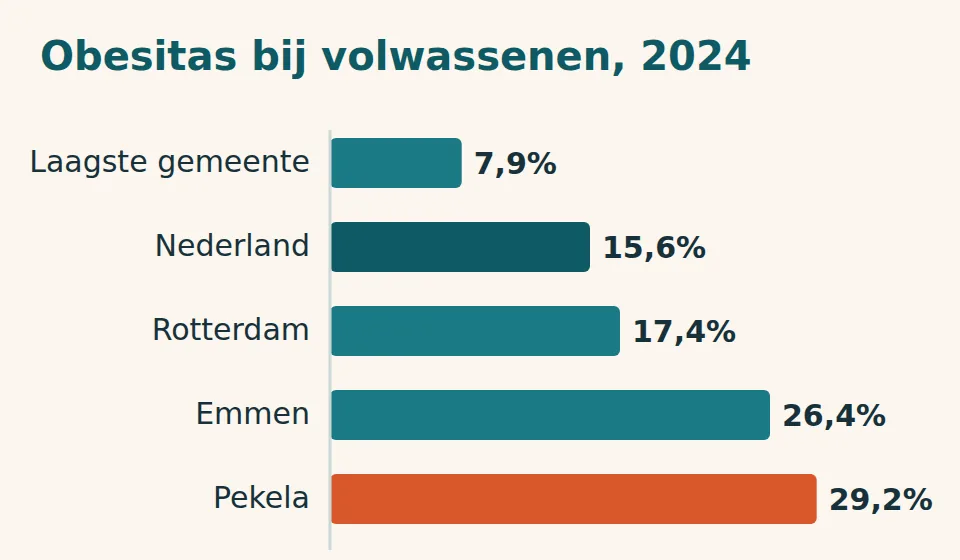
| Municipality | Obesity | Overweight (incl. obesity) |
|---|---|---|
| Pekela | 29,2% | 69,4% |
| Emmen | 26,4% | 64,2% |
| Veendam | 26,2% | 63,1% |
| Nissewaard | 24,5% | 60,2% |
| Neder-Betuwe | 22,8% | 57,4% |
| Netherlands | 15,6% | 50,0% |
Source: CBS/RIVM Gezondheidsmonitor Volwassenen en Ouderen 2024 (CBS StatLine 86137NED), reference date 25-09-2026.
Differences like these say something about groups, not about you as a person. They are linked to income, work, education, living environment and stress. See what it is like in your area in the figures on overweight by region and municipality.
You can see the change at the GP's practice too. According to Nivel, the number of people known to their GP (huisarts) to have overweight or obesity rose by 39% in 2025 compared with 2024. Nivel thinks media attention for weight loss medication plays a part (Nivel, 08-07-2026). So more people are going to their GP. That is a positive development.
Prejudice and shame
People with obesity often face prejudice, including in healthcare. In a study by Erasmus University among 590 people with obesity, a quarter of those with a BMI of 40 or higher had been ridiculed or called names by healthcare providers. One in three felt they were treated as if they were lazy or less capable (Erasmus ESHPM, 16-04-2024).
This has consequences. People who feel ashamed put off getting help. Research by Wageningen University showed that some people waited up to 10 years before considering surgery, because they felt they had to solve it themselves (Nieuws voor Diëtisten, 16-03-2026). The Partnerschap Overgewicht Nederland also describes how stigma leads to people avoiding care and to more stress.
What helps? The researchers advise healthcare providers to ask permission first before raising the subject of weight, to listen to what you want and to take their time. You can ask for this yourself too. Do you notice someone close to you struggling? Then read how to support someone with obesity without hurting them. Real stories about doubt and taking the first step can be found in the experiences of people with obesity.
When should you see your GP?
You can always see your GP (huisarts) with questions about your weight. It is especially worthwhile if:
- your BMI is 30 or higher;
- your BMI is 25 or higher and you also have a large waist circumference;
- your BMI is 25 or higher and you have conditions such as high blood pressure, type 2 diabetes, sleep apnoea or painful joints;
- you have often lost weight and then gained it back again.
Your GP (huisarts) or practice nurse (POH) will look at what suits you. Often the first step is the combined lifestyle intervention (GLI), covered with no compulsory excess. It lasts 24 months and is covered by basic health insurance (basisverzekering) (Zorginstituut Nederland, 2026). If that does not help enough, your GP may consider medication or refer you for surgery.
- Know where you stand. Calculate your BMI and measure your waist circumference.
- Make an appointment. Tell the doctor's assistant that you want to talk about your weight, and ask for a little more time.
- Prepare. Write down what you have already tried and what symptoms you have.
- Decide together. Choose the treatment that suits you with your GP.
Not sure how to start the conversation? Read how to discuss your weight with your GP, with a conversation card. If you already have a high BMI and want to know whether surgery is an option, see the criteria for weight loss surgery according to the NHG-Standaard. Always discuss it with your GP (huisarts).
Calculate your BMI Come to an information evening
Frequently asked questions about overweight and obesity
What is the difference between overweight and obesity?
Overweight is a BMI of 25 to 30, obesity a BMI of 30 or higher. With obesity, the amount of body fat is so large that the risk of diseases such as diabetes and heart problems clearly rises. Doctors also look at your waist circumference and your symptoms. See where you are with the BMI calculator for adults.
Is obesity really a disease?
Yes, the Dutch guideline treats obesity as a chronic condition with many causes. It does not go away on its own and often requires years of care, just like high blood pressure. That is why it deserves the same serious attention from your GP (huisarts). Read which obesity treatments are available.
Is it my fault that I can't keep the weight off?
No, it is not your fault. After weight loss, your body produces more hunger hormones and uses less energy. That is why the kilos often come back. Genetics, medication, sleep and stress also play a role. Support helps to break that cycle, for example through a lifestyle programme covered by insurance.
Can medication make you gain weight?
Yes, some medicines can cause weight gain, such as prednisone and certain medicines for mental health conditions. The NHG-Standaard of October 2025 asks GPs to look at this carefully. Never stop taking a medicine on your own. Ask your GP (huisarts) or pharmacist whether there is an alternative.
Which diseases are linked to obesity?
Obesity increases the risk of, among other things, type 2 diabetes, high blood pressure, cardiovascular disease, osteoarthritis, sleep apnoea and some types of cancer. Low mood is also more common. If you have such symptoms and a BMI of 35 or more, see when you are eligible for weight loss surgery.
What is the difference between class I, II and III obesity?
The classes are about how high your BMI is: class I is 30 to 35, class II 35 to 40 and class III 40 or higher. The higher the class, the greater the risk of disease and the more intensive the appropriate treatment. Work out which class you are in with the BMI calculation and class table.
In which municipalities is obesity most common?
Of the municipalities with a regional page on this site, Pekela has the highest percentage: 29.2% of adults there have obesity. Next come Emmen (26.4%) and Veendam (26.2%) (Gezondheidsmonitor 2024). Nationally it is 15.6%. See the figures on obesity by region.
Why are more and more people with overweight seeing their GP?
The number of people known to their GP (huisarts) to have overweight or obesity rose by 39% in 2025. Nivel thinks media attention for weight loss medication plays a part. It does not mean that so many more people developed obesity in one year, but that more people are asking for help.
How do I deal with comments about my weight from a healthcare provider?
You may say how you want to talk about your weight, and you may ask for an explanation. If you do not feel taken seriously, say so, or ask for a different healthcare provider at the practice. Tips for a good conversation are under discussing your weight with your GP.
Can stress or poor sleep make you gain weight?
Yes, long-term stress and too little sleep can contribute to weight gain. They change your hormones, your appetite and your energy to be active. It is rarely the only cause, but it is an important one. So also tell your GP (huisarts) how you sleep and what is on your mind, not just what you eat.
Why does obesity vary so much between municipalities?
The differences between municipalities, from 7.9% to 29.2%, are linked to income, education, work, living environment and stress. Where more people struggle financially, obesity is more common. It says something about groups, not about an individual. See, for example, the figures and help in Pekela.
Is obesity hereditary?
Genetics play a big role, but are rarely the only cause. Your genes help determine how strongly you feel hunger and how your body stores fat. Together with your environment, sleep and stress, that determines your weight. If obesity is common in your family, tell your GP (huisarts).
Can you be healthy with obesity?
Some people with obesity have no symptoms (yet). Even so, the risk of diseases such as diabetes and osteoarthritis is higher in the long run. It is precisely in that early phase that support can achieve a lot. Ask your GP (huisarts) whether your blood pressure and blood sugar can be checked.
Where can I find support if I feel alone with my weight?
You are not the only one: half of all adults have overweight. At an information evening you hear from a doctor and someone with lived experience, and you can ask questions without having to share anything. See the free information evenings and livestreams about obesity.
Can my family read along or help?
Yes, support from a partner, family or friends helps with every treatment. It works best when they think along without judging. Bring someone with you to your GP or to an information evening. For your loved ones there is a page with tips on supporting someone with obesity.
Sources
- VZinfo (RIVM) – Overgewicht regionaal: obesitas, Gezondheidsmonitor Volwassenen en Ouderen 2024 (accessed 25-09-2026)
- CBS StatLine – Gezondheid per wijk en buurt, tabel 86137NED (2024, accessed 25-09-2026)
- VZinfo (RIVM) – Gevolgen van overgewicht (accessed 25-09-2026)
- Huisarts en Wetenschap – NHG-Standaard Obesitas herzien (13-10-2025)
- VoedingOnline – NHG-standaard Obesitas 2025 (13-10-2025)
- Huisarts en Wetenschap – NHG-Standaard Obesitas, eerste versie (November 2010)
- Richtlijnendatabase – Overgewicht en obesitas bij volwassenen: uitkomstmaten (10-07-2023)
- Richtlijnendatabase – Gepersonaliseerde zorg bij overgewicht en obesitas (10-07-2023)
- Nivel – Jaarcijfers huisartsenzorg 2025 (08-07-2026)
- Erasmus School of Health Policy & Management – Stigmatisering bij obesitas (16-04-2024)
- Nieuws voor Diëtisten – Obesitasstigma vormt drempel voor medische hulp (16-03-2026)
- Partnerschap Overgewicht Nederland – Rol van stigma bij behandeling van overgewicht (2025, updated 11-03-2026)
- Erasmus MC – Check Oorzaken Overgewicht (accessed 25-09-2026)
- Zorginstituut Nederland – Gecombineerde leefstijlinterventie (GLI) (29-05-2026)