Food noise: when your mind keeps turning to food
Food noise is the feeling that your mind keeps turning to food: you think about food when you are not hungry, and those thoughts are hard to switch off. Researchers use the term as a working definition, not as a diagnosis. Here you can read what lies behind it, what the guideline says about psychological help for overweight and what support can and cannot do for you.
Transparency: for the programme, this site refers you to Overgewicht Nederland B.V., based in Amersfoort. We pass on the details from the form to them. The prices come from the provider itself (as of 21-10-2026). Everything about this site and the programme.
In brief
- Food noise is a working definition: increased or persistent responses to food cues, which often lead to intrusive thoughts about food (Hayashi et al., Nutrients, 17-11-2023).
- The authors themselves point to a lack of systematic research. Food noise is therefore not a diagnosis (Hayashi et al., 17-11-2023).
- The guideline on overweight and obesity in adults (Overgewicht en obesitas bij volwassenen) discusses, among other things, cognitive behavioural therapy and medication (Richtlijnendatabase, 10-07-2023).
- According to the guideline factsheet, a referral to a mental health practice nurse (POH-GGZ), psychologist or psychiatrist is an option (guideline factsheet, July 2023).
- That works out at €3.55 per day. Support from Overgewicht Nederland B.V. lasts 12 months and costs €108 per month or €1,295 per year (provider's information, 21-10-2026).
What researchers mean by food noise
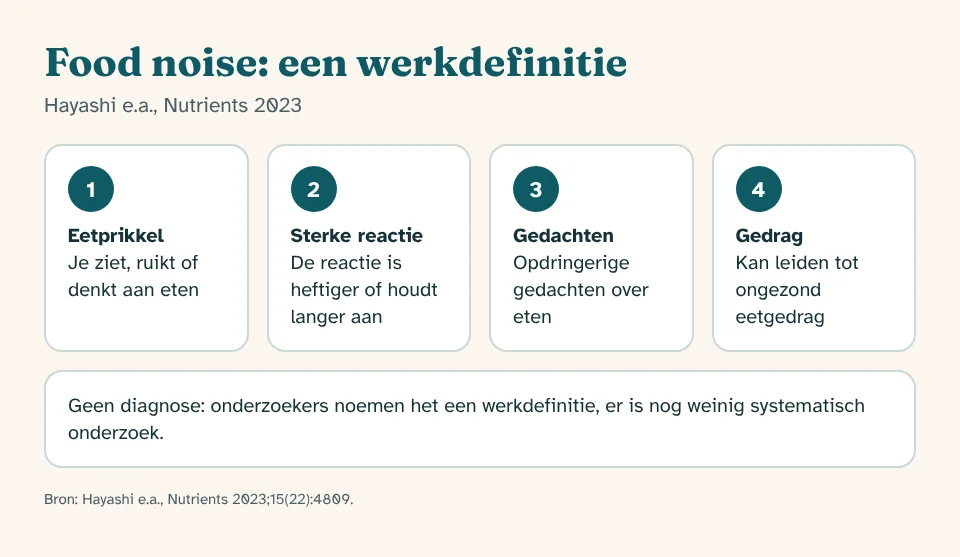
With the term food noise, people describe a kind of noise in their head: thoughts about food again and again, about what is in the cupboard or about the next meal. In 2023, researchers gave the term a working definition. Hayashi and colleagues describe food noise as increased and/or persistent responses to food cues, which often lead to intrusive thoughts about food and unhealthy eating behaviour (Nutrients, 17-11-2023).
A food cue is anything that reminds you of food. Think of the smell from a bakery, an advert, a bowl of biscuits at the office or the usual moment in the evening when you reach for a treat. Everyone responds to cues like these. With food noise, that response is stronger or lasts longer, so your thoughts keep returning to it.
Important to know: this is a working definition. The authors themselves write that systematic research on it is lacking. There is no test or yardstick that tells you whether you have food noise. So it is not a diagnosis, nor an eating disorder. It is a word that helps describe an experience you may recognise.
Normal appetite or constantly thinking about food
Feeling peckish is normal. Your body asks for energy, you eat, and the thought of food fades. With food noise it feels different. People describe the thoughts coming back even after a meal, taking up a lot of space in their head and being hard to ignore. That takes energy and can make you feel you are falling short.
Signs you may recognise
- You think about food when you have just eaten.
- A cue, such as a smell or an image, stays on your mind for a long time.
- You plan your day around moments when you can eat something.
- You feel tired of constantly saying no to yourself.
Do you recognise this? Then you are not weak or undisciplined. Eating behaviour comes from an interplay of body, habits, environment and feelings. That is why good support looks at all those sides at once. You can read more about overweight as a condition under what obesity is and how common it is.
Which help suits which situation
The guideline on overweight and obesity in adults (Overgewicht en obesitas bij volwassenen) describes how care for overweight is structured. The factsheet accompanying that guideline mentions a number of routes. You decide which route suits you together with your GP (huisarts).
| Situation (example) | Possible help | Through whom |
|---|---|---|
| You want to tackle eating, exercise and habits together | GLI: support with diet, exercise and behaviour as a whole | GP |
| Psychological problems play a part | Referral to a POH-GGZ, psychologist or psychiatrist | GP |
| Too little result after a year of GLI | Consider medication | GP |
| You want extra structure and contact | 12-month support programme | Sign up yourself |
In the Netherlands, a combined lifestyle intervention (GLI) is the reimbursed basis. You can read how it works under the reimbursed GLI lifestyle programme. More about medicines and when the GP considers them can be found under weight loss medication and the stopping rule.
What you can do yourself about food cravings
There is no trick that switches off food noise. But you can explore when the thoughts come up and what triggers them. That gives you something to hold on to and good material to discuss with your GP or coach.
- Write it down. For one week, note when you think about food, where you are and how you feel. Patterns then become visible.
- Look at cues. Is there food in sight? Does the craving come back at fixed times? You can try out small changes in your surroundings.
- Pay attention to regularity. A fixed rhythm of meals gives your day structure. Discuss with a professional what suits you.
- Be kind to yourself. Being angry with yourself usually does not make the thoughts quieter. See it as information, not as failure.
- Involve the people around you. Support at home helps. For partners and family there is an explanation for loved ones of someone with obesity.
Do you notice that trying on your own is not enough? That is not a sign of failure. It is a reason to seek help.
When to see your GP
See your GP (huisarts) if you have binge eating episodes, if you feel you have lost control over eating, or if you feel low or anxious. A conversation is also wise if thoughts about food dominate your day or put your relationships and work under pressure. Your GP can assess whether more is going on and can refer you to a mental health practice nurse (POH-GGZ), a psychologist or a psychiatrist. That is exactly the route the guideline factsheet mentions.
Psychological support for overweight may, for example, consist of cognitive behavioural therapy, a treatment the guideline discusses. In it you learn to recognise and change thoughts and habits around food. Whether that suits you is something you decide together with your GP (huisarts). A coaching programme is no substitute for it. If you are going to see your GP, prepare the conversation with the conversation card for help through your GP.
Support for food noise and eating behaviour
A support programme focuses on your daily life: what you eat, how you move, how you sleep and how you deal with stress. According to Overgewicht Nederland B.V., the programme consists of coaching sessions over 12 months. According to the provider, almost half of those sessions are about hormones and the menopause in women. If you recognise that, also read about weight loss during the menopause.
According to the provider, the team is specially trained in support alongside GLP-1 medication. If you use such a medicine, you will find more under coaching alongside GLP-1 medication. How the sessions take place, by phone, by video or on location in Amersfoort, is something you agree in the introductory meeting.
Questions for the introductory conversation
- What background does my coach have, and do they have experience with food cravings?
- How often do we talk, and how can I reach the coach in between?
- What happens if I find that I need psychological help?
- How do you work together with my GP?
What you can and cannot expect
From good support you can expect someone to think along with you, help you learn to see patterns and help you keep up small steps. You cannot expect a coach to make a diagnosis, treat an eating disorder or adjust your medicines. For that, you go to your GP (huisarts). Want to see the full offer first? Take a look at the support programme for overweight.
Cost of support for food noise
The prices below are according to Overgewicht Nederland B.V. (reference date 21-10-2026). If you pay monthly, this is done by direct debit. If, alongside the support, you also want extensive measurements, there is a 15-month research programme; read about it under the research programme with three measurement sessions.
With doctor, coach and psychologist
Monthly
€3.55 per day
€108 per month
- 12 months of support
- Direct debit, no large lump sum
- Total €1,296 over 12 months
Yearly
€3.55 per day
€1,295 in one payment
- 12 months of support
- One payment in advance
- Equivalent to €107.92 per month
Research programme
€2.84 per day
€1,295 for 15 months
- 15 instead of 12 months of support
- Three extensive measurement sessions in Amersfoort
- Equivalent to €86.33 per month
Amounts according to Overgewicht Nederland B.V., reference date 21-10-2026. The price per day is a conversion (total divided by the number of days in the term); you pay per month or per year. Medication comes on top. You will receive the exact terms, such as the term and cancellation, in writing before you start.
Less noise in your head, more calm around food
Want help with your eating behaviour, alongside the care from your GP? Sign up. In the introductory meeting you first discuss whether the programme suits you.
Sign up for support with food noise Come to an information evening
We value your privacy
Other forms of support
Weight loss during menopause
Your hormones change, and so does your body. Support that takes this into account.
PCOS and overweight
Insulin resistance and a cycle that does not cooperate: targeted support.
Support alongside weight loss injections
Semaglutide, tirzepatide or liraglutide: protein, muscles, side effects and stopping.
Support with GLP-1
Using semaglutide or tirzepatide? Coaching on nutrition, muscles and stopping.
Complex medical situation
Diabetes, heart problems, medicines or previous surgery: care that keeps an eye on things.
Extra personal support
More contact, a dedicated coach and quick availability. Let us know what you are looking for.
Take part in research
15 months of support with three extensive measurements in Amersfoort.
Overgewicht Nederland alongside the online providers
| What do you get? | Overgewicht Nederland | Goodweigh | Wellis | Yazen |
|---|---|---|---|---|
| Consultation with a doctor by phone or video | Yes: | No: | Partly: | Not mentioned: |
| Bariatric surgeon as medical director | Yes: | Not mentioned: | Not mentioned: | Not mentioned: |
| Dietitian or personal trainer | Not mentioned: | Not mentioned: | Not mentioned: | Yes: |
| Everything via chat, without phone calls | No: | Yes: | Yes: | Partly: |
yes no (according to the provider itself) partly not mentioned. Reference date 22-10-2026. Full comparison with sources
Frequently asked questions about food noise
What does food noise mean?
Food noise means that you think about food all the time, even when you are not hungry. Researchers describe it as heightened or persistent responses to food cues, which often lead to intrusive thoughts about food. It is a working definition from 2023 and not an official diagnosis. The term mainly helps to name an experience you may recognise.
Is food noise an eating disorder?
No, food noise is not an eating disorder and not a diagnosis either. It is a working definition on which little systematic research has been done yet. If you have binge-eating episodes, feel you have lost control over eating or are worried, go to your GP (huisarts). They can assess what is going on and refer you if necessary.
Why do I think about food all day?
That can have many causes, and they differ from person to person. Food cues around you, fixed habits, stress, sleep and your body all play a role. For one week, write down when the thoughts come up. Take that to your GP (huisarts), who can check whether there is a physical or psychological cause. You will find tips under what you can do yourself about food noise.
How can I tell the difference between appetite and food noise?
Appetite usually fades after you have eaten. With food noise, people describe the thoughts coming back, even just after a meal, and taking up a lot of space in their head. There is no test that measures the difference. If you notice the thoughts are dominating your day, discuss it with your GP (huisarts) or a coach.
Is food noise linked to ADHD?
That has not been established: the sources we use contain no research on food noise and ADHD. Food noise is a working definition from 2023, and the researchers themselves point to the lack of systematic research. If you have ADHD or suspect you do, and you notice that food takes up a lot of space in your head, discuss this with your GP (huisarts) or practitioner. They can assess what is going on.
Can a lifestyle coach help with food cravings?
A lifestyle coach can help you see patterns, adjust your surroundings and keep up small steps. Making a diagnosis or treating an eating disorder is not part of coaching. If psychological problems play a part, a referral (verwijzing) through your GP (huisarts) is the right route. You can read how the reimbursed version works under the GLI through your GP.
Do I need to see my GP first for food noise?
Not always, but it is wise if you have binge eating episodes, feel low or anxious, or feel you have lost control. Your GP (huisarts) can then look at what is going on. For regular support with your eating behaviour, you can also sign up yourself. Do tell your coach if you are receiving treatment.
Does food noise go away on its own?
There is too little research on this to say anything with certainty. The researchers who drew up the working definition point specifically to the lack of systematic research. What you can do is explore when the thoughts come up and work on that with the help of a professional. No approach can promise a result.
How long does support with eating behaviour last?
According to Overgewicht Nederland B.V., the standard programme lasts 12 months. If you choose the research programme, you receive 15 months of support for the same amount, with three extensive measurement sessions in Amersfoort. After the initial term, under the rules of the ACM you can always cancel with a maximum of one month's notice.
Can I take part if I am also seeing a psychologist?
The two can run side by side, as long as you coordinate them well. A psychologist treats psychological problems; a coach helps you with daily habits around eating and exercise. Mention in the introductory meeting that you are in treatment, so the advice fits together. If you are unsure, check first with your practitioner or your GP (huisarts).
Does medication help against food noise?
Whether a medicine reduces food noise has not been established in our sources; food noise is not a diagnosis and there is little systematic research on it. Weight loss medication is only prescribed by a doctor, and according to the NHG guideline (NHG-Standaard) only after a year of lifestyle treatment with too little result. If you already use a GLP-1 medicine, read about support with weight loss injections.
How do you stop food noise?
There is no proven way to stop food noise, because little systematic research has been done on it yet. What you can try: notice when the thoughts come up, put temptations out of sight, eat at regular times and get enough sleep. If that does not help enough, or if it makes you feel low or anxious, see your GP (huisarts). If needed, they can refer you to a mental health practice nurse (POH-GGZ) or psychologist.
What is an example of food noise?
An example: you have just eaten, but you keep thinking about the biscuits in the cupboard and that thought will not let go of you while you work. According to the 2023 working definition, it is about increased or persistent responses to food cues that lead to intrusive thoughts about food. An advert, a smell or a bakery on your way can be such a cue. Everyone recognises this sometimes; what matters is how often and how strongly.
What is food noise in Dutch?
There is no fixed Dutch translation; literally, food noise means something like "voedselruis" or "eetlawaai" in your head. In Dutch, people often talk about "steeds aan eten denken" (constantly thinking about food) or "eetdrang" (food cravings). The term comes from English and is used in research as a working definition, not as a diagnosis. That is why on this page we use food noise and food cravings side by side.
What do you do at the moment a food craving comes up?
At the moment a food craving comes up, you can try pausing for a moment before you reach for something. Ask yourself whether you are hungry, drink a glass of water or do something else for a while. Write down when it happens, so you discover patterns. If it keeps not working, that is not failure. Read how a weight loss coach can support you with this.
Sources
- Hayashi et al.: What Is Food Noise? A Conceptual Model of Food Cue Reactivity, Nutrients 2023;15(22):4809 (17-11-2023)
- Richtlijnendatabase: Herziening richtlijn Overgewicht en obesitas bij volwassenen (10-07-2023)
- Partnerschap Overgewicht Nederland: Factsheet Richtlijn overgewicht en obesitas bij volwassenen (July 2023)
- ACM: Annuleren en opzeggen (29-07-2025)
- Overgewicht Nederland B.V.: programme and price statement (21-10-2026)
Read more: weight loss
- Take the weight loss testPersonal advice in 5 minutes
- Why Overgewicht NederlandDoctor, coach and measurements, honestly compared
- Support with overweight€3.55 per day (€108 per month)
- Gastric balloonSwallowed, 16 weeks, not reimbursed
- Medical weight lossInjection, pill, GLI or surgery
- Weight loss with injectionsSupport alongside weight loss injections
- Weight loss with pillsPrescription weight loss pills
- Weight loss with PCOS (PMOS)Diet, medication and support
- Support with weight loss injectionsProtein, muscles and stopping
- Complex obesity careCare that looks along with you
- Personal supportMore personal contact
- Weight loss research programme€2.84 per day, 15 months
- Sign up for supportWe will call you within one working day