Supporting someone with obesity
The best way to support someone with obesity is to listen, to talk about health and doing things together rather than about kilos, and not to give unsolicited advice about food. Offer to go with them to the GP or an information evening, but leave the choice to them. And do not forget yourself: as a loved one, you are allowed to seek support too.
In brief
- Obesity is a chronic disease with many causes, not a lack of willpower (NHG-Standaard Obesitas, October 2025).
- Shame keeps people away from help: some waited up to 10 years before considering surgery (Wageningen University, via Nieuws voor Diëtisten, 16-03-2026).
- Of 590 people with obesity, one in three with a BMI of 40 or higher felt they were treated as lazy in healthcare (Erasmus Universiteit, 16-04-2024).
- Patients name involving family as one of the features of good care (Partnerschap Overgewicht Nederland, 26-10-2022).
Understand first: why losing weight is so hard
You may think: if only he or she would just eat less. That thought is understandable, but it is not correct. Obesity is caused by genetics, hormones, medicines, sleep, stress, work, money and the environment someone lives in. After losing weight, the body gets hungrier and uses less energy. That is why weight often comes back. Your partner, parent or friend usually knows this very well already, and has often tried many diets.
The GP guideline of October 2025 asks doctors to also look at medicines, hormones and hereditary factors. That perspective helps you too. If you understand that it is a disease, you judge less and help better. Take your time to read what obesity is and what its causes and consequences are.
What really helps?
- Talk about health and enjoyment, not about kilos or clothes. "Shall we go for a walk together on Sunday?" works better than "You need to exercise more."
- First ask whether the other person wants to talk about it. Doctors are given the same advice: ask permission before you bring up weight (Erasmus Universiteit, 2024).
- Do not give unsolicited advice about food. Even well-meant comments at the table feel like control.
- Join in. Cook together, go for a short walk together after dinner, cycle to the supermarket together. A healthy habit is easier to keep up together.
- Celebrate things other than the scales. Sleeping better, taking the stairs without a break, lower blood pressure: those are victories too.
- Be there in case of setbacks. Gaining weight after a difficult period is part of a chronic disease. No blame, but a listening ear.
A practical example. Suppose your partner is 1.70 m tall and weighs 120 kilos. Their BMI is then 120 ÷ (1.70 × 1.70) = 120 ÷ 2.89 = 41.5. That is class III obesity. According to the NHG guideline (NHG-Standaard) of 2010, 5 to 10% weight loss already brings considerable health benefits. For your partner, that is 6 to 12 kilos. So an achievable goal, if it happens with support. Want to see together where he or she stands? Then use the BMI calculator that stores nothing, and only if the other person wants to.
What to say and what better not to say
Words matter. People with obesity often hear comments that sound like reproaches, including from people who love them. These examples show how it can be done differently.
| Situation | Better not | Better |
|---|---|---|
| You are worried | "You really need to do something about your weight." | "I sometimes worry about your health. Could we talk about that sometime?" |
| At the table | "Are you having yet another portion?" | Say nothing. Or later, in private: "How are you really doing?" |
| After a failed diet | "You just need to keep at it." | "It really is so hard. What would help you now?" |
| About getting help | "Why don't you finally go to the doctor?" | "If you ever want to go to the GP, I'd be happy to come with you." |
| About surgery | "Isn't that the easy way out?" | "Tell me what you know about it. What appeals to you, and what are you unsure about?" |
| After a compliment from someone else | "You look so much better now." | "You seem to have more energy. How are you feeling?" |
Notice that you said something wrong? Just say so. "That came out wrong, sorry" repairs a lot. Help with a conversation about weight does not have to be perfect, but it does have to be honest.
Going along to the GP or an information evening
The GP (huisarts) is the gateway to all help with obesity, from a lifestyle programme to a referral to a hospital. For many people, that first appointment is the biggest hurdle. You can make a big difference there:
- Offer to go along. Two pairs of ears hear more. Let the other person do the talking.
- Help with preparation. Fill in the conversation card together: symptoms, what has already been tried and the questions.
- Take notes during the appointment. Then the other person can focus on the GP.
- Talk it over afterwards. What did the other person think? What is the next step?
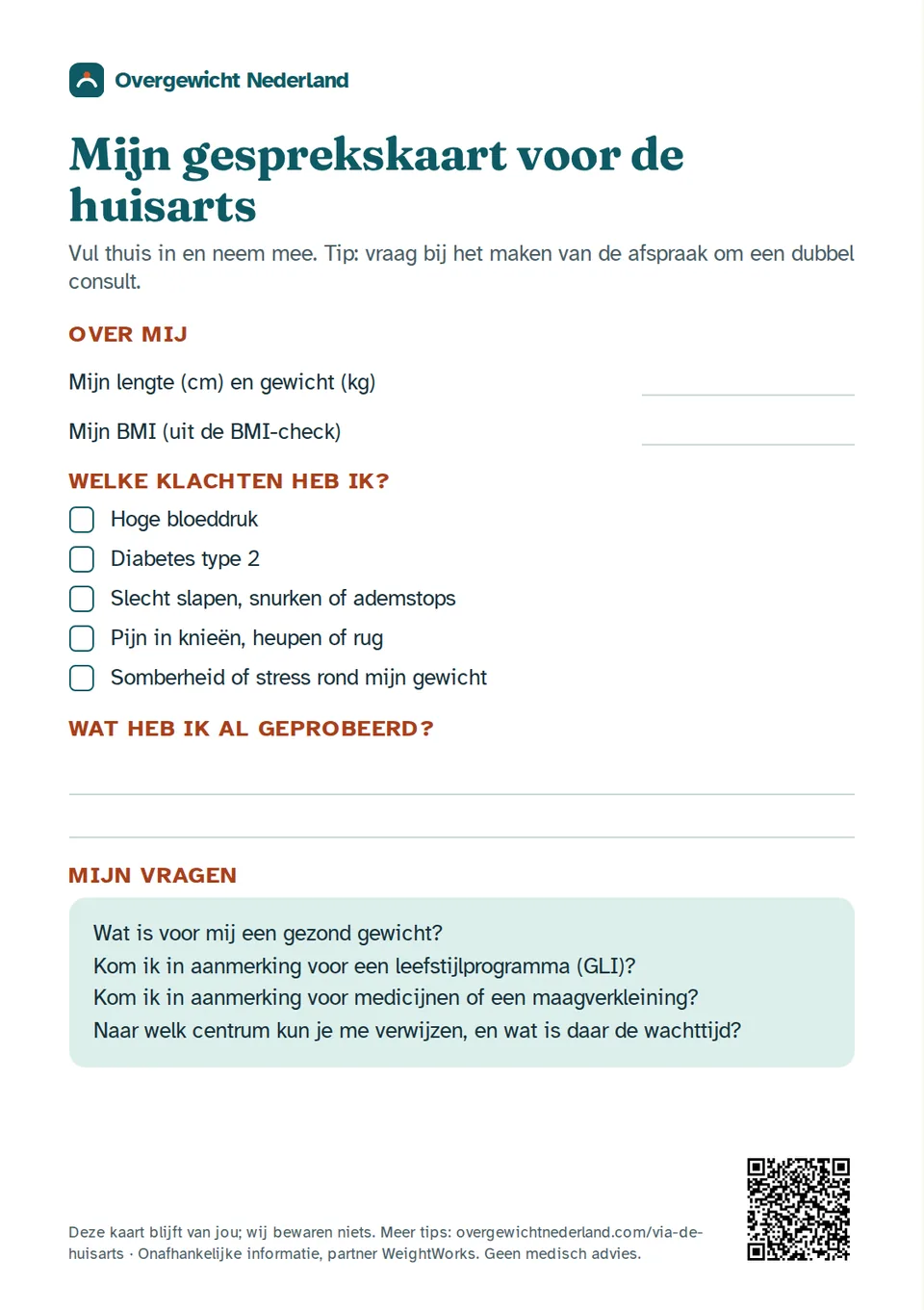
More tips for the appointment are in how to discuss overweight with your GP. Would you rather hear information together first, without anyone having to say anything about themselves? Then go together to a free information evening or livestream about obesity. There, a doctor and someone with lived experience talk about all the treatments.
The Partnerschap Overgewicht Nederland names shared decision-making with the person and their loved ones as a core principle of good care (PON, 2023). So you are part of it, if the other person wants that.
Around weight loss surgery
If your loved one chooses surgery, a lot changes for you too. Beforehand there is a screening by a team that includes an internist, a dietitian and a psychologist. Ask whether you can come along to an information session. The waiting time until the first consultation differs per centre; you can find them in the waiting times for weight loss surgery by hospital and clinic. Who is eligible is explained in the requirements for weight loss surgery.
After the operation, your loved one builds up their eating step by step, with help from a dietitian. After that, he or she eats three small meals and three small snacks a day, and takes vitamin pills for life (Thuisarts.nl). This is how you can help:
- Adapt dinners and parties. Choose a restaurant with small dishes, or agree that half a plate is completely normal.
- Do not push food on them. "Surely one slice of cake is fine" is hard for someone who is just learning a new eating rhythm.
- Help them remember. Vitamins and check-ups at the centre are for life. Aftercare following weight loss surgery lies with the centre, not with the GP (NHG/LHV, October 2025).
- Pay attention to the mental side. Losing weight quickly can bring unexpected feelings: happiness, but also insecurity or low mood. Take signals seriously and encourage them to discuss them with the treatment team.
What the operations involve and what the risks are is explained in weight loss surgery explained: sleeve and bypass. Real stories, including from partners, can be found in experiences with obesity and weight loss surgery.
Take care of yourself too
Supporting someone takes energy. You may feel powerless, worried or even angry. That is allowed. A few tips:
- Talk to someone who is not directly involved, such as a friend or your own GP.
- You are not responsible for the other person's weight or choices. You can support, not decide.
- Make sure you get your own rest, exercise and relaxation. That helps you, and often sets a good example too.
- Are you overweight yourself too? Then you can take the step to the GP together, and there is a lot you can do together at home.
Peer support and organisations
It helps to talk to people who are going through the same thing. These organisations offer support for people with obesity and those around them (websites accessed on 25-09-2026):
- Bariatrie Groep Nederland: foundation for people after weight loss surgery, with a monthly magazine, recipes, a handbook for life after the operation, information sessions and a chat room for peers. According to the foundation, membership is sometimes reimbursed by the health insurer.
- NVOO, Nederlandse Vereniging voor Overgewicht & Obesitas: association that represents the interests of people with overweight. Members have a digital platform for sharing experiences, a buddy programme (O-buddy's), meetings and podcasts.
- Nederlandse Stichting Over Gewicht: patient organisation for peer contact, information and advocacy. Please note: their website overgewichtnederland.org is not part of this site.
This site is independent and has no ties with these organisations. If you want to know who makes this site and who we work with, read about this site and our partner.
Frequently asked questions about support for loved ones
How do I start a conversation about my partner's weight?
Start with your concern for the person, not with their weight. Choose a calm moment, not at the table, and ask whether the other person wants to talk about it. For example, say: "I sometimes worry about your health. May I say something about that?" Accept it if the answer is no.
Should I discuss my loved one's weight if they do not bring it up themselves?
Not repeatedly. People with obesity usually know this very well already. Calmly letting them know once that you are there for them is enough. After that, it is better to do healthy things together than to keep talking about it. Also read what obesity is and why shame gets in the way.
What do I do during the appointment if I go along?
Your role is mainly to listen and remember. Let your loved one explain how things are going and only add something if you are asked to. Write down the advice and agreements, so that you can both read back at home what was said. Prepare together using the conversation card from the downloads.
What can I do if my loved one does not want help?
Respect that, even if it is difficult. You cannot force anyone. Show that you are there and that the door is open. Keep doing things together that have nothing to do with weight. Often a moment comes later when someone is ready.
How do I respond when others comment on my loved one's weight?
You can say calmly but clearly that you do not appreciate such comments. For example: "We'd rather not talk about that." Afterwards, ask your loved one how it felt and whether you handled it well. Some people want you to step in, others would rather you did not.
Is choosing surgery a form of giving up?
No, choosing surgery is not giving up. It is a treatment for a chronic disease, with screening beforehand, lifelong vitamins and years of check-ups. In fact, it requires a lot of commitment and lasting changes. Your support is badly needed. Read what weight loss surgery involves.
How do I help with food at home after weight loss surgery?
Adjust to the new rhythm together: small portions, eating slowly, and drinking between meals rather than with them. Keep protein-rich foods in the house and do not push food on them. The centre's dietitian gives the precise advice. Ask whether you can go along to an appointment.
Can I go along to the information session or screening at the hospital?
That differs per centre. Because life after the operation also changes at home, it makes sense to ask whether you can come along to the information session or a consultation. Ask the centre what is possible. You can see which centres there are in the waiting times by centre.
Can I attend an information evening together with my loved one?
Yes, you are welcome at the information evenings, including together. Signing up is free and you do not have to say anything about your health. You will hear a doctor and someone with lived experience, and you can ask questions. See the dates of the information evenings and livestreams.
My parent has obesity. How can I help as an adult child?
Even as their child, you can offer support without reversing roles. Ask how they are doing, offer to go with them to the GP and do something active together, such as walking with the grandchildren. Avoid lecturing. In older people, other conditions often play a part too; their GP looks at the whole picture.
My teenager is overweight. Where can I go for help?
For children and teenagers you can go to the youth health doctor (jeugdarts) or the GP (huisarts). If necessary, they can refer you to youth healthcare, the neighbourhood team or a paediatrician. At home, talk about healthy eating and exercise for the whole family, not about the weight of one child. This site focuses on adults.
What if I am also struggling with my weight?
Then you can take the step together. Each go to your own GP (huisarts), or make appointments one after the other. Look together at whether a lifestyle programme is suitable; it is free and does not count towards the compulsory excess (eigen risico). Read what the combined lifestyle intervention (GLI) involves.
Where can I find peer support as the partner of someone with obesity?
At patient organisations such as Bariatrie Groep Nederland and the NVOO you can share experiences, including as a loved one. At information evenings you meet other partners and family members. You can read other people's stories in the personal stories about obesity, shared with permission.
Can I make an appointment at a clinic for my loved one?
No, reimbursed surgery requires a referral (verwijzing) from the GP (huisarts), and your loved one has to request it themselves. You can, however, help look for information and prepare for the GP appointment. Look together at whether you are eligible for weight loss surgery.
How do I keep going myself when supporting someone becomes hard?
Take your own limits seriously. Talk to a friend, someone in a similar situation or your own GP about how you are doing. Plan time for yourself, even when your loved one is going through a difficult period. Taking good care of yourself makes you a better source of support, not a worse one.
Sources
- Huisarts en Wetenschap – NHG-Standaard Obesitas herzien (13-10-2025)
- VoedingOnline – NHG-standaard Obesitas 2025 (13-10-2025)
- VoedingOnline – Nazorg na bariatrie is geen huisartsenzorg (14-10-2025)
- Huisarts en Wetenschap – NHG-Standaard Obesitas (November 2010)
- Erasmus School of Health Policy & Management – Stigmatisering bij obesitas (16-04-2024)
- Nieuws voor Diëtisten – Obesitasstigma vormt drempel voor medische hulp (16-03-2026)
- Partnerschap Overgewicht Nederland – Persoonsgerichte zorg bij obesitas: verschillende visies (26-10-2022)
- Partnerschap Overgewicht Nederland – PON-tool Taken en verantwoordelijkheden (April 2023)
- Thuisarts.nl – Ik heb een maagverkleining gehad (accessed 25-09-2026)
- Stichting Bariatrie Groep Nederland – website (accessed 25-09-2026)
- Nederlandse Vereniging voor Overgewicht & Obesitas (NVOO) – website (accessed 25-09-2026)
- Nederlandse Stichting Over Gewicht – Over ons (accessed 25-09-2026)