Experiences of people with obesity
Experiences of people with obesity show what the route through the GP (huisarts) to treatment really feels like: often with years of doubt, many previous attempts and a long preparatory process. On this page you will find six public videos with experiences, a summary of what people say in public sources, and an explanation of how to read such a story.
In brief
- We only publish personal stories with written consent. We do not have any yet, so for now we show public videos and sources.
- The six videos come from a patient foundation, hospitals, NPO 3 and RTL Nieuws, made between 2014 and 2021.
- In research among 590 people with obesity, one in three with a BMI of 40 or higher felt they were treated as lazy in healthcare (Erasmus ESHPM, 2024).
- Participants in the combined lifestyle intervention (GLI) lose an average of 5% of their weight (RIVM, 2024). So one story is never the same as the average.
Six videos with experiences
We chose videos that are publicly available on YouTube and were made by a foundation, a hospital or a broadcaster. They are mainly about weight loss surgery, because most videos have been made about that. The videos only load when you click play. Each video comes with our own short summary and the source.
What can you expect from the process?
Our summary: a short opening to a series made by people who have been through it. In a few minutes you get a first impression of the process. Useful if you are right at the start and first want to know what you are getting into. Source: Stichting Bariatrie Groep Nederland, YouTube (2021).
Two people on their entire journey
Our summary: two people talk about every step, from the first screening to life after surgery. You hear how much time the preparatory process takes and what that feels like. Pay particular attention to what they say about the waiting. Source: Stichting Bariatrie Groep Nederland, YouTube (2021).
Followed for a year in a hospital: the beginning
Our summary: the first episode of a TV series about four people who were followed for a whole year. You see the conversations and tests at the start. The series is from 2014. The referral rules have changed since then, for example due to the NHG guideline (NHG-Standaard) of October 2025. Source: Catharina Ziekenhuis Eindhoven and Omroep Brabant, YouTube (2014).
Followed for a year: how it turned out
Our summary: the last episode of the same series, one year after the start. Not every story goes equally smoothly: one of the patients followed develops complications after surgery. That is exactly why this episode is an honest one to watch. Source: Catharina Ziekenhuis Eindhoven and Omroep Brabant, YouTube (2014).
Young and already having surgery
Our summary: a documentary clip about someone who had weight loss surgery at just 21 years of age. The video shows that eating and lifestyle remain a daily challenge after the procedure. Source: NPO 3, Operatie Obesitas, YouTube (2021).
Lost a lot of weight, and then what?
Our summary: a short news item about someone who lost 65 kilos after surgery. The key point is in the title: surgery is not the end of it. A nice number says little about how life really goes afterwards. Source: RTL Nieuws, YouTube (2018).
What people say about the route via the GP
In public sources, such as forums, blogs and patient stories on hospital websites, a few themes keep coming back. We summarise them in our own words and do not name private individuals. Want to check a source? You will find it at the bottom of the page.
"Am I really bad enough?"
A blogger who described her preparatory process doubted whether her problems were serious enough for help. Only after the screening was she sure she wanted to go ahead. She found waiting for the result emotionally hard. You often hear this doubt. Whether you are eligible does not depend on a feeling but on fixed criteria. You can find them under the criteria for being eligible for surgery.
Years of trying on your own first
Many people say they first tried all sorts of things themselves: diets, exercise, coaching. One forum user had lost more than 30 kilos through diet and exercise and then regained it. Another story on the website of an obesity centre is about someone who decided to seek help after many diets, after her partner had already had surgery. This matches what Wageningen University found: some people waited up to 10 years because they felt they should solve it themselves (Nieuws voor Diëtisten, 2026).
"If only I had done it sooner"
Looking back, some people say they wish they had sought help sooner. One forum user wrote more than five years after surgery: "should have done it much sooner". At the same time, others in the same thread warned that diet and discipline still count afterwards. Both voices belong in an honest picture.
Medication first, surgery later
A forum user with a BMI of 39 found surgery frightening and tried medication first. When that no longer helped, she chose surgery after all. Such an order fits the guideline: lifestyle first, then possibly medication, then surgery. Read more about the combined lifestyle intervention (GLI) as a first step and about when weight loss medication for obesity comes into the picture.
Loved ones make a difference
In a patient story from a hospital, a man says he distanced himself from family and friends who were worried. Later he called their support indispensable. Want to help someone? Read how to support someone with obesity without blaming them.
| What people say | What research says | What you can do with it |
|---|---|---|
| I was too ashamed to bring it up | In a survey of 417 adults, 20% of women and 7% of men named shame as a barrier (LIVET via Nieuws voor Diëtisten, 2026; commercial clinic) | Use a conversation card so you have to say less |
| I didn't feel taken seriously | 14% of people with severe overweight experience discrimination in healthcare, almost three times the average (Partnerschap Overgewicht Nederland, 2025) | Ask for a different GP or a second opinion |
| I put it off for years | Some waited up to 10 years before seeking help (Wageningen University, 2026) | Booking a double appointment is a small first step |
| I thought the doctor would just say "lose weight" | More than 40% of people with obesity expect that (LIVET via Nieuws voor Diëtisten, 2026) | Ask about all the options with the 3 good questions |
How to approach that conversation, with a conversation card and a double appointment, is explained in preparing for your conversation with the GP.
How to read an experience story
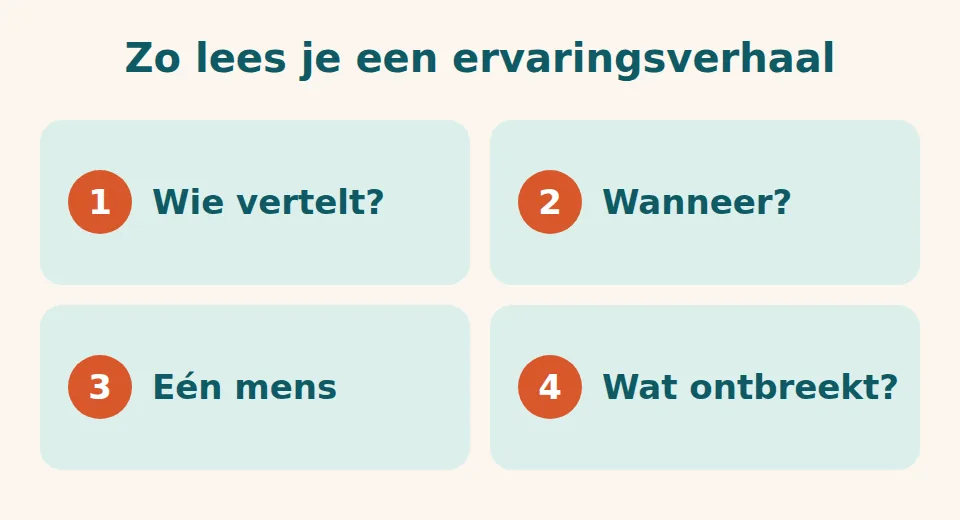
- Who is telling it, and who made it? A video from a hospital is health information, but the hospital also has an interest in a positive picture. A forum post is personal and not checked.
- When was it? A story from 2014 may be true for that person, but the rules and treatments have changed since then.
- It is one person. A story shows how things can go, not how they will go for you.
- What is missing? People who are satisfied tell their story more often. Pain, deficiencies and setbacks are sometimes left out.
Worked example. Suppose you weigh 110 kilos and you see a video in which someone has lost 65 kilos. That sounds like the goal. But participants in the combined lifestyle intervention (GLI) lose an average of 5% of their weight (RIVM, 2024). For you, that is 110 × 0.05 = 5.5 kilos. That may seem small, but 5 to 10% less weight already brings health benefits (NHG-Standaard 2010). The story in the video is real, but it is not a yardstick for you. Discuss with your GP (huisarts) what an achievable goal is for you.
How we choose and check sources is explained in the Overgewicht Nederland editorial policy. You can hear real-life experiences at an information evening with an expert by experience.
Share your story
Have you taken the route through the GP (huisarts), with a lifestyle programme, medication or surgery? Your story can help someone else take the first step. We only publish stories with your written consent. That means:
- You read the text beforehand and approve it.
- You choose whether your name, a first name or no name is used.
- We only publish a photo if you give separate consent for it.
- You can withdraw your consent later; we will then remove the story.
We do not ask for medical information you do not want to share yourself, and we do not give clinics stars or ratings. Would you like to take part? Send a message via the contact page with WhatsApp and email.
Frequently asked questions about experiences with obesity
Why are there no personal stories on this page yet?
We only publish stories for which someone has given written consent, and we do not have any yet. We did not want to make anything up or copy anything without consent. That is why we currently show public videos and summarise public sources. As soon as there are stories with consent, they will appear on this page.
How did you choose the six videos?
We chose videos that are publicly available on YouTube, are in Dutch and were made by a foundation, hospital or broadcaster. We made sure they also show the difficult sides. We left out videos from clinics advertising themselves. Read more in our editorial policy on sources.
Why are most of the videos about weight loss surgery?
Quite simply, most public videos have been made about surgery. There are far fewer about the lifestyle programme or medication. That does not mean surgery is the best or most chosen route. For most people it starts with lifestyle. See all obesity treatments at a glance.
Are old videos still accurate?
The experience itself is true for that person, but the rules may have changed. The NHG guideline on obesity (NHG-Standaard Obesitas) was revised in October 2025, and treatments have changed too. So always check the year of a video. For the current criteria, read the explanation of weight loss surgery in 2026.
Why don't you name people from forums?
People on a forum often write under a pseudonym and have not chosen to appear on another website. That is why we summarise their story without a name. Anyone who wants to check it can find the link at the bottom of the page. This keeps the source verifiable and the person protected.
Are experiences on a forum reliable?
A forum post is a real experience, but nobody checks it. It says something about one person and nothing about how often something happens. Use forums to come up with questions, not to make a decision. Take those questions to your GP (huisarts) or to a free information evening.
What do people say about their first conversation with the GP?
People often say they put it off for a long time, out of shame or because they felt they should solve it themselves. Some did not feel taken seriously, while others felt well supported. Good preparation helps. You will find tips under preparing for an appointment with your GP.
Do people regret seeking help?
In the public sources we read, many people say that looking back they wish they had started sooner. There are also stories about complications and setbacks. People with regrets write down their story less often, so the picture is not complete. Always discuss what you hear with your GP (huisarts).
Do you give clinics stars or ratings?
No, we do not give stars, ratings or reviews. A few stories say too little about an entire centre. What we do show is objective data, such as the waiting times per centre according to ZorgkaartNederland. That way you can compare without one opinion tipping the balance.
Can I share my story anonymously?
Yes, you choose whether to use your full name, just a first name or no name at all. Even without a name, we ask for your written consent for the text. A photo is never required. You get in touch via WhatsApp or email on the contact page and we agree together what the story will look like.
Can I have my story removed later?
Yes, you can withdraw your consent at any time. Send a message and we will take the story off the site. Unfortunately, we cannot retrieve copies that others have already made elsewhere. That is why you read the text carefully beforehand, before giving consent.
I recognise myself in a story. What now?
Recognising yourself in these stories is a good moment to take a step. Take the BMI check and write down what you recognised. Take that with you to your GP (huisarts) in a double appointment. If you would like to know more first, or listen together with someone, come to an information evening. Start by calculating your BMI without anything being stored.
Can my partner or a family member share a story too?
Yes, the experiences of loved ones are valuable too. What was it like to support someone, what helped and what did not? Here too we ask for written consent, and if it concerns someone else, from that person as well. Take a look at the tips for family and friends.
Why don't the videos load straight away?
The videos only load when you click play. This way YouTube does not connect and does not place cookies as long as you are not watching. It also makes the page load faster. If you prefer to watch on YouTube itself, there is a link with each video.
Does an experience story replace my GP's advice?
No, an experience is one person's story and not medical advice. It can help you come up with questions and feel less alone. Which treatment suits you depends on your health, your BMI and your wishes. You discuss that with your GP (huisarts) or practice nurse (POH).
Sources
- Stichting Bariatrie Groep Nederland – Maagverkleining en nu?, episode 1 (18-06-2021)
- Stichting Bariatrie Groep Nederland – Maagverkleining en nu?, episode 3 (25-06-2021)
- Catharina Ziekenhuis Eindhoven – Dik Tevreden, aflevering 1 (09-09-2014)
- Catharina Ziekenhuis Eindhoven – Dik Tevreden, episode 9 (27-10-2014)
- NPO 3 – Operatie Obesitas: een maagverkleining op je 21e (09-09-2021)
- RTL Nieuws – 65 kilo kwijt na maagverkleining (19-07-2018)
- Fun and healthy food (blog) – Mijn maagverkleiningstraject: het voortraject (19-12-2022)
- Mumsnet (forum, UK) – Gastric weight loss surgery, any regrets? (03-01-2022)
- Centrum Obesitas Noord-Nederland – Patiëntervaring over de keuze voor een maagoperatie (accessed 25-09-2026)
- Viva Forum – Maandag gesprek voor gastric bypass (twijfel, twijfel) (10-12-2009)
- Viva Forum – Gastric bypass, page 2 (14-03-2026)
- Maasstad Ziekenhuis – Patiëntervaring afdeling Obesitaszorg (accessed 25-09-2026)
- Erasmus School of Health Policy & Management – Stigmatisering bij obesitas (16-04-2024)
- Nieuws voor Diëtisten – Obesitasstigma vormt drempel voor medische hulp (WUR) (16-03-2026)
- Nieuws voor Diëtisten – Overgewicht niet vaak besproken met zorgverlener (enquête LIVET, n=417) (27-08-2026)
- Partnerschap Overgewicht Nederland – Discriminatie mensen met overgewicht groot probleem in de zorg (23-07-2025)
- RIVM – Jaarrapportage monitor GLI 2024 (11-12-2024)
- Huisarts en Wetenschap – NHG-Standaard Obesitas, eerste versie (November 2010)