Frequently asked questions
On this page you will find short answers to the questions people ask most often about overweight, obesity and its treatment, from your BMI to aftercare following weight loss surgery. Each answer links to a page with more explanation. For personal advice, go to your GP (huisarts).
In brief
- 30 questions, divided into 5 themes: BMI and health, GP and referral, treatments, insurance cover and waiting times, and aftercare.
- 15.6% of adults in the Netherlands have obesity and 50.0% are overweight (CBS/RIVM Gezondheidsmonitor 2024).
- The answers follow the NHG obesity guideline (NHG-Standaard Obesitas) of October 2025 and other sources at the bottom of the page.
Many people walk around for years with questions about their weight before they raise them. That is understandable. Obesity is a chronic disease with many causes, and yet for many people it feels like something to be ashamed of. This page helps you get started. Here you can read what you want to know in a few sentences, and see where you can read more.
The questions are grouped into five themes. Just starting out? Then read the questions about BMI and health first. Already thinking about surgery? Then the questions about insurance cover, waiting times and aftercare are important. Looking for something about your own situation? Then use the calculators on this site. They only calculate on your own device and do not store anything.
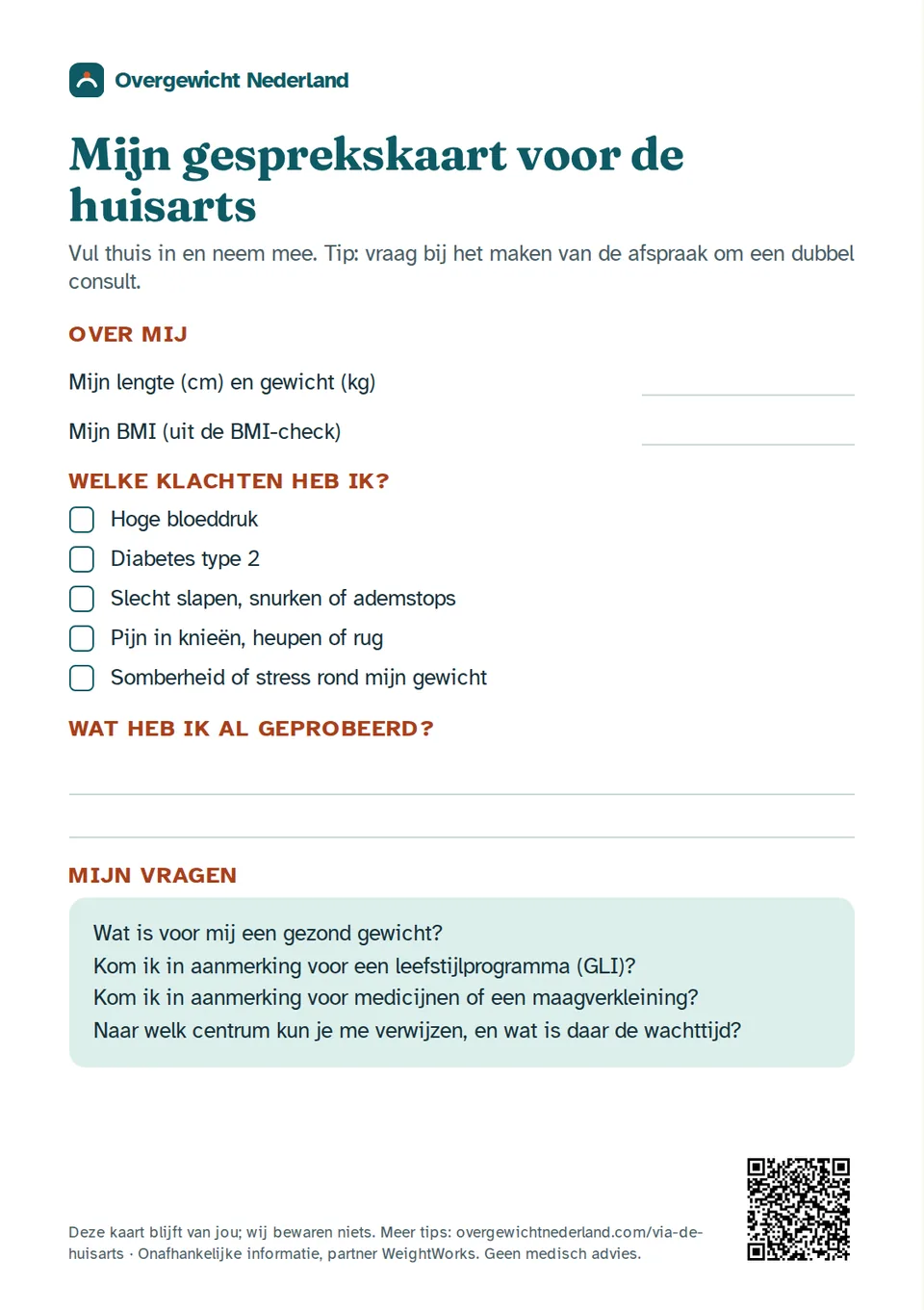
This site is an independent information guide. We show all treatments and all centres, even if they are not partners. Our answers are not personal medical advice. So take your questions to your GP (huisarts), for example on the conversation card you can download for free.
| Theme | In-depth page |
|---|---|
| BMI and health | Calculate your BMI with an explanation for each result |
| GP and referral | How to discuss your weight with your GP |
| Treatments | All treatments for obesity |
| Insurance cover and waiting times | Insurance cover for weight loss surgery and waiting times by centre |
| Aftercare | All about weight loss surgery |
BMI and health
Which BMI qualifies for which treatment?
Roughly: the combined lifestyle intervention (GLI) is possible from BMI 25 with a large waist circumference or a condition, or from BMI 35. Medicines are possible at BMI 35 with a condition or BMI 40, after a year of GLI. Surgery is possible at BMI 40, BMI 35 with a serious condition or BMI 30 with poorly controlled diabetes (NHG, 2025). The full overview is in the treatments for overweight and obesity.
Is BMI the only measure that counts?
No. Your BMI is a starting point, but your GP (huisarts) also looks at your waist circumference and at conditions linked to your weight, such as high blood pressure or type 2 diabetes. Age, muscle mass and ethnic background also play a role. Together they determine your health risk. Calculate your BMI with the BMI calculator and discuss the result with your GP.
What happens to what I enter in the calculators?
Nothing: the BMI check and the bariatric surgery check only calculate in your own browser. We do not store or send your height, weight or answers. Our forms never ask about your weight or your health either. Read more about this in the privacy statement.
How many adults in the Netherlands have obesity?
In 2024, 15.6% of adults had obesity and 50.0% were overweight (CBS/RIVM Gezondheidsmonitor 2024). So you are certainly not the only one. Obesity is a chronic disease with many causes, such as genetics, hormones, medicines, sleep and stress. You can find more explanation in what obesity is and how common it is.
From what waist circumference does the GP speak of an increased risk?
For people with a European background, waist circumference is considered enlarged from 88 cm in women and 102 cm in men; a slightly increased risk already starts at 80 and 94 cm (Richtlijn Overgewicht en obesitas, 2023). Lower thresholds apply for other ethnic backgrounds. Waist circumference counts towards the decision on the combined lifestyle intervention (GLI). Measure and calculate further with the BMI calculator with an explanation of waist circumference.
Where might I come across the BMI check outside this site?
In the waiting room of some GP practices, on the poster, the leaflet and the waiting room screen from Overgewicht Nederland. The QR code takes you straight to the calculator. You can also view and download the materials yourself, for example to show your GP practice. Everything is in the free downloads.
GP and referral
When is a good time to raise my weight with my GP?
If your BMI is 30 or higher, or 25 or higher with conditions such as high blood pressure or diabetes. But if your weight simply worries you, you are also welcome to bring it up. Since the NHG guideline (NHG-Standaard) of October 2025, your GP (huisarts) is expected to actively think along with you. Tips are in how to start the conversation with your GP.
Who can refer me: only the GP?
That depends on the treatment. For the combined lifestyle intervention (GLI), your GP (huisarts) or practice nurse (POH) refers you. For reimbursed bariatric surgery, your GP usually refers you to a centre via ZorgDomein. For a dietitian under basic health insurance (basisverzekering) you do not need a referral (verwijzing) (Menzis, 2026). Read which criteria apply for surgery in am I eligible for weight loss surgery.
What information should I take to the GP?
Take your height, your weight and your BMI, the symptoms you have and a list of what you have already tried in order to lose weight. Also write down your medicines. The conversation card sets everything out clearly, with the questions for your GP included. Fill it in at home. You can download it free of charge from the downloads for patients and practices.
What is ZorgDomein?
ZorgDomein is the digital system GPs use to refer you to a hospital, clinic or other healthcare provider. Your GP (huisarts) uses it to send your details, such as your BMI, medicines and medical history, to the centre you choose together. The centre then contacts you. How this works for referrers is explained in the referral guide for GPs and practice nurses (POH).
Can I see a dietitian if I am overweight?
Yes. Basic health insurance (basisverzekering) covers a maximum of 3 hours of dietary advice per year for a medical purpose; this does count towards your compulsory excess (eigen risico) (Menzis, 2026). A dietitian is also part of the combined lifestyle intervention (GLI), and there you do not pay any excess. Discuss with your GP what suits you best. The GLI lifestyle programme with dietitian and coach is explained separately.
How does my GP know which centres there are and how long the wait is?
Many GPs know the centres in their region. In addition, this site has a referral guide with all centres, their waiting times and the referral route, updated monthly. You can look at that page together with your GP. See the information about referral and collaboration or the referral guide for GPs.
Questions about treatments
What treatments are there, from light to intensive?
There are three main forms: a lifestyle programme such as the combined lifestyle intervention (GLI), medicines and surgery. You usually start with lifestyle, and a more intensive step only comes if that does not help enough. A dietitian or psychologist can also help. Your GP (huisarts) works out with you what suits you. An overview is in the overview of treatments for obesity.
What does the GLI involve, in a few sentences?
The combined lifestyle intervention (GLI) is a 24-month programme in which a lifestyle coach helps you with eating, exercise, sleep and behaviour. The first year is intensive, the second year focuses on keeping it up. It is covered by basic health insurance (basisverzekering), without a compulsory excess (eigen risico) (Zorginstituut Nederland, 2026). Read more in the GLI via your GP.
Who is eligible for weight loss medication?
According to the NHG guideline (NHG-Standaard) (2025), the GP may consider medicines with a BMI of 35 or higher with a condition, or with a BMI of 40 or higher, after at least a year of combined lifestyle intervention (GLI) with less than 10% weight loss. The GLI then continues. More about the rules is in weight loss medication for obesity.
What types of weight loss surgery are there?
The best known are the gastric sleeve, in which a large part of the stomach is removed, and the gastric bypass, in which food bypasses part of the intestine. There is also a mini bypass. You discuss which operation suits you with the team at the centre. The differences are explained in the types of weight loss surgery.
Is weight loss surgery a minor procedure?
No. It is major surgery with consequences for the rest of your life, such as lifelong vitamins and years of aftercare. The risks are, however, well documented in the Netherlands: in the DATO registry, on average 1.4% of patients had a serious complication in 2024 (DATO-jaarverslag 2024). Ask the centre for its own figures. What else to look out for is explained in waiting times and choosing a centre.
What happens at an information evening about obesity?
A doctor and someone with lived experience talk about obesity and all the treatments, and answer your questions. The evenings are free, with no obligation, and you do not have to disclose anything about your weight. There is also a livestream you can follow at home. You can find the dates in the information evenings near you.
Insurance cover and waiting times
What do I pay myself if my weight loss surgery is reimbursed?
Usually only your compulsory excess (eigen risico): €385 in 2026 and €400 in 2027. This applies if you meet the criteria and your insurer has a contract with the centre. If you have a voluntary excess, that comes on top. You usually pay for vitamins after surgery yourself. Everything is in the insurance cover for weight loss surgery.
How long is the average wait for weight loss surgery?
That depends greatly on the centre: from 1 day to 142 days, with 45 days as the median at 15 centres (ZorgkaartNederland, 25-09-2026). After that come screening and preparation. See the current table in the waiting times for weight loss surgery.
Who measures the waiting times in the table?
ZorgkaartNederland. The centres supply their waiting times, the Dutch Healthcare Authority (Nederlandse Zorgautoriteit) collects them every 2 weeks and we take them over monthly. Each table shows the reference date. Always ask the centre what the figure includes. An explanation is in what a waiting time for weight loss surgery tells you.
What should I look out for besides the waiting time?
The aftercare, the travel distance, the team's experience and above all the contract with your health insurer. Without a contract, part of the bill may be yours. A shorter waiting time is therefore not automatically better. Discuss your choice with your GP. You can find a comparison table in waiting times for weight loss surgery by centre.
What changes in 2027 for my compulsory excess?
The compulsory excess (eigen risico) will rise from €385 to €400 in 2027 (Zilveren Kruis, September 2026). If your operation takes place in 2027, you will therefore pay at most that new amount, plus any voluntary excess. If your programme runs over the turn of the year, ask your insurer how it will work out. Worked examples are in the insurance cover for weight loss surgery and the compulsory excess.
Why does my insurer's contract matter so much?
Because at a centre with a contract you only pay your compulsory excess (eigen risico), and at a centre without a contract you sometimes pay a considerable part yourself. Some policies then reimburse only 60 or 65% (Zorgwijzer, 25-11-2025). Check before the screening, with your insurer and the centre. Read more about insurance cover for weight loss surgery with contracted care.
After the operation and aftercare
Who supports you in the years after the operation?
The centre where you had the operation, because aftercare following weight loss surgery is not GP care (NHG and LHV, 2025). How long that support lasts differs per centre. At WeightWorks (partner of this site) it is 5 years (weightworks.nl, September 2026); other centres have their own arrangements. Check before you choose. Read more about the process in the weight loss surgery pathway.
Do I always have to take vitamins after the operation?
Yes. After weight loss surgery your body absorbs fewer nutrients. That is why you take special vitamins for life and have your blood checked regularly. You usually pay for those vitamins yourself. Ask the centre which ones you need. What else you pay yourself is shown in the costs of weight loss surgery.
How does eating change after weight loss surgery?
In the first months you eat small portions, more often per day. You learn again what you tolerate well, with help from the centre's dietitian. That also asks something of the people around you, for example at dinners and parties. Tips for partners, family and friends are in supporting someone with obesity.
What should I know about wanting children and weight loss surgery?
Wait at least 1 year after the operation before getting pregnant and use contraception during that first year (Thuisarts.nl). In that year you lose weight quickly and take in fewer nutrients. If you want children, mention it at the screening. What else the team asks of you is explained in the requirements for weight loss surgery.
Which patient organisations are there for people with obesity?
For example the Bariatrie Groep Nederland, with peer support days and information for people before and after surgery and their loved ones. Talking to people who have been through it helps many people make their choice. Real stories, shared with permission, can be found in the experiences with obesity and weight loss surgery.
What should I do if I develop symptoms after the operation?
Contact the centre where you had the operation, because that is where the aftercare lies. Before the operation, ask where you can go at night and at weekends. If you do go to an out-of-hours GP service (huisartsenpost) or A&E, tell them you have had weight loss surgery. Who to call and when is also in contact; we do not give medical advice ourselves.
Is your question not listed? Then see an explanation of overweight and obesity, an overview of all treatments, the criteria for surgery, insurance cover for weight loss surgery, weight loss support, the free weight loss and menopause check, what your GP can do for you and contact with the editorial team.
Sources
- Huisarts en Wetenschap – NHG-Standaard Obesitas herzien (13-10-2025)
- CBS – Gezondheidsmonitor, obesitas afgelopen 40 jaar verdrievoudigd (2024)
- Richtlijnendatabase – Richtlijn Overgewicht en obesitas, buikomvang (10-07-2023)
- Zorginstituut Nederland – Gecombineerde leefstijlinterventie (GLI) (29-05-2026)
- VoedingOnline – NHG-standaard Obesitas 2025 (13-10-2025)
- VoedingOnline – Nazorg na bariatrie is geen huisartsenzorg (14-10-2025)
- Menzis – Vergoeding dieetadvisering (2026)
- ZorgkaartNederland – Wachttijden maagverkleining (accessed 25-09-2026)
- Zilveren Kruis – Prinsjesdag en je zorgverzekering in 2027 (September 2026)
- Zorgwijzer – Budgetpolis stopt, maar beperkingen blijven (25-11-2025)
- Dutch Audit for Treatment of Obesity (DATO) – Jaarverslag 2024 (January 2026)
- NVVH, Richtlijnendatabase – Operatietechniek bij volwassenen (accessed 25-09-2026)
- Thuisarts.nl – Ik denk na over een maagverkleining en ik wil graag een kind (accessed 25-09-2026)
- Bariatrie Groep Nederland – website (accessed 25-09-2026)
- WeightWorks Clinics – Nazorg (September 2026)