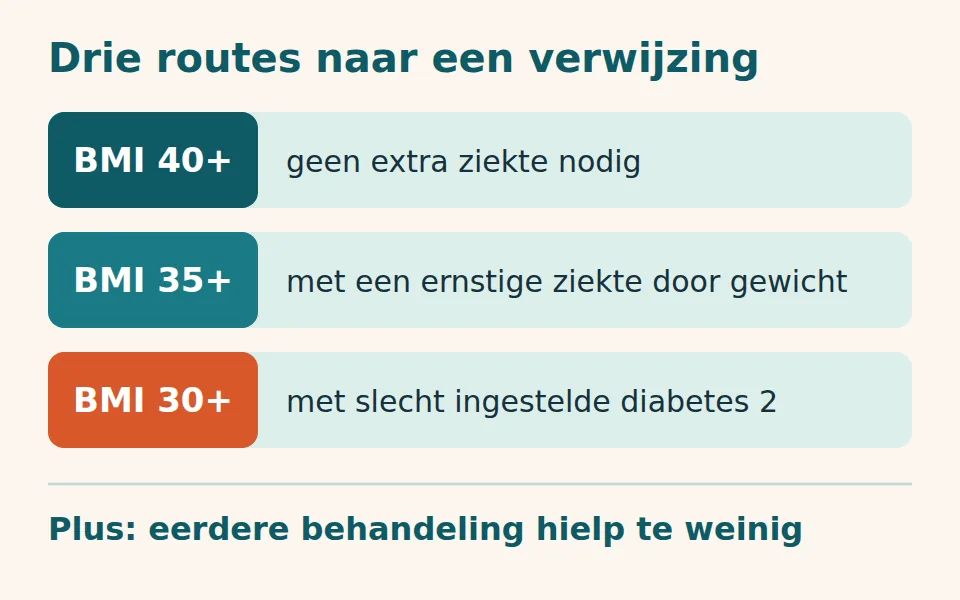
You are eligible for weight loss surgery (bariatric surgery) if you have a BMI of 40 or higher, a BMI of 35 or higher with a serious disease related to your weight, or a BMI of 30 or higher with type 2 diabetes that is poorly controlled, and earlier treatment did not help enough. This is what the NHG-Standaard Obesitas of October 2025 states. Your GP (huisarts) assesses whether this applies to you and can refer you.
In brief
There are three routes: BMI 40 or higher, BMI 35 or higher with a serious weight-related disease, or BMI 30 or higher with poorly controlled type 2 diabetes (NHG-Standaard Obesitas, October 2025).
In all cases: a lifestyle programme or other treatment produced too little result, and you are 18 or older.
With an Asian or Hindustani background the threshold is lower: surgery may already be considered at BMI 35 (NVVH guideline, 2020).
Not eligible (yet)? Then the combined lifestyle intervention (GLI) is often the first step: 24 months, with no compulsory excess (eigen risico) (Zorginstituut Nederland, 2026).
You may meet the criteria
Based on your answers, you may meet the criteria for weight loss surgery in the NHG-Standaard Obesitas (October 2025). If you qualify, your health insurance pays for the operation and you only pay your compulsory excess (eigen risico). Discuss this with your GP (huisarts). They look at your whole situation and can refer you via ZorgDomein. Read whether weight loss surgery is covered.
Another treatment first
Your BMI and health may match the criteria, but usually a lifestyle programme (GLI) or other treatment is the first step. Discuss with your GP (huisarts) what suits you now. Read about the GLI lifestyle programme.
Surgery is probably not right (for now)
Based on your answers, you probably do not meet the criteria for weight loss surgery. Other help is available, such as a lifestyle programme. Discuss with your GP (huisarts) what suits you. See all obesity treatments.
Weight loss surgery is a major treatment with permanent effects. That is why it is intended for people with severe obesity for whom other help has not done enough. The GP (huisarts) first looks at your BMI: your weight in kilos divided by your height in metres squared. Don't know your BMI yet? Then calculate it first with the BMI calculator with an explanation for each result.
Then your health counts. A high BMI alone is not always enough, and a lower BMI does not always rule out surgery. The table shows which combinations the NHG-Standaard mentions.
When can the GP refer you for weight loss surgery? (NHG-Standaard Obesitas, October 2025)
Route
BMI
What else is needed
1
40 or higher
Earlier treatment produced too little result
2
35 or higher
A serious disease related to weight, such as diabetes, high blood pressure, sleep apnoea or joint problems, and earlier treatment did not help enough
3
30 or higher
Type 2 diabetes that is poorly controlled, and earlier treatment did not help enough
The three routes to a referral. Each route requires that earlier treatment did not help enough. Source: NHG-Standaard Obesitas (2025).
Besides your BMI and your health, the treatment team looks at a few other things. These are not exactly the same everywhere. So ask the centre which rules it uses.
You are 18 or older. Different arrangements apply to young people.
You are willing to change your lifestyle permanently. Surgery helps you, but eating, exercise and sleep remain important.
You take part in aftercare for years. That aftercare is provided by the centre, not by your GP (NHG and LHV, 2025).
You are not required to lose weight beforehand. The surgeons' guideline (NVVH, 2020) does not make weight loss before surgery a requirement. Some centres do ask for a short diet just before the procedure.
Sometimes surgery is too risky, or it is better to treat something else first. This is called a contraindication. Your GP does not decide on this alone. The centre's treatment team assesses it during the screening. There you will see, among others, an internist, a dietitian, a psychologist and a nurse.
Examples from the surgeons' guideline (NVVH, 2020) and from practice:
serious heart or lung disease that makes anaesthesia too dangerous;
an eating disorder that needs to be treated first;
mental health problems that are not yet stable, such as severe depression or an acute mental health condition;
a current addiction, or an addiction that stopped less than a year ago;
too little support at home to get through the demanding period after surgery.
A contraindication is often temporary. After treatment or with more support, surgery may still become possible later. So be open during the screening. The team works with you to find out what is safe.
Different thresholds for diabetes and descent
Type 2 diabetes
With type 2 diabetes, surgery may come into view sooner, because it often greatly improves blood sugar. The NHG-Standaard mentions a BMI from 30 if the diabetes is poorly controlled. The surgeons' guideline goes further: at BMI 30 to 35 with poorly controlled diabetes it recommends considering a referral, and at BMI 35 to 40 with poorly controlled diabetes it recommends referring (NVVH, diabetes module, 2023). According to that guideline, surgery is not a last resort. People who have had diabetes for a shorter time have a better chance of the disease going into remission.
Asian or Hindustani background
People with an Asian or Hindustani background are more likely to develop diabetes and cardiovascular disease at a lower weight. That is why the NVVH guideline (2020) advises considering surgery for them from a BMI of 35, even without an additional disease. Lower thresholds also apply to waist circumference: 80 cm for Asian women and 85 cm for Asian men, compared with 88 and 102 cm for people of European background (Richtlijn Overgewicht en obesitas, 2023). Does this apply to you? Then mention it in the conversation with your GP (huisarts).
Five worked examples
Examples make the rules clearer. The people in the table are made up. The BMI is rounded to one decimal place. It is an indication; the GP and the treatment team decide.
Five examples: BMI calculated and checked against the criteria
Situation
Calculation
BMI
Weight loss surgery an option?
1.70 m, 95 kg, no disease
95 / 2,89
32,9
Not yet; GLI is the logical step
1.75 m, 99 kg, type 2 diabetes poorly controlled
99 / 3,0625
32,3
Possibly, via route 3
1.58 m, 90 kg, Hindustani background
90 / 2,4964
36,1
Possibly; NVVH threshold of 35
1.80 m, 118 kg, sleep apnoea
118 / 3,24
36,4
Possibly, via route 2
1.62 m, 106 kg, no disease
106 / 2,6244
40,4
Possibly, via route 1
Take the first example. Say you are 1.70 m and weigh 95 kilos. Your height squared is 1.70 × 1.70 = 2.89. Your BMI is then 95 / 2.89 = 32.9. That is obesity, but without type 2 diabetes it is not yet a reason for surgery. At the same height, BMI 35 is at about 101 kilos and BMI 40 at about 116 kilos. A lower BMI does not mean, by the way, that your symptoms are less serious. There is other help that suits you.
Not eligible (yet)?
Then you are not left empty-handed. For many people, surgery is not the first step anyway. An overview of all the options is available under all treatments for overweight and obesity. The two most important:
The GLI. You qualify for the combined lifestyle intervention (GLI) with a BMI of 25 to 35 and a large waist circumference (women 88 cm or more, men 102 cm or more) or a disease related to your weight, or with a BMI of 35 or higher. The programme lasts 24 months. It is covered by basic health insurance (basisverzekering), with no compulsory excess (eigen risico) and no personal contribution (Zorginstituut Nederland, 2026). Your GP (huisarts) or practice nurse (POH) refers you.
Medication. According to the NHG-Standaard (2025), the GP may consider medication with a BMI of 35 or higher with a disease, or a BMI of 40 or higher, if you have lost less than 10% after at least one year of GLI. If you lose less than 5% after 12 weeks on the highest dose, you stop again. More about this on the page about weight loss medication according to the NHG-Standaard.
Your situation can change. Do you later develop a disease related to your weight, or did the GLI not help enough? Then discuss again with your GP whether surgery comes into view.
The conversation with your GP
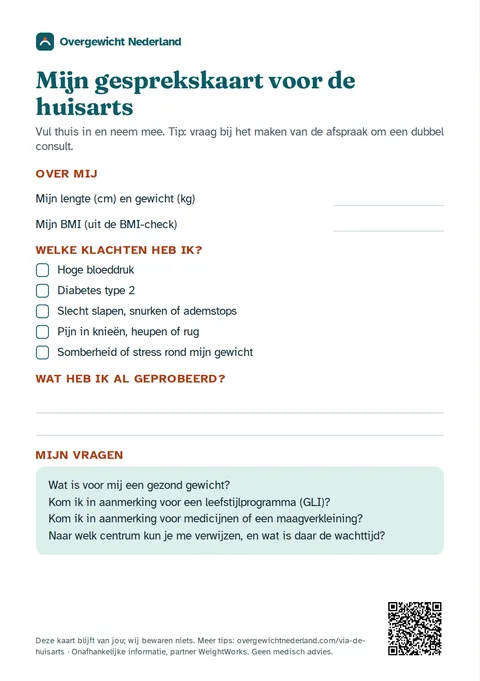
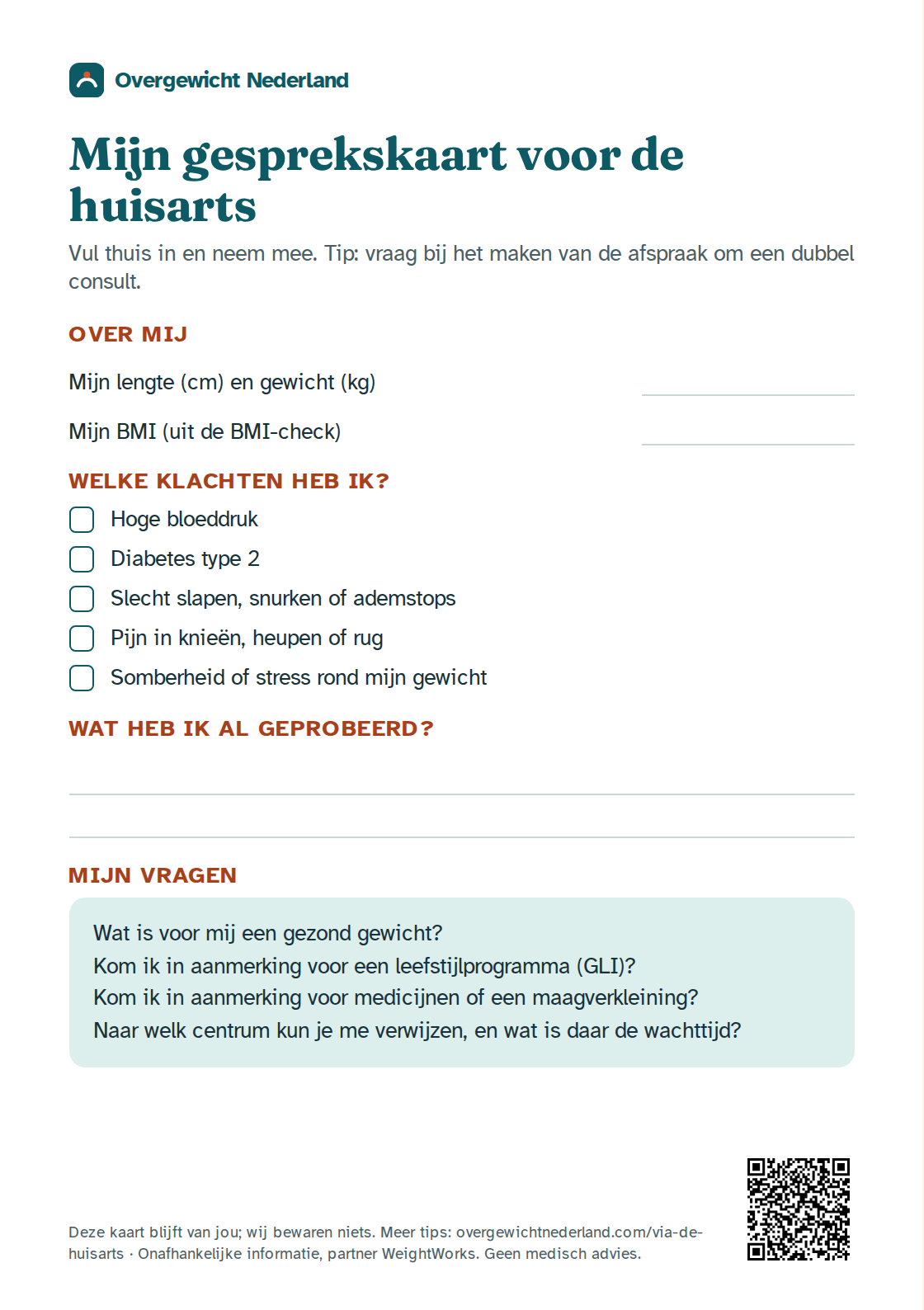
The GP (huisarts) is the gateway to care covered by insurance. For weight loss surgery you need a referral (verwijzing). It helps if you come well prepared. So bring the conversation card. On it you fill in your height, weight and BMI, tick your symptoms and write down what you have already tried. The questions for your GP are already on it.
For you
Conversation card for your GP
Fill it in before your appointment: what you have already tried, your symptoms and your questions. Take it with you to your GP (huisarts) or practice nurse (POH).
Tips for the appointment itself, such as asking for a double appointment, are in how to discuss your weight with your GP. After the referral, this is what happens next:
Your GP refers you via ZorgDomein to a bariatric centre. You can have a say in which centre.
Would you like to hear more before you go to your GP? At a free information evening about obesity and treatments you can put your questions to a doctor and someone with lived experience. Then discuss everything with your GP.
Frequently asked questions about eligibility for weight loss surgery
Is a BMI of 40 enough for a referral?
Often, but not automatically. With a BMI of 40 or higher no additional disease is needed, but the GP (huisarts) also checks whether a lifestyle programme or other treatment produced too little result. After that, the team at the centre assesses whether surgery is safe. Check your BMI with the BMI calculator and take the result to your GP.
Which diseases count with a BMI between 35 and 40?
These are serious diseases related to your weight. The NHG-Standaard gives diabetes, high blood pressure, sleep apnoea and joint problems as examples. Other conditions can count too; your GP (huisarts) will assess that. Put your symptoms on the conversation card so you do not forget anything during the appointment. You can find the card among the free downloads for patients.
What exactly does "poorly controlled diabetes" mean?
It means your blood sugar stays too high, even with the treatment you are currently receiving. Your GP (huisarts) or internist can see this from your blood tests. From a BMI of 30, surgery may then come into view, because it often greatly improves diabetes. Discuss with your GP whether this applies to you. Also read the thresholds for diabetes on this page.
Which earlier treatments count as "not helped enough"?
Usually this means a supervised programme, such as the combined lifestyle intervention (GLI), support from a dietitian or medication. The NHG-Standaard calls the GLI the first step; surgery only comes into view if earlier treatment did not help enough. Read how the GLI works and who gets it under the GLI lifestyle programme. Discuss with your GP what applies in your situation.
Will the centre ask me to follow a diet just before surgery?
Often, yes, although according to the surgeons' guideline (NVVH, 2020) losing weight beforehand is not a mandatory requirement. Many centres ask you to follow a short diet just before the operation. This makes the liver smaller and the operation safer. You will hear what your centre asks during the screening. Read more about the preparation on the page about weight loss surgery.
Is there a maximum age for weight loss surgery?
We do not state a fixed upper limit here, because centres handle this differently. The lower limit is 18. The surgeons' guideline (NVVH, 2020) has a separate section on people over 65: in that case the team weighs the risks and the expected benefit with extra care. Ask the centre of your choice about its rules.
Why does a lower threshold apply to me because of my descent?
People with an Asian or Hindustani background are more likely to develop diabetes and cardiovascular disease at a lower BMI. That is why the NVVH guideline (2020) advises considering surgery for them from a BMI of 35, even without an additional disease. So mention your background to your GP (huisarts). That way they know which threshold applies to you.
Is a contraindication always permanent?
No, it is often temporary. With severe depression, a current addiction or an eating disorder, the team usually wants this to be treated and stable first. A psychologist at the centre assesses this during the screening. Be open: the team wants you to get through the operation and the period afterwards safely. Also discuss your concerns with your GP (huisarts).
What happens during the screening at the centre?
During the screening, the treatment team checks whether surgery is safe and right for you. Your GP (huisarts) refers you, but the team of internist, dietitian, psychologist, nurse and surgeon carries out the screening. Only then is it decided whether surgery is right for you. You can see how long you wait for that first step under the waiting times per centre.
What does the check on this page do with my answers?
Nothing: the check does not save or send your answers. Everything happens in your own browser. The result is an indication, not medical advice. Take the result to your GP (huisarts), for example on the conversation card. Read how we handle data in this site's privacy statement.
I meet the criteria. Will the operation be covered then?
Yes, if you meet the medical criteria, weight loss surgery is covered by basic health insurance (basisverzekering). You do pay your compulsory excess (eigen risico). Check whether your insurer has a contract with the centre, because otherwise you may have to pay part of it yourself. Everything about this is under insurance cover for weight loss surgery.
My BMI is just below the threshold. What now?
Then surgery is usually not the right step yet, but help is available. Think of the combined lifestyle intervention (GLI), a dietitian or, under certain conditions, medication. Your weight and your health can change, so discuss it again if that happens. You can find an overview of all the options under obesity treatments. Discuss it with your GP (huisarts).
Do joint problems count as a disease?
Yes, serious joint problems related to your weight can count at a BMI of 35 or higher. Think of pain in the knees or hips due to osteoarthritis. Your GP (huisarts) assesses how serious the symptoms are and whether they are related to your weight. Tick them on the conversation card so they are not forgotten during the conversation.
Can I refer myself to a bariatric centre?
For surgery covered by insurance you always need a referral (verwijzing), usually from your GP (huisarts). Without a referral, some clinics let you pay yourself, but that is expensive. So start with your GP. Read how to approach that conversation on the page getting the right help via your GP.
Where can I ask questions before I go to my GP?
At a free information evening or during the "Ask the doctor" livestream. There, a doctor and someone with lived experience talk about obesity and all the treatments, and you can ask your own questions. You do not have to share anything about your weight. You can find the dates under information evenings and livestreams.