Obesity with complex medical problems
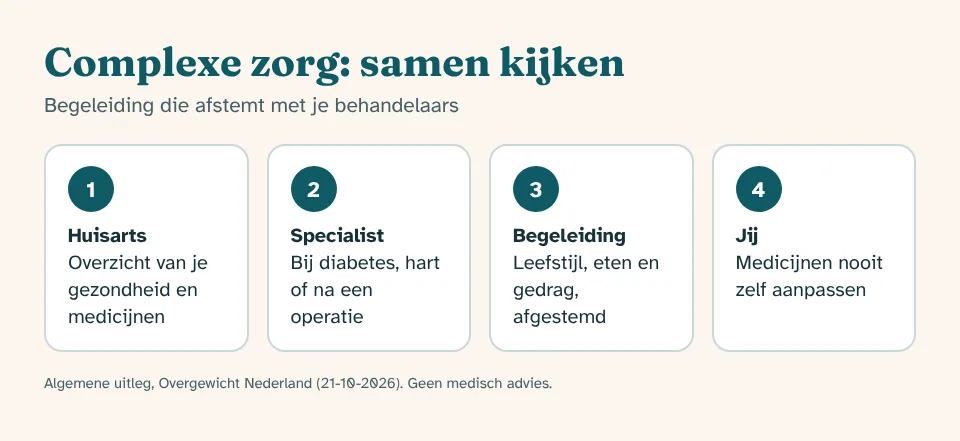
Obesity with complex medical problems calls for support that looks beyond an eating plan. If you have diabetes or heart problems, take a lot of medication or have already had surgery, every change in eating, exercise and weight affects the rest of your treatment. That is why good coaching works together with your GP (huisarts) and specialist, and you never adjust your medication yourself.
Transparency: for the programme, this site refers you to Overgewicht Nederland B.V., based in Amersfoort. We pass on the details from the form to them. The prices come from the provider itself (as of 21-10-2026). Everything about this site and the programme.
In brief
- According to its own statement, Overgewicht Nederland B.V. has experience with clients with complex medical problems (provider's statement, 21-10-2026).
- According to the NHG guideline (NHG-Standaard), obesity medicines only come into the picture after a year of combined lifestyle intervention (GLI) with insufficient results (NHG-Standaard Obesitas, October 2025).
- Liraglutide and naltrexone/bupropion are only reimbursed after at least one year of combined lifestyle intervention (GLI) (Zorginstituut Nederland, 03-02-2026).
- Semaglutide can cause nausea, diarrhoea, constipation, abdominal pain and vomiting; the basis remains fewer calories and more exercise (Apotheek.nl, 15-09-2026).
- Making a diagnosis and changing medication are matters for your doctor, not for the coaching.
Not medical advice. This page provides general information. Never change anything about your medication yourself, not even if you lose weight or eat less. Discuss every step with your GP (huisarts), specialist or pharmacist.
When obesity care becomes complex
Losing weight seems like a simple sum, but for many people it is not. Certainly not if you have other conditions as well as obesity. Think of type 2 diabetes, high blood pressure, cardiovascular disease, PCOS, joint problems or previous bariatric surgery. You then often take several medicines and have more than one care provider.
In a situation like that, everything is connected. A different eating pattern can affect how you feel and how your doctor wants to set your medication. Exercising more is good, but with heart problems or joint problems you preferably build it up in consultation. And anyone who has already had surgery follows the hospital's aftercare first. That is why we speak of complex obesity care here: care in which several conditions and care providers need to be aligned.
According to its own statement, Overgewicht Nederland B.V. has experience with clients with complex medical problems. That does not mean the programme takes over your medical treatment. Whether and how the coaching suits your situation, and when something needs to go back to your doctor, is discussed in the introductory meeting. What obesity is exactly and how common it is, you can read in the explanation of obesity as a chronic disease.
Situations that need extra coordination
The table below gives general examples. It says nothing about your personal situation. Discuss that with your own doctor.
| Situation | Why extra coordination | With whom |
|---|---|---|
| Diabetes with medication | Different eating can affect your medication settings | GP or internist |
| Cardiovascular disease | Build up exercise safely | GP or cardiologist |
| Many different medicines | Changes only via the prescriber | GP and pharmacist |
| GLP-1 medication | Side effects such as nausea | GP and pharmacist |
| Previous bariatric surgery | Hospital aftercare comes first | Bariatric team |
| PCOS | Guideline recommends GLI and monitoring | GP or gynaecologist |
Losing weight with diabetes and medication
If you take medication for diabetes, blood pressure or your heart, the most important rule is simple: never adjust it yourself. Not even if you start eating less, lose weight or feel better. Your doctor assesses whether anything needs to change. So tell your doctor in good time that you are starting a programme, and keep him or her informed of major changes.
For obesity medicines themselves, there is also a clear order. According to the NHG guideline (NHG-Standaard) of October 2025, the GP (huisarts) only considers a medicine after a year of combined lifestyle intervention (GLI) with insufficient results. The Dutch Health Care Institute (Zorginstituut) only reimburses liraglutide with a BMI of 35 or higher with an additional condition, or 40 or higher, and naltrexone/bupropion from a BMI of 30, or 27 or higher with risk factors. For both, the rule is: first at least one year of GLI (Zorginstituut Nederland, 03-02-2026).
Semaglutide and tirzepatide are not reimbursed for obesity under basic health insurance (basisverzekering). The Dutch Health Care Institute (Zorginstituut) discussed them on 5 October 2026; advice is expected in early 2027 and nothing has been decided yet (Zorgkiezer, 20-10-2026). The details are in the NHG rules for obesity medication. Coaching alongside such a medicine can be found at coaching alongside GLP-1 medication.
Previous surgery
If you have had bariatric surgery, your eating pattern follows the advice of the bariatric team. A coach adds to that, but does not replace the aftercare. If you are wondering whether surgery is an option for you, read the criteria for weight loss surgery and discuss it with your GP (huisarts).
Working together with your GP and specialist
With several conditions, your GP (huisarts) is your regular point of contact. They keep the overview, refer you to a specialist and can determine whether you are eligible for the reimbursed combined lifestyle intervention (GLI). How that conversation goes is explained in talking to your GP about your weight.
How to make the collaboration strong:
- Make a medication list. Ask your pharmacy for an up-to-date overview and take it with you to your coach and your doctor.
- Say who is treating you. Name your GP, specialists and, if applicable, your dietitian, so that everyone knows who does what.
- Agree when you will call your doctor. For example in case of dizziness, persistent nausea or other new symptoms.
- Keep track of what changes. Write down what you eat differently and how you feel. That helps your doctor with the assessment.
- Ask for an explanation. If you do not understand something about your treatment, ask. A pharmacist is happy to explain your medicines.
An overview of all steps, from lifestyle to surgery, can be found in the stepped model for obesity treatment.
Support with multiple conditions
According to the provider, the programme of Overgewicht Nederland B.V. lasts 12 months and centres on coaching sessions. According to the provider, the team is specially trained in PCOS and in supporting people on GLP-1 medication. If you have PCOS, also have a look at support for PCOS and overweight. How the sessions take place, by phone, by video or in person in Amersfoort, is agreed in the introductory meeting.
If you want more insight into your body, according to the provider you can also go to Amersfoort for a REE measurement of your resting metabolism and an InBody measurement. The 15-month research programme includes three extensive measurement sessions with, among other things, blood tests and blood pressure measurements. Read about it in the research programme with extra measurements.
Questions for the introductory conversation
- What experience does my coach have with my conditions?
- How do you coordinate with my GP or specialist?
- What does the coach do if I report new symptoms?
- How do you handle my medication list and my privacy?
What you can and cannot expect
From good coaching you can expect your health to be taken into account, help in thinking about achievable steps and to be referred on when something is medical. Ask in the introductory meeting how that works here. You should not expect a coach to adjust medication, interpret results as a doctor would or replace your care provider. Nor does a programme promise a particular number of kilos.
Costs of coaching for complex obesity
The prices below are according to Overgewicht Nederland B.V. (reference date 21-10-2026). Whether your insurer covers anything is not known; check this yourself. The reimbursed combined lifestyle intervention (GLI) is arranged via your GP (huisarts).
With doctor, coach and psychologist
Monthly
€3.55 per day
€108 per month
- 12 months of support
- Direct debit, no large lump sum
- Total €1,296 over 12 months
Yearly
€3.55 per day
€1,295 in one payment
- 12 months of support
- One payment in advance
- Equivalent to €107.92 per month
Research programme
€2.84 per day
€1,295 for 15 months
- 15 instead of 12 months of support
- Three extensive measurement sessions in Amersfoort
- Equivalent to €86.33 per month
Amounts according to Overgewicht Nederland B.V., reference date 21-10-2026. The price per day is a conversion (total divided by the number of days in the term); you pay per month or per year. Medication comes on top. You will receive the exact terms, such as the term and cancellation, in writing before you start.
Coaching that takes your health into account
Want to lose weight with coaching that fits alongside your doctor's care? Sign up. In the introductory meeting you first discuss your situation and whether the programme is a good fit.
Sign up for complex obesity coaching View the weight loss coaching
We value your privacy
Other forms of support
Weight loss during menopause
Your hormones change, and so does your body. Support that takes this into account.
PCOS and overweight
Insulin resistance and a cycle that does not cooperate: targeted support.
Support alongside weight loss injections
Semaglutide, tirzepatide or liraglutide: protein, muscles, side effects and stopping.
Support with GLP-1
Using semaglutide or tirzepatide? Coaching on nutrition, muscles and stopping.
Food noise and cravings
Always thinking about food? Psychological support alongside lifestyle.
Extra personal support
More contact, a dedicated coach and quick availability. Let us know what you are looking for.
Take part in research
15 months of support with three extensive measurements in Amersfoort.
What is included where? Four providers compared
| What do you get? | Overgewicht Nederland | Goodweigh | Wellis | Yazen |
|---|---|---|---|---|
| Consultation with a doctor by phone or video | Yes: | No: | Partly: | Not mentioned: |
| Lifestyle coach | Yes: | Yes: | Partly: | Yes: |
| Dietitian or personal trainer | Not mentioned: | Not mentioned: | Not mentioned: | Yes: |
| Everything via chat, without phone calls | No: | Yes: | Yes: | Partly: |
yes no (according to the provider itself) partly not mentioned. Reference date 22-10-2026. View the cost calculator
Frequently asked questions about complex obesity care
What is complex obesity care?
By complex obesity care we mean care for people with obesity who also have other conditions, such as diabetes, cardiovascular disease or PCOS, or who have already had surgery. Lifestyle, medication and care providers then need to be aligned. Your GP (huisarts) keeps the overview; a coach supports your daily habits and refers medical questions back to the doctor.
Can I lose weight if I have diabetes and take medication?
Yes, you can, but do it in consultation with your GP (huisarts) or internist. Different eating and weight loss can affect how your doctor wants to set your medication. So never adjust your medication yourself. Tell your doctor that you are starting a programme and report new symptoms in good time.
Can you lose weight if you take thyroid medication?
Yes, you can work on losing weight while taking thyroid medication too, in consultation with your doctor. Your GP (huisarts) or internist decides whether your thyroid medication is set correctly; a coach never adjusts medication. Say which medicines you take at the start and let your doctor know that you are starting a programme. A coach then helps you with eating, exercise and keeping going in your daily life.
Does my GP need to know that I am getting coaching?
That is strongly recommended, especially if you have several conditions or take medication. Your GP (huisarts) can then assess whether anything needs to change and knows what you are doing. Prepare for the conversation with the conversation card for the GP. You decide for yourself what information you share.
Can I take part after bariatric surgery?
You discuss that in the introductory meeting, and the hospital's aftercare always comes first. Your eating pattern follows the advice of the bariatric team. Mention in the introductory meeting that you have had surgery and when. If in doubt, consult your treatment team first. You can read more about the process in the steps around weight loss surgery.
Does an additional condition count towards reimbursement of obesity medication?
For some medicines, yes. Liraglutide (Saxenda) is reimbursed with a BMI of 35 or higher with an additional condition, or with a BMI of 40 or higher. Naltrexone/bupropion (Mysimba) with a BMI of 30 or higher, or 27 or higher with risk factors. In both cases you first follow at least one year of combined lifestyle intervention (GLI) (Zorginstituut Nederland, 03-02-2026). Your doctor assesses which condition or risk factor counts for you.
Does the provider have experience with complex situations?
According to Overgewicht Nederland B.V., the team has experience with clients with complex medical problems and is specially trained in PCOS and GLP-1 support. If you want to know what that means for you, ask in the introductory meeting about your coach's experience with your conditions and how the collaboration with your doctor works.
How is obesity treated without surgery?
Without surgery, obesity treatment consists of lifestyle coaching, psychological help if needed and, in some cases, medication. The guideline names the combined lifestyle intervention (GLI) as support with nutrition, exercise and behaviour together, and referral to a mental health practice nurse (POH-GGZ) or psychologist as an option. According to the NHG guideline (NHG-Standaard), medication is only considered after a year of GLI with insufficient results. An overview can be found in all obesity treatments at a glance.
Which measurements can help with complex obesity?
According to the provider, you can go to Amersfoort for a measurement of your resting metabolism and your body composition. The research programme adds blood tests and blood pressure measurements. Such measurements give extra insight for the coaching, but do not replace check-ups with your doctor. Read more in the REE measurement in Amersfoort.
What if I develop new symptoms during the programme?
Then contact your GP (huisarts), or in an emergency the out-of-hours GP service (huisartsenpost). Tell your coach as well, so they can take it into account. Agree with your doctor beforehand which symptoms are a reason to call straight away. That way you know what to do if something changes.
How many kilos do you lose with metformin?
There is no fixed number, and the sources we use do not give one either. Metformin is a medicine your doctor prescribes, and how your weight responds to it differs from person to person. Ask your GP (huisarts) or internist what you can expect in your situation and why the medicine was prescribed. A coach can help you with your eating pattern, but does not assess your medication.
Which diet suits type 2 diabetes?
There is no single diet that is right for everyone with type 2 diabetes. What suits you depends on your medication, your blood sugar, your weight and what you can keep up. Change your eating pattern in consultation with your GP (huisarts) or practice nurse (POH), because eating less can affect how your medication needs to be set. A dietitian can give personal advice; your GP knows how you can get there.
How can you lose weight with type 1 diabetes?
Losing weight with type 1 diabetes is possible, but only in close consultation with your diabetes care provider. Eating less and exercising more affect your blood sugar and therefore how much insulin you need. Never adjust your insulin yourself based on a weight loss plan. Discuss beforehand how you will monitor your levels and what to do if your blood sugar is low. A coach helps with habits, your care provider with the medical side.
Can you lose weight again after bariatric surgery if you have gained weight?
Yes, even after weight loss surgery you can work on losing weight again, but start with the bariatric team or your GP (huisarts). They can find out why you have gained weight and whether anything medical is going on. After that, a regular eating pattern, watching portions and daily exercise help. Lifestyle coaching can offer support with this, alongside the hospital's aftercare and never instead of it.
Does a weight loss medicine fit with my other medication?
That is assessed by your doctor and pharmacy, not by a coach. With several conditions, your GP (huisarts) or specialist checks whether a medicine fits with what you already take and with your symptoms. According to the NHG guideline (NHG-Standaard), a medicine only comes into the picture after a year of combined lifestyle intervention (GLI) with insufficient results. Take an up-to-date medication list to your appointment. Read beforehand whether you are eligible, so that you go well prepared.
Sources
- Zorginstituut Nederland: Forse kostenstijging medicijnen en leefstijlprogramma voor obesitas (03-02-2026)
- Zorgkiezer: Mounjaro en Wegovy in het basispakket? (updated 20-10-2026)
- Apotheek.nl: Semaglutide (updated 15-09-2026)
- Richtlijnendatabase: Richtlijn PCOS, obesitas en gewichtsreductie (18-07-2023)
- Partnerschap Overgewicht Nederland: Factsheet Richtlijn overgewicht en obesitas bij volwassenen (July 2023)
- Overgewicht Nederland B.V.: programme and price statement (21-10-2026)
Read more: weight loss
- Take the weight loss testPersonal advice in 5 minutes
- Why Overgewicht NederlandDoctor, coach and measurements, honestly compared
- Support with overweight€3.55 per day (€108 per month)
- Gastric balloonSwallowed, 16 weeks, not reimbursed
- Medical weight lossInjection, pill, GLI or surgery
- Weight loss with injectionsSupport alongside weight loss injections
- Weight loss with pillsPrescription weight loss pills
- Weight loss with PCOS (PMOS)Diet, medication and support
- Support with weight loss injectionsProtein, muscles and stopping
- Food noiseConstantly thinking about food
- Personal supportMore personal contact
- Weight loss research programme€2.84 per day, 15 months
- Sign up for supportWe will call you within one working day