Obesity treatments
In the Netherlands, obesity is treated according to a stepped model: you start with lifestyle, and only if that does not achieve enough do a specialised programme, medication or weight loss surgery (bariatric surgery) come into consideration. Which step suits you depends on your BMI, your waist circumference and your health. You make that assessment together with your GP (huisarts) or practice nurse (POH).
In brief
- The guideline divides your health risk into four levels, from slightly to extremely increased. Each level corresponds to its own treatment step (Richtlijn Overgewicht en obesitas, 2023).
- The combined lifestyle intervention (GLI) lasts 24 months and costs you nothing: no compulsory excess (eigen risico) and no personal contribution (Zorginstituut Nederland, 2026).
- Your GP (huisarts) only considers medication at a BMI of 35 with a condition or of 40, after at least 1 year of GLI with less than 10% weight loss (NHG-Standaard Obesitas, October 2025).
- Weight loss surgery gives an average of 25 to 30% weight loss in the first 1 to 2 years (Thuisarts; Richtlijn Chirurgische behandeling van obesitas).
The stepped model in brief
Healthcare professionals also call it stepped care: care in steps. The idea is simple. You get the lightest treatment that suits your risk. If it does not help enough, or if your risk is higher, you go up a step. Lifestyle remains the basis at every step, even if you later receive medication or surgery.
Obesity is a chronic disease with many causes, such as heredity, hormones, sleep, stress and some medicines. The NHG-Standaard Obesitas of October 2025 therefore asks GPs to also look at underlying causes, not just at eating and exercise (VoedingOnline, 13-10-2025). So needing a next step says nothing about how hard you have tried.
The five steps are:
- Advice on a healthy lifestyle. For a slightly increased risk. You get explanations and tips from your GP (huisarts) or practice nurse (POH), sometimes with help from your neighbourhood or the municipality.
- Basic GLI. A recognised two-year lifestyle programme with a lifestyle coach. Read all about the combined lifestyle intervention.
- Specialised GLI. More or more intensive support for an extremely increased risk, or if there are additional issues, such as mental health problems or a suspected eating disorder.
- Medication alongside the GLI. A medicine that suppresses appetite, alongside the lifestyle programme. Who it is for, and when you stop, is described in the NHG rules for weight loss medication.
- Bariatric surgery. Weight loss surgery in a specialised centre, with screening beforehand and years of aftercare. See the weight loss surgery pathway.
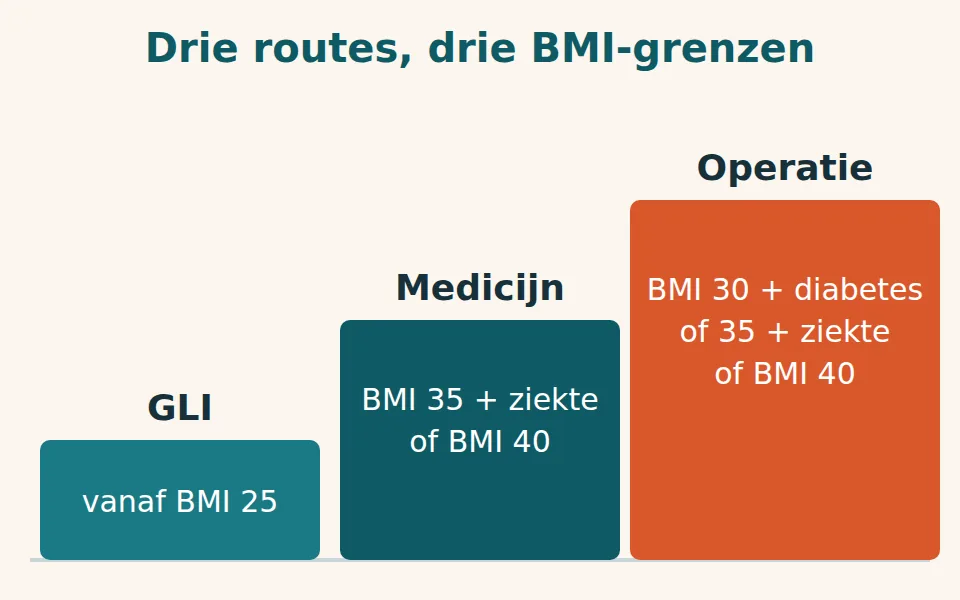
Which step fits your BMI?
Your GP (huisarts) does not only look at your BMI. Your waist circumference and weight-related conditions also count. Together they give your weight-related health risk, abbreviated GGR (gewichtsgerelateerd gezondheidsrisico). An increased waist circumference is 88 centimetres or more in women and 102 centimetres or more in men. Conditions include, for example, type 2 diabetes, high blood pressure, sleep apnoea, osteoarthritis or mental health problems.
| BMI | Without increased waist circumference or condition | With increased waist circumference | With a weight-related condition |
|---|---|---|---|
| 25 to 30 | Slightly increased: healthy lifestyle advice | Moderately increased: basic GLI | Moderately increased: basic GLI with additional care |
| 30 to 35 | Moderately increased: healthy lifestyle advice | Highly increased: basic GLI | Highly increased: basic GLI with additional care |
| 35 to 40 | Highly increased: basic GLI | Extremely increased: specialised GLI | Extremely increased: specialised GLI |
| 40 or higher | Always extremely increased: specialised GLI | ||
Two caveats. Different thresholds apply to people over 70 and to people with an Asian, African or other non-European background (Richtlijn Overgewicht en obesitas, 2023). And the table shows the lifestyle steps. Medication and surgery come on top of that, under these conditions from the NHG-Standaard of October 2025:
- Medication: consider at a BMI of 35 or higher with a condition, or a BMI of 40 or higher, after at least one year of motivated participation in a GLI with less than 10% weight loss. The GLI then simply continues.
- Weight loss surgery: at a BMI of 40 or higher, a BMI of 35 or higher with a serious weight-related condition, or a BMI of 30 or higher with poorly controlled type 2 diabetes. Always when previous treatment did not give enough results, and from the age of 18. Check the details in the criteria for being eligible for weight loss surgery.
Don't know your BMI yet? With the BMI calculator that saves nothing you will have it in a few seconds. Also measure your waist circumference: standing, on bare skin, halfway between your lowest rib and the top of your pelvis.
What does each treatment achieve?
How much weight you lose varies greatly from person to person. The figures below are averages from research or national monitoring. They are meant for comparison, not as a promise. A smaller loss can also do a lot: 5 to 10% less weight already brings considerable health benefits, such as better blood pressure and blood sugar (NHG-Standaard Obesitas, 2010).
| Treatment | Average result | What you pay yourself | Source |
|---|---|---|---|
| Combined lifestyle intervention (GLI) | 47% of those who completed the whole programme had lost at least 5% of their weight | Nothing | RIVM, GLI monitor (June 2024); Zorginstituut (2026) |
| Semaglutide | About 15% after 68 weeks, as long as you use it | Not reimbursed for obesity | STEP 1 study (2021); Farmacotherapeutisch Kompas (reference date 25-09-2026) |
| Placebo with lifestyle advice | About 2.4% in the same study | n.v.t. | STEP 1 study (2021) |
| Weight loss surgery | 25 to 30% in the first 1 to 2 years | Your compulsory excess (eigen risico) (€385 in 2026) | Thuisarts; Richtlijn Chirurgische behandeling van obesitas |
A few things stand out. On average, the lifestyle programme produces the least weight loss, but it costs you nothing and teaches you habits you need at every next step. Of the participants, however, 41% stopped early (RIVM, 2025). Medication only works as long as you take it. And surgery has the biggest effect, but is a major procedure with lifelong consequences, such as taking vitamins every day.
You can read more about the costs of surgery and what your insurance pays in insurance cover for weight loss surgery from your health insurer.
A practical example
Say you are 1.70 metres tall and weigh 95 kilos. Your BMI is then 95 divided by 2.89 (1.70 × 1.70) = 32.9. Your waist circumference is 96 centimetres and you are a woman. According to the table, your risk is then greatly increased, and the appropriate step is a basic GLI.
If you lose 5% in that programme, that is 4.75 kilos. You then weigh 90.25 kilos, with a BMI of 31.2. You still have obesity. Yet this is a real gain: your blood pressure and blood sugar often already improve with this loss. In this example, medication or surgery is not yet an obvious option, because your BMI stays below 35 and you do not have diabetes.
If you weigh 118 kilos at the same height, your BMI is 40.8. An extremely increased risk then applies straight away. Your GP can then refer you to a specialised GLI and open the conversation about medication or weight loss surgery if the programme achieves too little.
Your GP as the starting point
Almost every step starts with your GP (huisarts) or practice nurse (POH). They determine your risk, refer you to a GLI, prescribe medication if necessary or refer you to a bariatric centre. The figures show you are not alone in this: in 2025, the number of people known to their GP with overweight or obesity rose by 39% (Nivel, 2026).
Do you find it difficult to bring it up? That is perfectly normal. In discussing your weight with your GP you will find a conversation card and questions you can ask. Bring:
- your BMI and waist circumference;
- conditions or symptoms you have, such as high blood pressure, diabetes or pain in your knees;
- what you have already tried, with or without support;
- the medicines you use, because some medicines can increase your weight.
Would you rather listen in a group first? At the free information evenings and livestreams about obesity, a doctor and someone with lived experience answer your questions.
Read more by treatment
Each treatment has its own page with more explanation. Choose what fits your question:
- The combined lifestyle intervention (GLI) and how to sign up: eligibility criteria, the nine recognised programmes, dropout and results.
- Weight loss medication according to the NHG-Standaard: the preferred medicines, the stopping rule and the current state of reimbursement.
- The types of weight loss surgery and the pathway: sleeve, bypass and mini-bypass, risks and aftercare.
- Waiting times for weight loss surgery by centre: all hospitals and clinics, updated monthly.
- What obesity is and why it is a chronic disease.
Whichever route you choose: discuss it with your GP. This site gives general information and does not replace medical advice.
Am I eligible? Calculate your BMI
Besides treatments via the hospital, you can also look for support with weight loss. Read about a year of support from a coach and doctor, about the Allurion gastric balloon without surgery and about losing weight with a prescription injection pen. Still unsure? Take the 5-minute check first.
Frequently asked questions about obesity treatments
What does stepped care mean for obesity?
Stepped care means that you start with the lightest treatment that suits your health risk. If it does not work well enough or your risk is higher, a more intensive step follows. The steps run from lifestyle advice via the GLI and medication to weight loss surgery. You can see the breakdown by BMI in the table of obesity treatments by risk.
What is a weight-related health risk (GGR)?
The GGR is an estimate of how much risk your weight poses to your health. To determine it, your GP (huisarts) combines your BMI, your waist circumference and weight-related conditions. There are four levels: slightly, moderately, greatly and extremely increased. Each level corresponds to its own treatment step. You can calculate your BMI with the BMI calculator on your own phone.
Why does my waist circumference count?
Your waist circumference counts because fat around your organs carries more risk of diabetes and cardiovascular disease, among other things. With a BMI between 25 and 35, your waist circumference therefore determines whether you qualify for a combined lifestyle intervention (GLI). The threshold is 88 centimetres for women and 102 centimetres for men. Measure standing up and on bare skin.
Do I always have to start at the bottom of the ladder?
No, you do not always start at the bottom. With a high risk, such as a BMI of 40 or higher, your GP refers you directly to a specialised GLI. For medication and weight loss surgery, however, previous treatment must have helped insufficiently. How this works out for you is explained in the eligibility conditions.
What is the difference between a basic GLI and a specialised GLI?
A specialised GLI offers more or more intensive support than a basic GLI. The guideline mentions it at a BMI of 35 or higher, but also with low literacy, mental health problems or a suspected eating disorder. Your GP (huisarts) will tell you which form is available near you. More about the programme can be found at the combined lifestyle intervention (GLI).
What percentage of weight loss already brings health benefits?
According to the NHG, losing just 5 to 10 percent of your weight brings considerable health benefits. Think of lower blood pressure, better blood sugar and less strain on your joints. At 100 kilos, 5 percent is already 5 kilos. So a lower weight is not the only goal; your health and how you feel count too.
Can the GP provide all treatments themselves?
No, your GP (huisarts) does not provide all treatments personally. The GP or practice nurse (POH) determines your risk, gives advice and can prescribe medication. For the GLI, the GP refers you to a lifestyle coach; for surgery, to a bariatric centre. You can prepare for such a referral (verwijzing) with the tips for discussing your weight with your GP.
Who decides which treatment I get?
You decide which treatment you get together with your GP (huisarts). The guideline asks healthcare professionals to choose based on your risk, causes, motivation and wishes, and to discuss your expectations honestly. So you do not have to accept anything that does not suit you. You can ask a doctor questions outside the consulting room at an information evening or livestream.
Do different BMI thresholds apply to older people?
Yes, different thresholds apply to people aged 70 and over. According to the guideline, overweight only starts at a BMI of about 28 for them. The thresholds for BMI and waist circumference are also different for people with a non-European background. So discuss your own situation with your GP (huisarts), rather than relying only on a table.
Why is lifestyle still needed after surgery?
Lifestyle remains necessary because your new habits determine whether the result of surgery or medication lasts. After weight loss surgery, you eat small portions and take vitamins for life. With medication, according to the NHG, the GLI simply continues. What changes after surgery is explained in the risks and life after weight loss surgery.
Which treatment suits a BMI of 32?
That depends on your waist circumference and your health. Without a large waist or a condition, you get advice on a healthy lifestyle. With a waist circumference above the threshold or a weight-related condition, a basic GLI is the appropriate step. If you have poorly controlled type 2 diabetes, surgery may also be discussed. First check your figures with the BMI calculator.
What role does type 2 diabetes play in the choice?
Type 2 diabetes weighs heavily. It increases your health risk, so you are eligible for a GLI at a lower BMI. And with poorly controlled diabetes, according to the NHG, surgery can be discussed from a BMI of 30. The details are in the criteria for weight loss surgery.
What if I don't want any treatment?
Then that is your choice, and you are entitled to make it. A good GP (huisarts) respects that and first asks whether you want to talk about your weight. You can always come back later. It is wise, though, to have conditions such as high blood pressure or diabetes checked, even if you do not want to work on losing weight.
Why doesn't everyone with obesity get surgery straight away?
Because surgery is a major procedure with lasting consequences, such as taking vitamins for life. That is why the guideline first opts for lighter steps, and surgery only comes into play with a high risk and insufficient results from previous treatment. Read about the consequences involved in the risks of weight loss surgery.
What if the GLI does not achieve enough for me?
Then you look at the next step together with your GP (huisarts). After at least one year of GLI with less than 10% weight loss, medication may come into consideration, at a BMI of 35 with a condition or of 40. At a higher BMI, surgery may also be appropriate. The conditions are described under weight loss medication and the stopping rule.
Sources
- Richtlijnendatabase – Richtlijn Overgewicht en obesitas, tabel 13.1 gewichtsgerelateerd gezondheidsrisico (2023)
- Richtlijnendatabase – Uitkomstmaten bij behandeling van overgewicht en obesitas (10-07-2023)
- Richtlijnendatabase – Gecombineerde leefstijlinterventie (10-07-2023)
- VoedingOnline – NHG-Standaard Obesitas 2025 (13-10-2025)
- Nederlands Tijdschrift voor Leefstijlgeneeskunde – Huisarts wordt spelverdeler bij aangescherpte NHG-richtlijn (October 2025)
- Zorginstituut Nederland – Gecombineerde leefstijlinterventie (GLI) (Zvw) (29-05-2026)
- RIVM – Bijna de helft van de deelnemers verloor na afronden GLI minimaal 5% van het gewicht (June 2024)
- RIVM – Deelname en uitval bij de GLI, rapport 2025-0085 (2025)
- Wilding et al. – STEP 1-studie semaglutide, New England Journal of Medicine (2021)
- Farmacotherapeutisch Kompas – Indicatietekst obesitas (accessed 25-09-2026)
- Thuisarts – Ik denk na over een maagverkleining (accessed 25-09-2026)
- Richtlijnendatabase – Chirurgische behandeling van obesitas, operatietechniek bij volwassenen (2020)
- Huisarts en Wetenschap – NHG-Standaard Obesitas, eerste versie (November 2010)
- Nivel – Jaarcijfers huisartsenzorg 2025 (08-07-2026)
Further reading: treatments
- Combined lifestyle intervention (GLI)Two years of support, covered
- Weight loss medicationWhen it is an option
- Weight loss surgerySleeve, bypass and the process
- Am I eligible?The criteria in three questions
- Weight loss surgery waiting timesPer centre, updated monthly
- Insurance cover for weight loss surgeryBasic health insurance and compulsory excess