PCOS and overweight
PCOS and overweight often go together, and that can make losing weight extra difficult. The Dutch PCOS guideline therefore asks healthcare providers to be aware of overweight and obesity in women with PCOS. On this page you can read what the guideline says about lifestyle, what you can do yourself and how coaching that understands PCOS helps.
Transparency: for the programme, this site refers you to Overgewicht Nederland B.V., based in Amersfoort. We pass on the details from the form to them. The prices come from the provider itself (as of 21-10-2026). Everything about this site and the programme.
In brief
- Overweight and obesity are more common in women with PCOS; healthcare providers should be aware of this (Richtlijn PCOS, 18-07-2023).
- The guideline recommends preventing weight gain, monitoring weight and a combined lifestyle intervention (GLI) (Richtlijn PCOS, 18-07-2023).
- Central obesity, fat around the belly, increases insulin resistance (Richtlijn PCOS, background text, 18-07-2023).
- According to the provider, the team at Overgewicht Nederland B.V. is specially trained in PCOS (provider's statement, 21-10-2026).
PCOS and weight: how are they linked?
PCOS stands for polycystic ovary syndrome. It is a hormonal condition. Whether you have PCOS is determined by a doctor. This page is not about the diagnosis, but about the weight that often goes with it.
The Dutch guideline on PCOS is a translation of an international guideline, initiated by the Dutch Society of Obstetrics and Gynaecology (NVOG). It states that healthcare providers should be aware of the higher prevalence of overweight and obesity in women with PCOS (Richtlijn PCOS, 18-07-2023). In other words: overweight is more common with PCOS than in other women.
The background text of the guideline contains something else important. Central obesity, meaning fat that sits mainly around your belly, increases insulin resistance. Insulin resistance means that your body responds less well to insulin, the hormone that regulates your blood sugar. That may explain why you feel that your body is working against you. It is not a matter of laziness or lack of willpower.
Want to know where you stand first? Calculate your BMI with the BMI calculator. Read in what overweight and obesity mean what the thresholds are and what they mean.
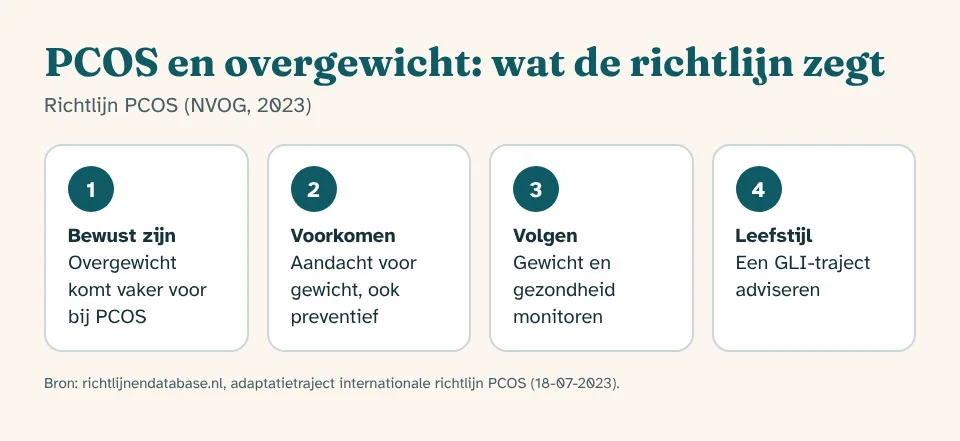
What the PCOS guideline recommends about lifestyle and weight
The guideline is written for healthcare providers, but its core is useful for you too. It does not say that you should start with a special PCOS diet. It says that attention to weight and lifestyle should be a standard part of care. The table sets out the recommendations.
| Recommendation | What it means | What you can do with it |
|---|---|---|
| Being aware of overweight | Overweight is more common with PCOS | Feel free to discuss your weight with your doctor |
| Prevention | Preventing weight gain | Start in good time, even with a few kilos |
| Monitoring | Tracking weight over time | Measure weight and waist circumference at set times |
| Combined lifestyle intervention (GLI) | Support with eating, exercise and behaviour | Ask your GP about a GLI |
A GLI is a combined lifestyle intervention (gecombineerde leefstijlinterventie): support with nutrition, exercise and behaviour together (Factsheet richtlijn overgewicht en obesitas, July 2023). How it works and who is eligible, you can read in the reimbursed lifestyle programme.
Losing weight with PCOS: what you can do yourself
You do not have to wait for a referral to take steps. Below are things that help everyone with overweight and that fit with what the guideline recommends. They are not medical advice for PCOS itself.
- Track your waist circumference. Because belly fat increases insulin resistance, your waist often says more than your weight alone.
- Choose an eating pattern you can keep up. Extreme diets often lead to a relapse. Small, consistent changes are easier to keep up for longer.
- Move every day. Walking, cycling or swimming. Regularity counts for more than intensity.
- Be kind to yourself. Losing weight with PCOS can go more slowly. That is not failure.
- Keep track of what you notice. Write down when you feel hungry, how you sleep and how you feel. That helps in conversations with your doctor and your coach.
Do you notice that your thoughts keep revolving around food? Then read more about constantly thinking about food and what you can do about it.
Coaching for PCOS and weight loss
Perhaps you have already tried quite a lot. You know the calorie tables, the apps and the gym memberships. What is often missing is someone who understands why things go differently for you and who does not start again with the same advice at every setback.
According to the provider, the team at Overgewicht Nederland B.V. is specially trained in PCOS. What that training involves, you can ask in the introductory meeting. According to the provider, the coaching lasts 12 months. In addition, according to the provider, you can go to Amersfoort for measurements such as an InBody measurement and a REE measurement of your energy use at rest.
What you can expect
From good coaching you can expect your whole situation to be looked at: your eating habits, your daily rhythm, your work and the symptoms PCOS gives you. How goals are set and who monitors your progress, you can ask in the introductory meeting. How the sessions take place, by phone, by video or in person, is agreed in the introductory meeting.
What you should not expect
A diagnosis, medication and advice about hormones, your cycle or a wish to have children are matters for your GP (huisarts) or gynaecologist, not for the coaching. And no one promises you a fixed number of kilos. The coaching is an addition to your medical care, not a replacement.
Questions for the introductory conversation
- What does your team's training in PCOS involve?
- How often do I speak to my coach and how?
- How do you coordinate with my GP or gynaecologist?
- What happens if my weight does not change for a while?
Do you have other medical problems as well as PCOS, such as diabetes or heart problems? Then read in complex obesity care how this is taken into account.
Prices of coaching for PCOS and overweight
That works out at €3.55 per day. According to Overgewicht Nederland B.V., the standard programme costs €108 per month by direct debit, or €1,295 per year. There is also a 15-month research programme for the same amount, with three extensive measurement sessions. Read about it in taking part in the research.
With doctor, coach and psychologist
Monthly
€3.55 per day
€108 per month
- 12 months of support
- Direct debit, no large lump sum
- Total €1,296 over 12 months
Yearly
€3.55 per day
€1,295 in one payment
- 12 months of support
- One payment in advance
- Equivalent to €107.92 per month
Research programme
€2.84 per day
€1,295 for 15 months
- 15 instead of 12 months of support
- Three extensive measurement sessions in Amersfoort
- Equivalent to €86.33 per month
Amounts according to Overgewicht Nederland B.V., reference date 21-10-2026. The price per day is a conversion (total divided by the number of days in the term); you pay per month or per year. Medication comes on top. You will receive the exact terms, such as the term and cancellation, in writing before you start.
When to see your GP or gynaecologist
Do you think you have PCOS, but has it never been diagnosed? Then go to your GP (huisarts). If you have questions about your cycle, a wish to have children, hormones or medication, discuss them with your GP or gynaecologist. Your GP can also refer you to a combined lifestyle intervention (GLI). How such a conversation goes is explained in the route via your GP.
Coaching that understands PCOS
Sign up for an introductory meeting. In it you discuss what you need and whether the programme is a good fit for you.
Sign up for PCOS coaching More about weight loss coaching
We value your privacy
Other forms of support
Weight loss during menopause
Your hormones change, and so does your body. Support that takes this into account.
Support alongside weight loss injections
Semaglutide, tirzepatide or liraglutide: protein, muscles, side effects and stopping.
Support with GLP-1
Using semaglutide or tirzepatide? Coaching on nutrition, muscles and stopping.
Food noise and cravings
Always thinking about food? Psychological support alongside lifestyle.
Complex medical situation
Diabetes, heart problems, medicines or previous surgery: care that keeps an eye on things.
Extra personal support
More contact, a dedicated coach and quick availability. Let us know what you are looking for.
Take part in research
15 months of support with three extensive measurements in Amersfoort.
PCOS and overweight: by town within 30 km of Amersfoort
For each town you will find the municipality's figures, the distance to the measurement location in Amersfoort and the questions people there ask.
- PCOS and overweight in Amersfoort
- PCOS and overweight in Hoogland
- PCOS and overweight in Hoevelaken
- PCOS and overweight in Leusden
- PCOS and overweight in Soest
- PCOS and overweight in Bunschoten
- PCOS and overweight in Nijkerk
- PCOS and overweight in Soesterberg
- PCOS and overweight in Baarn
- PCOS and overweight in Eemnes
- PCOS and overweight in Woudenberg
- PCOS and overweight in Scherpenzeel
- PCOS and overweight in Zeist
- PCOS and overweight in Bilthoven
- PCOS and overweight in Laren
- PCOS and overweight in Blaricum
- PCOS and overweight in De Bilt
- PCOS and overweight in Renswoude
- PCOS and overweight in Utrechtse Heuvelrug
- PCOS and overweight in Doorn
- PCOS and overweight in Driebergen-Rijsenburg
- PCOS and overweight in Hilversum
- PCOS and overweight in Putten
- PCOS and overweight in Voorthuizen
- PCOS and overweight in Huizen
- PCOS and overweight in Leersum
- PCOS and overweight in Barneveld
- PCOS and overweight in Lunteren
- PCOS and overweight in Bunnik
- PCOS and overweight in Bussum
- PCOS and overweight in Veenendaal
- PCOS and overweight in Zeewolde
- PCOS and overweight in Wijdemeren
- PCOS and overweight in Wijk bij Duurstede
- PCOS and overweight in Loosdrecht
- PCOS and overweight in Naarden
- PCOS and overweight in Gooise Meren
- PCOS and overweight in Almere
- PCOS and overweight in Ermelo
- PCOS and overweight in Houten
- PCOS and overweight in Utrecht
- PCOS and overweight in Maarssen
- PCOS and overweight in Nieuwegein
- PCOS and overweight in Rhenen
- PCOS and overweight in Stichtse Vecht
- PCOS and overweight in Buren
- PCOS and overweight in Ede
- PCOS and overweight in Harderwijk
- PCOS and overweight in Breukelen
- PCOS and overweight in Bennekom
- PCOS and overweight in De Meern
- PCOS and overweight in Vleuten
- PCOS and overweight in Culemborg
- PCOS and overweight in IJsselstein
- PCOS and overweight in Wageningen
What is included where? Four providers compared
| What do you get? | Overgewicht Nederland | Goodweigh | Wellis | Yazen |
|---|---|---|---|---|
| Consultation with a doctor by phone or video | Yes: | No: | Partly: | Not mentioned: |
| Gastric balloon as a route | Yes: | Not mentioned: | Not mentioned: | Not mentioned: |
| Unlimited contact via chat | Not mentioned: | Yes: | Not mentioned: | Not mentioned: |
| Everything via chat, without phone calls | No: | Yes: | Yes: | Partly: |
yes no (according to the provider itself) partly not mentioned. Reference date 22-10-2026. All differences and sources
Want to get started on your weight in a practical way? Then read how to lose weight with PCOS step by step, with nutrition, exercise, medication and coaching in line with the guideline.
Frequently asked questions about PCOS and overweight
Why is losing weight with PCOS so hard?
Losing weight with PCOS can be harder, partly because of belly fat and insulin resistance. The PCOS guideline states that central obesity increases insulin resistance. Your body then responds less well to insulin. That makes it harder, but not impossible. An approach you can keep up for a long time and someone who keeps an eye on things help you not to give up when progress is slow.
Are women with PCOS more often overweight?
Yes, overweight and obesity are more common in women with PCOS. That is stated in the Dutch PCOS guideline from 2023. According to the guideline, healthcare providers should be aware of this and pay attention to prevention and monitoring weight. Not every woman with PCOS is overweight, but the chance is greater.
What does the guideline recommend for PCOS and overweight?
The PCOS guideline recommends preventing weight gain, monitoring your weight and a combined lifestyle intervention (GLI). A GLI is support with nutrition, exercise and behaviour together. Your GP (huisarts) can refer you for it. Whether you are also eligible for other treatments, you can read in who is eligible for treatment.
Is there a special PCOS diet for weight loss?
The guideline we use as a source does not mention a special PCOS diet. It recommends a lifestyle approach with attention to nutrition, exercise and behaviour. So be careful with diets sold online as THE solution for PCOS. If you want help with your diet, ask your GP (huisarts) for a referral or look for coaching that looks at your eating pattern together with you.
What is insulin resistance in PCOS?
Insulin resistance means that your body responds less well to insulin, the hormone that regulates your blood sugar. According to the PCOS guideline, fat around your belly increases insulin resistance. Whether you have insulin resistance is determined by a doctor. A coach can, however, help you with a lifestyle that keeps an eye on your waist circumference.
Is the coach trained in PCOS?
According to Overgewicht Nederland B.V., the team is specially trained in PCOS. What that training involves exactly, you can ask in the introductory meeting. Medical questions about PCOS, hormones or your cycle are discussed with your GP (huisarts) or gynaecologist. The coaching is about eating, exercise and behaviour in your daily life.
Can I get coaching if I also take medication for PCOS?
Yes, lifestyle coaching can run alongside medication from your doctor. Your doctor decides about your medication, not the coaching. Do mention in the introductory meeting which medicines you take, so that your coach can take this into account. If you use GLP-1 medication, also read about coaching alongside GLP-1 medication.
What is the best way to lose weight with PCOS?
According to the PCOS guideline, a combined lifestyle approach works: attention to nutrition, exercise and behaviour at the same time, preferably in a combined lifestyle intervention (GLI). That guideline does not mention a miracle cure or special diet. Choose small changes you can keep up for years and monitor your waist circumference, because according to the guideline belly fat increases insulin resistance. Ask your GP (huisarts) whether you are eligible for a reimbursed GLI.
Can you get pregnant with PCOS and overweight?
That differs from woman to woman and only a doctor can assess it for you. If you have PCOS, overweight and a wish to have children, start with your GP (huisarts); they will refer you to a gynaecologist if necessary. The PCOS guideline asks healthcare providers to pay attention to your weight and recommends a lifestyle programme. Lifestyle coaching can run alongside a medical treatment, but never replaces it.
Can you reverse insulin resistance with PCOS?
Whether you can reduce insulin resistance with PCOS differs from person to person and is assessed by your doctor. The PCOS guideline states that fat around the belly increases insulin resistance, so less belly fat through a healthy lifestyle is a logical goal. Track your waist circumference with a tape measure and let your doctor decide how your blood values are checked. A measurement of your body fat percentage helps you follow your own progress.
What are the three features of PCOS?
With PCOS, a doctor usually looks at a combination of symptoms and tests, such as irregular or absent periods, signs of higher male hormones such as acne or extra hair growth, and the appearance of the ovaries on an ultrasound scan. The guideline we use as a source is about lifestyle and weight, not about the diagnosis. Only a doctor can determine whether you have PCOS. Overweight is not a standard part of it, but according to the guideline it is more common.
What should you not eat if you have PCOS?
The PCOS guideline we use as a source does not contain a list of forbidden foods. That guideline recommends a lifestyle approach combining nutrition, exercise and behaviour. In general, it helps to have fewer sugary drinks, snacks and large portions, without cutting out entire food groups. If you want personal dietary advice, ask your GP (huisarts) for a referral to a dietitian.
Can you have PCOS without being overweight?
Yes, women without overweight can also have PCOS. The PCOS guideline only says that overweight and obesity are more common in women with PCOS, not that this is always the case. Even at a healthy weight it can be worthwhile to pay attention to nutrition, exercise and your waist circumference. Discuss your symptoms and any treatment with your GP (huisarts) or gynaecologist.
What can you do if losing weight with PCOS is not working?
The first step is to ask your GP (huisarts) to look at your symptoms, your medication and the possibility of a combined lifestyle intervention (GLI). After that, it helps to shift your goal from the scales to habits and your waist circumference. If things keep going wrong because of thoughts about food, read about food noise and constantly thinking about food. Coaching can help you keep going when results take a long time to come.
At what age does PCOS usually start?
The sources we use do not give a fixed age. Symptoms such as an irregular cycle can already be noticeable in the teenage years, but the diagnosis is sometimes only made later, for example when someone wants to have children or visits the GP. If you recognise the symptoms, at whatever age, discuss them with your GP (huisarts). They can carry out tests or refer you to a gynaecologist.
Sources
- Richtlijnendatabase: Richtlijn PCOS, Obesitas en gewichtsreductie (18-07-2023)
- Richtlijnendatabase: Factsheet Richtlijn overgewicht en obesitas bij volwassenen (July 2023)
- Merrigan et al.: InBody vergeleken met DXA, Journal of Exercise and Nutrition (2022)
- Overgewicht Nederland B.V.: programme and price statement (21-10-2026)