You calculate your BMI by dividing your weight in kilos by your height in metres times your height in metres: someone who is 1.72 m tall and weighs 112 kilos has a BMI of 37.9. Enter your height and weight below. The calculator only works on your own device and does not save anything. Then you can read what your result means and what help fits it.
Underweight
Your BMI is low (underweight). Concerned about your health? Discuss it with your GP (huisarts).
Healthy weight
Your BMI is in the healthy range.
Overweight
You are overweight. Do you also have a large waist circumference, high blood pressure or diabetes? Then a combined lifestyle intervention (GLI) can help. Read about the GLI.
Obesity
You have obesity. Your GP (huisarts) can help you with a lifestyle programme. Do you have type 2 diabetes that is poorly controlled? Then surgery may also be an option. View the criteria.
Obesity
You have obesity. With conditions such as diabetes, high blood pressure or sleep apnoea, you may be eligible for medication or weight loss surgery (bariatric surgery). View the criteria.
Severe obesity
You have severe obesity. You may be eligible for weight loss surgery (bariatric surgery). View the criteria.
You see the thresholds for an Asian, Hindustani, Middle Eastern, African or African-Caribbean background (NHG-Standaard Obesitas, 2025). The BMI thresholds for weight loss surgery (30 with poorly controlled type 2 diabetes, 35 and 40) apply to everyone.
BMI does not tell the whole story. Muscle strength, age and background play a part. Your GP looks at the whole picture.
In brief
BMI = weight (kg) ÷ (height (m) × height (m)). From 25 it is called overweight, from 30 obesity (Richtlijn overgewicht en obesitas, 2023).
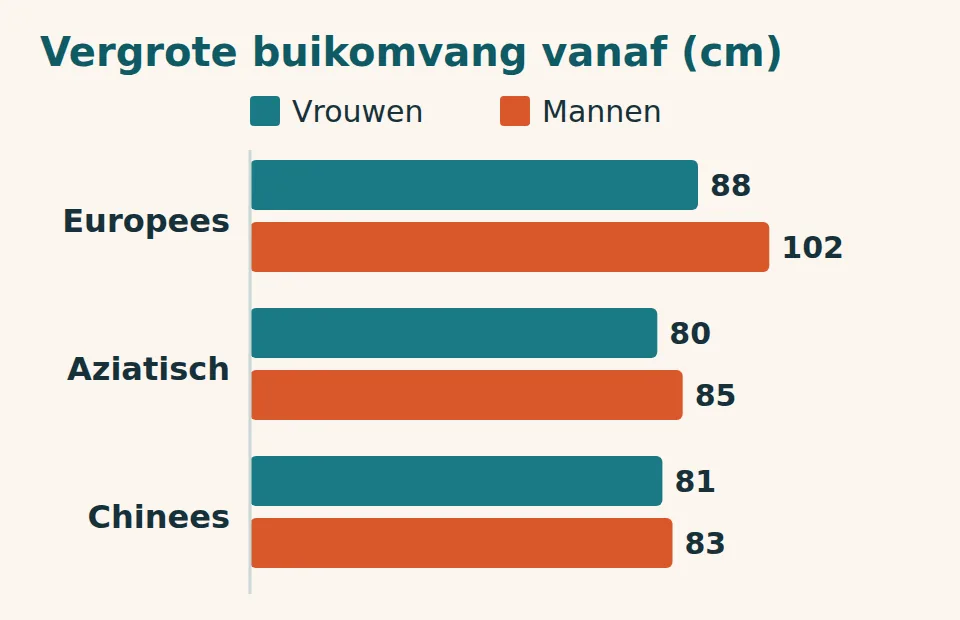
Also measure your waist circumference: from 88 cm (women) or 102 cm (men) it is increased for people of European origin; for other backgrounds the thresholds are lower (Richtlijnendatabase, 2023).
For people over 70, a different threshold applies: overweight at a BMI of 28 to 30 (Richtlijnendatabase, 2023).
The combined lifestyle intervention (GLI) is possible from a BMI of 25 with an increased waist circumference or a weight-related condition, and always from 35 (Zorginstituut Nederland, 2026).
How to calculate your BMI yourself
BMI stands for body mass index. The number shows whether your weight matches your height. The calculation takes three steps:
Convert your height to metres. 172 centimetres is 1.72 metres.
Multiply your height by itself. 1.72 × 1.72 = 2.958.
Divide your weight by that result. 112 ÷ 2.958 = 37.9.
Another example. Say you are 1.60 m and weigh 78 kilos. Then 1.60 × 1.60 = 2.56. Your BMI is 78 ÷ 2.56 = 30.5. That is just within obesity class I. At 1.60 m, obesity starts at 76.8 kilos (30 × 2.56) and the threshold for overweight is 64 kilos (25 × 2.56).
So you can also reverse the calculation: threshold × height × height = weight. That way you can see what a few kilos do. For someone who is 1.72 m, a BMI of 35 corresponds to 103.5 kilos (35 × 2.958) and a BMI of 40 to 118.3 kilos (40 × 2.958).
What does your result mean?
The multidisciplinary Richtlijn overgewicht en obesitas (2023) divides adults of European origin into the classes below. The last column shows what the BMI check recommends for that result.
BMI classes for adults up to 70 years, European origin
BMI
Class
What the check recommends
below 18.5
Underweight
Concerned about your health? Discuss it with your GP.
18.5 to 25
Healthy weight
No action needed for your weight.
25 to 30
Overweight
With a large waist circumference, high blood pressure or diabetes, the GLI can help.
30 to 35
Obesity class I
Ask your GP about the GLI. With poorly controlled type 2 diabetes, surgery may also come into consideration.
35 to 40
Obesity class II
With conditions such as diabetes, high blood pressure or sleep apnoea, medication or surgery may be an option.
40 or higher
Obesity class III
Weight loss surgery can be an option, after previous treatment.
Source for classes: Richtlijnendatabase, Richtlijn overgewicht en obesitas bij volwassenen (10-07-2023). Advice: NHG-Standaard Obesitas (October 2025).
For people with an Asian (including Hindustani), Middle Eastern, African or African-Caribbean background, the same BMI comes with a higher risk of diabetes and cardiovascular disease. That is why GPs use lower thresholds for them (NHG-Standaard Obesitas, October 2025). In the BMI check you choose the matching profile. That choice stays on your own device.
BMI thresholds for adults by background. Source: NHG-Standaard Obesitas (October 2025).
Class
General
Asian, Hindustani, Middle Eastern, African or African-Caribbean
Overweight
25 to 30
23 to 27.5
Obesity
30 to 35
27.5 to 32.5
Severe obesity
35 to 40
32.5 to 37.5
Very severe obesity
40 or higher
37.5 or higher
For some backgrounds the waist thresholds are also lower (Dutch guideline on overweight and obesity, 2023). That is why the check also shows your waist-to-height ratio (WHtR): your waist divided by your height. From 0.5 the risk is increased, from 0.6 it is high (NICE guideline NG246, 2025). This measure works for everyone, whatever their background. The BMI thresholds for weight loss surgery are the same for everyone.
Measuring waist circumference
Fat around your belly and organs is more strongly linked to diabetes and cardiovascular disease than fat on your hips or legs. That is why the guideline recommends measuring waist circumference in all adults with a BMI of 25 or more. This is how to do it:
Stand up straight and breathe out calmly.
Place the tape measure on your bare skin.
Measure halfway between your lowest rib and the top of your pelvis. That is often just above your navel.
Do not pull the tape tight and keep it straight all the way round.
Which measurement counts as increased depends on your background. The guideline gives these thresholds:
Thresholds for an increased waist circumference by background (adults)
Background
Women
Men
European
88 cm or more (risk already rises from 80 cm)
102 cm or more (risk already rises from 94 cm)
Asian
80 cm
85 cm
Chinese
81 cm
83 cm
African (sub-Saharan)
80 cm
94 cm
South American
83 to 90 cm
88 to 94 cm
Source: Richtlijnendatabase, Richtlijn overgewicht en obesitas bij volwassenen, module uitkomstmaten (10-07-2023).
Threshold values for an increased waist circumference in centimetres, by background, for women and men. Source: Richtlijn overgewicht en obesitas bij volwassenen (2023).
BMI is quick and free, but it remains a rough measure. It does not know whether your weight consists of fat or muscle, nor where the fat is. Pay particular attention in these situations:
A lot of muscle mass. People who do a lot of strength training can have a BMI above 25 without much fat. Waist circumference then says more.
Aged 70 or over. According to the guideline, overweight in people over 70 only starts at a BMI of 28, up to 30. A slightly higher BMI is less unfavourable at that age.
Non-European background. Lower cut-off values apply to other backgrounds; for these, the guideline refers to the Canadian guideline. The NVVH guideline (2020), for example, mentions surgery for people with an Asian or Hindustani background from a BMI of 35. For medication too, the thresholds are lower for some groups (Farmacotherapeutisch Kompas, 2026).
Pregnancy. Your weight then changes because of the pregnancy itself. BMI says little during that period.
Children and teenagers. Thresholds for them depend on age and sex. This calculator is for adults.
That is why your GP never looks at BMI alone. Your waist circumference, your symptoms, your age and your background also count. Together they give a fairer picture than a single number.
Your health risk: BMI, waist and symptoms together
Healthcare professionals use a table for weight-related health risk, GGR for short (gewichtsgerelateerd gezondheidsrisico). It combines your BMI with your waist circumference and with weight-related conditions. Think of diabetes, cardiovascular disease, sleep apnoea, osteoarthritis and mental health problems. The result determines which care is appropriate.
Weight-related health risk (GGR) and appropriate care
BMI
Without increased waist or condition
With increased waist circumference
With a weight-related disease
25 to 30
Slightly increased: advice on a healthy lifestyle
Moderately increased: basic GLI
Moderately increased: basic GLI with additional care
30 to 35
Moderately increased: advice on a healthy lifestyle
Highly increased: basic GLI
Highly increased: basic GLI with additional care
35 to 40
Highly increased: basic GLI
Extremely increased: specialised GLI
Extremely increased: specialised GLI
40 or higher
Extremely increased: specialised GLI
Extremely increased: specialised GLI
Extremely increased: specialised GLI
Source: Richtlijnendatabase, table 13.1 of the Richtlijn overgewicht en obesitas (2023). We were unable to check whether the NHG-Standaard of October 2025 uses exactly this table. The thresholds differ for people over 70 and people of non-European descent.
Example. Say you are a woman of 1.65 m, you weigh 80 kilos and your waist measures 92 cm. Your BMI is 80 ÷ (1.65 × 1.65) = 80 ÷ 2.7225 = 29.4. That is overweight. Because your waist circumference is above 88 cm, your weight-related health risk (GGR) is moderately increased. You then qualify for a combined lifestyle intervention (GLI) covered by your insurance, even without obesity.
What can you do now?
Your result is not a diagnosis, but it is a good starting point for a conversation. What you do next depends on your BMI, your waist and your symptoms:
BMI 25 to 35 with a large waist or a disease, or BMI 35 or higher: ask your GP (huisarts) or practice nurse (POH) about the combined lifestyle intervention (GLI). It lasts 24 months, is covered by basic health insurance (basisverzekering) and is not deducted from your compulsory excess (eigen risico) (Zorginstituut Nederland, 2026).
BMI 35 or higher with a disease, or BMI 40 or higher, after one year of GLI with less than 10% weight loss: your GP (huisarts) may consider medication (NHG-Standaard, October 2025). Read what is known about weight loss medication and when to stop taking it.
BMI 40 or higher, BMI 35 or higher with a serious disease, or BMI 30 or higher with poorly controlled type 2 diabetes: if previous treatment did not help enough, weight loss surgery (sleeve or bypass) may be an option.
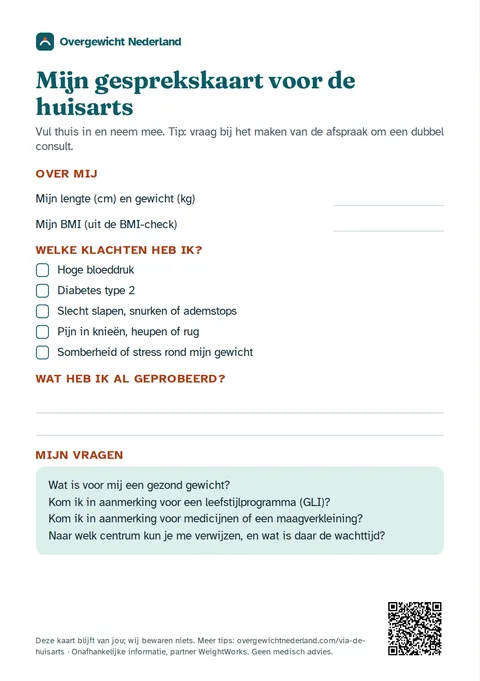
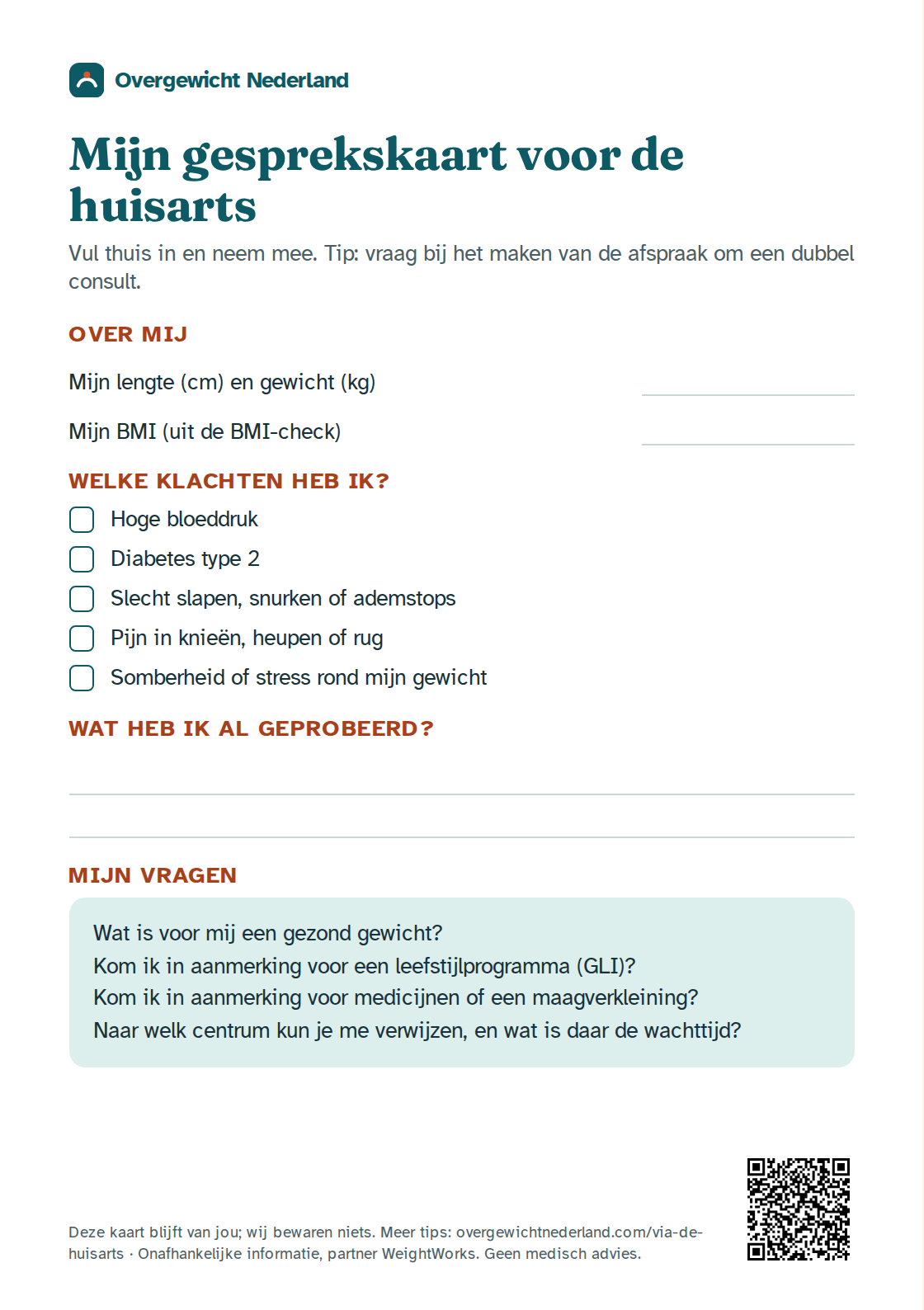
Fill it in before your appointment: what you have already tried, your symptoms and your questions. Take it with you to your GP (huisarts) or practice nurse (POH).
Frequently asked questions about calculating your BMI
How do I calculate my BMI without a calculator?
You divide your weight in kilos by your height in metres multiplied by your height in metres. At 1.80 m and 100 kilos, that is 100 ÷ (1.80 × 1.80) = 100 ÷ 3.24 = 30.9. Use the calculator on your phone for the last step. What the result means is shown in the table of BMI classes on this page.
Does the BMI check store my height and weight?
No, the BMI check does not store or send anything. The calculation only happens in the browser on your own phone or computer. When you close the page, the numbers are gone. Read how we handle data in this site's privacy statement.
Is a BMI of 30 already obesity?
Yes, in adults of European descent obesity starts at a BMI of exactly 30. Up to 35 this is called class I obesity. At that level the combined lifestyle intervention (GLI) is often the first step, especially if your waist circumference is large. Read what you can expect from the GLI with your GP or lifestyle coach.
What does a BMI of 35 mean?
A BMI of 35 is class II obesity. If you also have a disease related to your weight, such as diabetes, high blood pressure or sleep apnoea, medication or surgery may come into view after earlier treatment. See the criteria for weight loss surgery at BMI 35 and discuss them with your GP (huisarts).
What does a BMI of 40 or higher mean?
A BMI of 40 or higher is class III obesity, sometimes called morbid obesity. Your health risk is then extremely increased, even without other diseases. If earlier treatments have not helped enough, weight loss surgery may be an option. Read what weight loss surgery involves.
Is BMI accurate if I have a lot of muscle?
Not always. Muscle is heavy, so athletes with a lot of muscle mass can have a BMI above 25 without much fat. In that case, measure your waist circumference. If it stays below the threshold for your background, your health risk is probably lower than your BMI suggests. If in doubt, ask your GP (huisarts).
Why is my BMI at the GP different from at home?
Small differences are normal. Your weight fluctuates during the day, and clothes and shoes weigh one to two kilos. Scales also differ. So weigh yourself at home at a fixed time, for example in the morning without clothes, and always use the same scales. The trend over weeks says more than a single measurement.
What waist circumference is too large with an African background?
For people of sub-Saharan African descent, waist circumference is considered large from 80 cm in women and 94 cm in men, according to the 2023 guideline. For men, that is lower than the 102 cm that applies to people of European descent. Discuss your result with your GP (huisarts). See also the criteria for weight loss surgery.
How do I measure my waist circumference correctly?
Measure standing up, on bare skin, halfway between your lowest rib and the top of your pelvis. Breathe out calmly and do not pull the tape tight. Measure twice and take the average. For women of European origin, 88 cm or more is increased; for men, 102 cm or more.
Am I eligible for the GLI with a BMI of 27?
It can, if your waist circumference is large or if you have a disease related to your weight, such as high blood pressure. With only a BMI of 27 and no other risks, the GLI is usually not needed. Your GP (huisarts) or practice nurse (POH) will assess this. Read how to raise this with your GP.
Why does the check say something different from my GP?
The check only looks at your height and weight; your GP (huisarts) looks at more. They also take into account your waist circumference, your age, your descent and diseases such as high blood pressure. That is why your GP's advice may turn out stricter or milder. Read in the overview of obesity treatments which care fits which level of risk.
Should I take my BMI result to the GP?
Yes, that helps. Write down your height, weight, BMI and waist circumference, together with your symptoms and what you have already tried. That way your GP (huisarts) can see more quickly what fits. The conversation card has boxes for this. Download it via the free downloads, such as the conversation card.
How often should I recalculate my BMI?
There is no fixed rule for this. Preferably do not weigh yourself every day, because your weight fluctuates from day to day. Once a month at the same time gives a calmer picture. If you are following a treatment, agree with your practitioner how often you measure.
Can I use the BMI check for my child?
No, this calculator is only for adults. For children and teenagers, the thresholds depend on age and sex. If you are worried about your child's weight, discuss it with the youth health doctor (jeugdarts) or the GP (huisarts). They use growth charts that suit your child.
How does my BMI change if I lose 5 kilos?
That depends on your height. At 1.72 m, 5 kilos makes a difference of about 1.7 BMI points: 5 ÷ 2.958 = 1.69. So going from 112 to 107 kilos takes you from 37.9 to 36.2. Even without dropping a class, that kind of weight loss already brings health benefits. Read more about the consequences of overweight and obesity.
Sources
NHG-Standaard Obesitas, October 2025: different BMI reference values by migration background
NICE, Overweight and obesity management (NG246), 2025: waist-to-height ratio 0.5 and 0.6