Weight loss during the menopause
Losing weight during the menopause can feel like rowing against the current. You are not eating any differently than before, but the scales and your waistband tell a different story. That is not due to a lack of willpower: your body really is changing. On this page, you can read what happens according to the Voedingscentrum (Netherlands Nutrition Centre) and Thuisarts, what you can do yourself and when support helps.
Transparency: for the programme, this site refers you to Overgewicht Nederland B.V., based in Amersfoort. We pass on the details from the form to them. The prices come from the provider itself (as of 21-10-2026). Everything about this site and the programme.
In brief
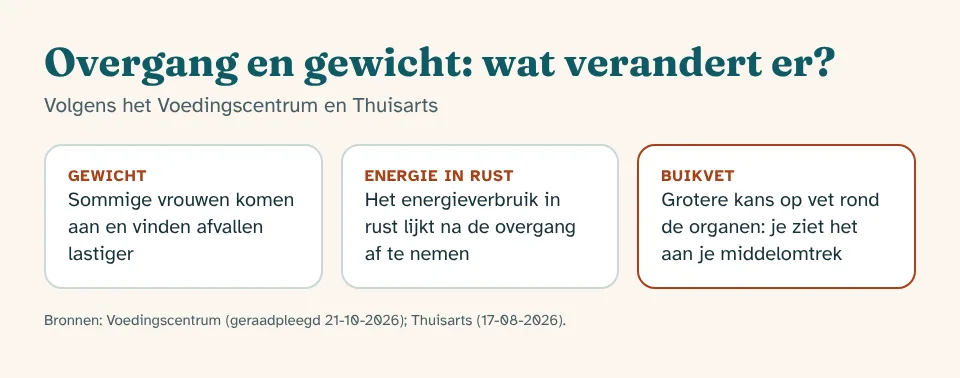
- Some women gain weight during the menopause and find it difficult to lose weight (Voedingscentrum, accessed 21-10-2026).
- Energy use at rest appears to decrease after the menopause (Voedingscentrum, accessed 21-10-2026).
- Women going through the menopause have a greater chance of more fat around the organs in the abdomen, visible as a larger waist circumference (Voedingscentrum, accessed 21-10-2026).
- Thuisarts lists weight gain as a symptom of the menopause and advises checking whether you have a healthy weight (Thuisarts, 17-08-2026).
- According to Overgewicht Nederland B.V., almost half of their coaching sessions are about hormones and the menopause (provider information, 21-10-2026).
Menopause and weight: what changes in your body
The menopause is the period in which your ovaries slowly stop working and your hormone balance changes. You notice this through hot flushes, poor sleep or mood swings. But also in your weight. Thuisarts, the GPs' public information site, explicitly lists weight gain among the symptoms that the menopause can cause. The advice there is to check whether you have a healthy weight (Thuisarts, 17-08-2026).
The Voedingscentrum (Netherlands Nutrition Centre) is also clear about it: some women gain weight during the menopause and find it difficult to lose it again. One of the reasons is that energy use at rest appears to decrease after the menopause (Voedingscentrum, accessed 21-10-2026). So your body uses less energy while you are doing nothing. If you eat exactly the same as before, that difference can slowly add up.
That is important to know, because it explains why old tricks sometimes no longer work. What you did in your thirties to lose a few kilos may now have less effect. That is not failure. It is a signal that your approach needs to change along with your body. If you want to know where you stand first, calculate your BMI with the BMI calculator on this site.
| What changes | What you notice | What you can do yourself | Where support helps |
|---|---|---|---|
| Energy use at rest appears lower | You gain weight while eating the same | Take a critical look at portions and snacks | Choosing an eating pattern together that suits you now |
| Greater chance of belly fat | Larger waist circumference | Measure your waist, not just your weight | Tracking progress and adjusting course |
| Losing weight is harder | Old approach works less well | No crash diet, choose what you can keep up | Dealing with motivation and relapse |
| Weight gain as a symptom | You feel less fit | Check whether you have a healthy weight | Setting achievable goals |
Belly fat during the menopause: why your waist grows
Many women first notice it in their clothes. Trousers feel tighter around the waist, even when the scales barely move. That matches what the Voedingscentrum (Netherlands Nutrition Centre) writes: women going through the menopause have a greater chance of more fat around the organs in the abdomen. You notice this as a larger waist circumference (Voedingscentrum, accessed 21-10-2026).
Fat around the organs is different from fat under the skin. It sits deeper and you do not see it directly. That is why your waist circumference is a useful measure alongside your weight. Measure it at a fixed time, for example in the morning, with an ordinary tape measure, always in the same place. Write it down and do not measure more often than once every few weeks. That way you see the trend without getting worried every day by small fluctuations.
If you want to know more precisely how your body is made up, a measurement of your body fat percentage can tell you more than the scales. Read under the InBody measurement in Amersfoort what such a measurement does and does not show. And because your energy use at rest appears to fall during the menopause, a measurement of your resting metabolism is also a way to discover how much energy your body really uses now.
Weight gain during the menopause: what you can do yourself
You do not have to wait for a programme to get started. There are a few things you can pick up today. They are not spectacular, but that is exactly why you can keep them up.
- Take an honest look at your portions. If your body uses less, a slightly smaller plate often works better than a strict diet.
- Pay attention to what you drink. Wine, soft drinks and juice count too, but they do not make you feel full.
- Move a little every day. Walking, cycling or taking the stairs. Something you enjoy is something you will keep up longer.
- Make sure you get rest. Poor sleep due to hot flushes makes it harder to make healthy choices. Discuss sleep problems with your GP.
- Track your waist circumference. In this phase, that often says more than kilos alone.
Do you notice that you keep thinking about food or that hunger dominates your day? Then it helps to know what food noise and cravings are. And if you want to see the bigger picture first, read what overweight and obesity mean exactly and which risks are involved.
Support with weight loss during the menopausal years
Some women manage fine losing weight on their own. Others keep running into the same thing: a good start, then a busy week, a bad night and the old habits are back. Support is there for that moment. Not to tell you what to eat, but to work out together what fits into your life and to support you when things are tough for a while.
According to Overgewicht Nederland B.V., almost half of their coaching sessions are about hormones and the menopause in women. So the subject comes up often in the sessions. According to the provider, the support lasts 12 months. A year gives you time to get through the ups and downs.
What you can expect from support
From good support, you can expect your situation to be looked at: your eating pattern, your work, your sleep and the symptoms you have. In the introductory meeting, ask how this works in this programme, how goals are set and who tracks your progress. How the sessions take place, by phone, by video or in person, is something you agree on in the introductory meeting.
What you should not expect
Support is not medical treatment of the menopause. Advice about hormone therapy or medication belongs with your GP, not with the support programme. And no one promises you a fixed number of kilos. Every woman responds differently and, to be honest, no one knows in advance how it will go for you.
Questions for the introductory conversation
- How often do I talk to my coach and in what way?
- How do you deal with symptoms such as poor sleep or hot flushes?
- What do we do if I see no progress for a few weeks?
- How do you coordinate with my GP if that is needed?
If you want to know how the programme is set up in general, read more about personal support with overweight. If you are looking for more contact, take a look at extra personal support. We regularly hear that people want more contact.
Cost of support with weight during the menopause
That works out at €3.55 per day. According to Overgewicht Nederland B.V., the standard programme costs €1,295 per year, or €108 per month by direct debit. There is also a 15-month research programme for the same amount, with three extensive measurement sessions in Amersfoort. You can read more about this under the 15-month research programme.
With doctor, coach and psychologist
Monthly
€3.55 per day
€108 per month
- 12 months of support
- Direct debit, no large lump sum
- Total €1,296 over 12 months
Yearly
€3.55 per day
€1,295 in one payment
- 12 months of support
- One payment in advance
- Equivalent to €107.92 per month
Research programme
€2.84 per day
€1,295 for 15 months
- 15 instead of 12 months of support
- Three extensive measurement sessions in Amersfoort
- Equivalent to €86.33 per month
Amounts according to Overgewicht Nederland B.V., reference date 21-10-2026. The price per day is a conversion (total divided by the number of days in the term); you pay per month or per year. Medication comes on top. You will receive the exact terms, such as the term and cancellation, in writing before you start.
When to see your GP
See your GP (huisarts) if your menopause symptoms have a major impact on your daily life, if you are unsure about hormone therapy or if you are gaining weight quickly and for no clear reason. Your GP can also check whether you are eligible for the reimbursed lifestyle programme. Read more about this under the combined lifestyle intervention (GLI) and under how the conversation with your GP works.
Ready to get started?
Sign up and schedule an introductory meeting. In it, you discuss what you need in this phase of your life, with no obligation in advance.
Sign up for support during the menopause How signing up works
We value your privacy
Other forms of support
PCOS and overweight
Insulin resistance and a cycle that does not cooperate: targeted support.
Support alongside weight loss injections
Semaglutide, tirzepatide or liraglutide: protein, muscles, side effects and stopping.
Support with GLP-1
Using semaglutide or tirzepatide? Coaching on nutrition, muscles and stopping.
Food noise and cravings
Always thinking about food? Psychological support alongside lifestyle.
Complex medical situation
Diabetes, heart problems, medicines or previous surgery: care that keeps an eye on things.
Extra personal support
More contact, a dedicated coach and quick availability. Let us know what you are looking for.
Take part in research
15 months of support with three extensive measurements in Amersfoort.
Weight loss during the menopause: by town within 30 km of Amersfoort
For each town you will find the municipality's figures, the distance to the measurement location in Amersfoort and the questions people there ask.
- Weight loss during the menopause in Amersfoort
- Weight loss during the menopause in Hoogland
- Weight loss during the menopause in Hoevelaken
- Weight loss during the menopause in Leusden
- Weight loss during the menopause in Soest
- Weight loss during the menopause in Bunschoten
- Weight loss during the menopause in Nijkerk
- Weight loss during the menopause in Soesterberg
- Weight loss during the menopause in Baarn
- Weight loss during the menopause in Eemnes
- Weight loss during the menopause in Woudenberg
- Weight loss during the menopause in Scherpenzeel
- Weight loss during the menopause in Zeist
- Weight loss during the menopause in Bilthoven
- Weight loss during the menopause in Laren
- Weight loss during the menopause in Blaricum
- Weight loss during the menopause in De Bilt
- Weight loss during the menopause in Renswoude
- Weight loss during the menopause in Utrechtse Heuvelrug
- Weight loss during the menopause in Doorn
- Weight loss during the menopause in Driebergen-Rijsenburg
- Weight loss during the menopause in Hilversum
- Weight loss during the menopause in Putten
- Weight loss during the menopause in Voorthuizen
- Weight loss during the menopause in Huizen
- Weight loss during the menopause in Leersum
- Weight loss during the menopause in Barneveld
- Weight loss during the menopause in Lunteren
- Weight loss during the menopause in Bunnik
- Weight loss during the menopause in Bussum
- Weight loss during the menopause in Veenendaal
- Weight loss during the menopause in Zeewolde
- Weight loss during the menopause in Wijdemeren
- Weight loss during the menopause in Wijk bij Duurstede
- Weight loss during the menopause in Loosdrecht
- Weight loss during the menopause in Naarden
- Weight loss during the menopause in Gooise Meren
- Weight loss during the menopause in Almere
- Weight loss during the menopause in Ermelo
- Weight loss during the menopause in Houten
- Weight loss during the menopause in Utrecht
- Weight loss during the menopause in Maarssen
- Weight loss during the menopause in Nieuwegein
- Weight loss during the menopause in Rhenen
- Weight loss during the menopause in Stichtse Vecht
- Weight loss during the menopause in Buren
- Weight loss during the menopause in Ede
- Weight loss during the menopause in Harderwijk
- Weight loss during the menopause in Breukelen
- Weight loss during the menopause in Bennekom
- Weight loss during the menopause in De Meern
- Weight loss during the menopause in Vleuten
- Weight loss during the menopause in Culemborg
- Weight loss during the menopause in IJsselstein
- Weight loss during the menopause in Wageningen
Compare at a glance
| What do you get? | Overgewicht Nederland | Goodweigh | Wellis | Yazen |
|---|---|---|---|---|
| Consultation with a doctor by phone or video | Yes: | No: | Partly: | Not mentioned: |
| Blood tests | Partly: | Not mentioned: | Not mentioned: | Yes: |
| Unlimited contact via chat | Not mentioned: | Yes: | Not mentioned: | Not mentioned: |
| Everything via chat, without phone calls | No: | Yes: | Yes: | Partly: |
yes no (according to the provider itself) partly not mentioned. Reference date 22-10-2026. View the cost calculator
Frequently asked questions about weight loss during the menopause
Why am I gaining weight during the menopause when I am not eating more?
One possible explanation is that your energy use at rest appears to decrease after the menopause. That is what the Voedingscentrum (Netherlands Nutrition Centre) writes. If you eat as much as before, your body has more left over and your weight can slowly rise. That is not a matter of willpower. It calls for an approach that suits how your body works now, for example slightly smaller portions and daily exercise.
Is losing weight during the menopause harder?
For some women, yes. The Voedingscentrum (Netherlands Nutrition Centre) writes that some women gain weight and find it difficult to lose it again. What used to work sometimes has less effect now. That is why it helps to adjust your approach and to have someone who keeps an eye on things with you, as with support with overweight.
How do I get rid of belly fat during the menopause?
There is no way to remove only belly fat. What does help is adjusting your overall eating pattern and moving more, so that your body starts using fat. Track your waist circumference with a tape measure, because the Voedingscentrum (Netherlands Nutrition Centre) mentions more fat around the organs in the abdomen as typical of the menopause. That way you can see whether your approach is working, even if the scales stand still.
Is it possible to lose 10 kilos during the menopause?
It can be done, but no one can tell you in advance whether ten kilos is achievable for you. The Voedingscentrum (Netherlands Nutrition Centre) writes that some women gain weight during the menopause and find it hard to lose it again. How much you can lose depends on your starting weight, your health and what you can keep up. Discuss an achievable goal with your GP or in the introductory meeting, and track your waist circumference as well as your weight.
Is belly fat during the menopause caused by hormones?
Belly fat is linked to the changes of the menopause, and that is precisely the period in which your hormone balance changes. The Voedingscentrum (Netherlands Nutrition Centre) writes that women going through the menopause have a greater chance of more fat around the organs in the abdomen. Whether hormone therapy makes sense for you is something you discuss with your GP; that is outside the scope of the support programme. The support focuses on eating, exercise, sleep and behaviour.
Should I eat differently during the menopause?
Often a little, yes. Because your energy use at rest appears to fall, a slightly smaller amount of food usually suits your body better. A strict diet is not necessary and is rarely sustainable. Start with portions, snacks and drinks. With support, you look together at which small adjustments work well in your week.
Can I get support during the menopause if I do not have obesity?
You discuss that in the introductory meeting. This site does not list any BMI limits for the programme from Overgewicht Nederland B.V., so just ask. Even a few extra kilos during the menopause can be a reason to seek help. Together you look at whether the support suits your situation and goals. You sign up via the sign-up page for support.
Does the coach also address bad nights and hot flushes?
Poor sleep affects your lifestyle, so you can discuss it in the sessions. According to Overgewicht Nederland B.V., almost half of the coaching sessions are about hormones and the menopause. Medical treatment of hot flushes or sleep problems does belong with your GP. In the introductory meeting, ask how the support helps you organise your eating pattern and daily routine so that a bad night does not determine your whole day.
Can I get free help with weight loss during the menopause?
About €3.55 per day. The programme from Overgewicht Nederland B.V. is not free: according to the provider, it costs €108 per month or €1,295 per year, and we know nothing about reimbursement by your health insurer. If you want a reimbursed programme, ask your GP (huisarts) about the combined lifestyle intervention (GLI); its own conditions apply. You can find free, reliable information about the menopause at Thuisarts and the Voedingscentrum (Netherlands Nutrition Centre).
How long does it take to see results when losing weight during the menopause?
That differs from person to person and no one can promise you a timeframe. Especially during the menopause, it often goes more slowly than you are used to. According to the provider, the support lasts 12 months, or 15 months in the research programme. That gives you time to build habits that last, even if a week is disappointing. Measure your progress by more than just weight.
What really helps with weight loss during the menopause?
What really helps is an approach that suits how your body works now and that you can keep up for a long time. Because your energy use at rest appears to fall after the menopause, slightly smaller portions often work better than a strict diet. Daily exercise, good sleep and paying attention to what you drink also count. There is no single fixed approach for everyone. Start with the tips for weight loss during the menopause.
How do you lose weight after the menopause?
After the menopause, you lose weight in the same way as before, only often with more patience: eat slightly less than you use and move more. The Voedingscentrum (Netherlands Nutrition Centre) writes that energy use at rest appears to decrease after the menopause, so your old portions may now be too large. If you want to know what your body uses at rest, an REE measurement in Amersfoort gives you insight into that.
Does belly fat disappear by itself after the menopause?
You cannot count on that. The sources we use give no indication that belly fat disappears by itself after the menopause. In fact, the Voedingscentrum (Netherlands Nutrition Centre) notes that energy use at rest appears to decrease after the menopause. If you want to lose belly fat, a suitable eating pattern and more exercise help. Measure your waist circumference every few weeks, so you can see whether your approach is working.
Which exercises help against belly fat during the menopause?
There is no exercise that removes only belly fat. Abdominal exercises make your abdominal muscles stronger, but do not make the fat around them disappear in a targeted way. What does help is moving more in general, such as walking, cycling or swimming, together with exercises for the muscles throughout your body and a suitable eating pattern. If you have problems with your heart, joints or back, consult your GP (huisarts) first.
What are people's experiences with weight loss during the menopause?
Experiences vary greatly from woman to woman, and we do not share results or reviews of the programme because we do not know them. What is recognisable is what the Voedingscentrum (Netherlands Nutrition Centre) writes: some women gain weight during the menopause and find losing weight difficult. If you want to read how others deal with overweight, look at experiences of others with obesity. Feel free to ask in the introductory meeting how the support works in practice.
Sources
- Voedingscentrum: Moet ik anders gaan eten tijdens de overgang? (accessed 21-10-2026)
- Thuisarts: Ik wil goed omgaan met klachten door de overgang (17-08-2026)
- Overgewicht Nederland B.V.: programme and price statement (21-10-2026)