Weight loss medication
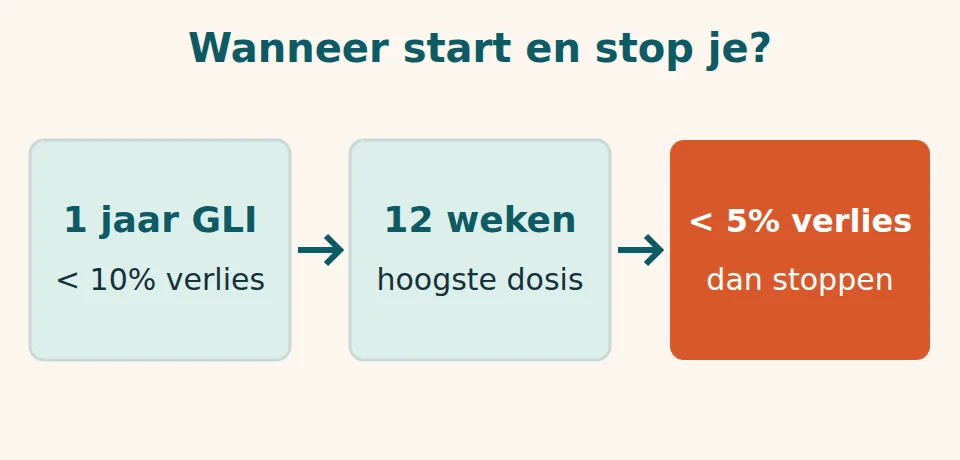
According to the NHG-Standaard Obesitas (October 2025), weight loss medication is an addition to a lifestyle programme, not a replacement. Your GP (huisarts) only considers it with a BMI of 35 or higher plus a weight-related condition, or a BMI of 40 or higher, if you have lost less than 10% after at least a year of combined lifestyle intervention (GLI). If a medicine does not work well enough after 12 weeks on the highest dose, you stop taking it.
In brief
- The preferred medicines are liraglutide, semaglutide and naltrexone/bupropion; orlistat is not recommended (Farmacotherapeutisch Kompas, reference date 25-09-2026).
- Stopping rule: less than 5% weight loss after 12 weeks on the maximum tolerated dose (Farmacotherapeutisch Kompas, update August 2026).
- Liraglutide and naltrexone/bupropion are reimbursed under certain conditions, semaglutide is not. The Zorginstituut has yet to decide on new reimbursement (reference date September 2026).
- In the STEP 1 study, people taking semaglutide lost on average about 15% after 68 weeks, compared with 2.4% with a placebo (Wilding et al., 2021).
No advertising: this is general information. This page names active substances, not recommended brands. Brand names are only included so you can recognise them. In the Netherlands, there is a ban on advertising prescription medicines. Whether a medicine suits you is something to discuss with your GP (huisarts).
The place of medication in treatment
Weight loss medication is all over the news. GPs notice this too: in 2025 the number of people known to their GP (huisarts) as having overweight or obesity rose by 39%, and Nivel points, among other things, to the media attention for these medicines (Nivel, 08-07-2026). Even so, the revised NHG-Standaard deliberately gives medication a limited place. Lifestyle remains the cornerstone; medication only comes after a year of lifestyle treatment with too little result (Obesitas Platform, 13-10-2025). The Dutch Association of Dietitians sums it up as "additional provision" (NVD, 30-10-2025).
That does not mean medicines do not work. It means they work best as part of a bigger plan, with a lifestyle coach, check-ups with the GP and a clear moment at which you assess whether it makes sense. How the steps fit together can be read in the overview of all obesity treatments.
When does the GP prescribe a medicine?
The NHG-Standaard of October 2025 names three conditions that must all apply (VoedingOnline, 13-10-2025):
- Your BMI. A BMI of 35 or higher with a condition related to your weight, such as osteoarthritis or heart problems, or a BMI of 40 or higher.
- Lifestyle first. You have taken part with motivation in a combined lifestyle intervention (GLI) for at least a year. You can read more about this at the reimbursed GLI lifestyle programme.
- Too little result. You have lost less than 10% in that year. The GLI continues when you start medication.
In secondary care, for example with an internist, the thresholds are sometimes lower: from a BMI of 27 with a large waist circumference or a condition, or from 35, after insufficient effect from a GLI. For people with an Asian, Middle Eastern, African or Afro-Caribbean background, lower BMI thresholds apply there (Farmacotherapeutisch Kompas, reference date 25-09-2026).
Note: a medicine's package leaflet often mentions broader thresholds than the GP uses. So the fact that a medicine is registered for your BMI does not mean that your GP will prescribe it or that your insurer will pay for it. You can see your own BMI with the BMI calculator that stores nothing.
The preferred medicines at a glance
The Farmacotherapeutisch Kompas, which the NHG-Standaard follows, names three preferred medicines. Two of them resemble GLP-1, a hormone that your gut produces after eating and that gives your brain a feeling of fullness. The third acts on appetite and reward in the brain.
| Active substance | Form | Place according to the guideline | Reimbursed for obesity? | Brand name (for recognition) |
|---|---|---|---|---|
| Liraglutide | Injection, every day | Preferred medicine | Yes, under certain conditions | Saxenda |
| Semaglutide | Injection, every week | Preferred medicine | No; new assessment announced | Wegovy |
| Naltrexone/bupropion | Tablets | Preferred medicine | Yes, under certain conditions | Mysimba |
| Tirzepatide | Injection, every week | Advised against in primary care | No; assessment ongoing | Mounjaro |
| Orlistat | Capsules | Not recommended | n.v.t. | – |
How much weight you lose varies greatly from person to person. A well-researched example is the STEP 1 study: participants who received semaglutide in addition to lifestyle advice were on average about 15% lighter after 68 weeks; the group with a placebo and the same advice about 2.4% (Wilding et al., 2021). In a follow-up study, on average about two thirds of the weight lost came back within a year of stopping (Wilding et al., 2022). So a medicine mainly works as long as you use it.
The stopping rule after 12 weeks
The dose is built up in steps so that your body can get used to it. Once you are on the highest dose you tolerate well, the clock starts. The Farmacotherapeutisch Kompas says: stop at less than 5% weight loss after 12 weeks on the maximum tolerated dose (update August 2026). Thuisarts explains that the medicine then does not work for you (Thuisarts, 04-11-2025).
Worked example
Suppose you are 1.80 metres tall and weigh 130 kilos at the start of your GLI. Your BMI is 130 divided by 3.24 (1.80 × 1.80) = 40.1. After a year of the programme you have lost 6 kilos. That is 6 divided by 130 = 4.6%, so less than 10%. Your GP (huisarts) may then consider medication.
You start at 124 kilos. For the stopping rule, you calculate 5% of that weight: 6.2 kilos. If you still weigh more than 117.8 kilos 12 weeks after reaching the highest tolerated dose, the advice is to stop. If you weigh less, you can continue in consultation with your doctor and the GLI keeps running.
Does medication not work, or do you not want it? With a BMI of 40 or higher, weight loss surgery as a next step may be discussed. Whether you are eligible for it can be found in the NHG criteria for weight loss surgery.
Insurance cover: the situation in September 2026
The rules on reimbursement are changing. What is stated below applies on the reference date of September 2026. Always check with your GP (huisarts), pharmacy or insurer what applies to you.
- Liraglutide and naltrexone/bupropion are reimbursed under certain conditions from basic health insurance (basisverzekering) (Farmacotherapeutisch Kompas, reference date 25-09-2026). The costs of these rose from €9.3 million for about 3,800 users in 2021 to €31.8 million for about 27,000 users in 2024 (Zorginstituut Nederland, 03-02-2026).
- Semaglutide is not reimbursed for obesity. The Dutch Health Care Institute (Zorginstituut Nederland) gave negative advice on 12-07-2024 and has announced a new assessment; no dates for this are known yet.
- Tirzepatide is being assessed. According to the work agenda of the Dutch Health Care Institute (Zorginstituut Nederland), the first discussion in the Scientific Advisory Board is scheduled for 5 October 2026; when a decision will be made is not yet known.
The Dutch Health Care Institute (Zorginstituut Nederland) uses a stepped approach: if reimbursement comes, it will first be for people with the highest burden of disease. Prior participation in a combined lifestyle intervention (GLI) would be a condition for this (Zorginstituut Nederland, 03-02-2026). Nobody knows at this moment what the outcome will look like. We will update this page as soon as there is a decision. How insurance cover works for an operation can be read at insurance cover for weight loss surgery from the basic package.
Side effects and who should not use it
Every medicine can cause side effects. Thuisarts gives nausea and diarrhoea as examples. Some people sleep less well or feel anxious or tense. These symptoms usually pass after a few weeks (Thuisarts, 04-11-2025). Always read the package leaflet and ask your pharmacist to explain.
The Farmacotherapeutisch Kompas advises against obesity medication for people over 75 and during pregnancy or breastfeeding, because too little is known about it (reference date 25-09-2026). If you use other medicines or have a condition, tell your GP (huisarts). They can then assess whether a medicine is safe for you.
Using it safely
- Only use a medicine on a doctor's prescription, and get it from a registered pharmacy.
- Never buy "weight loss injections" via social media or unknown online shops. The CBG warns that you then do not know what you are getting (CBG, August 2026).
- Make a plan with your GP (huisarts) beforehand: when will you assess the effect, and what will you do if you stop?
- Keep following your lifestyle programme. Those habits will also help you if you ever stop the medicine.
Would you like to put your questions about medication to a doctor, without it immediately being about you personally? Then come to an information evening or the livestream "Ask the doctor". And prepare your appointment with the conversation card for your GP. Discuss it with your GP (huisarts).
According to the guideline, medication works best alongside lifestyle support. So also read about coaching alongside semaglutide or tirzepatide, about losing weight with pills and what is available and about less urge to eat and food noise.
Frequently asked questions about weight loss medication
Does weight loss medication work without a lifestyle programme?
Medication is meant to be used alongside lifestyle, not instead of it. In the large studies, all participants also received lifestyle advice, and according to the NHG-Standaard the GLI continues when you start. Without that foundation, the chance is greater that the weight comes back after stopping. So start with the combined lifestyle intervention.
What are the preferred medicines for obesity?
The preferred medicines are liraglutide, semaglutide and the combination naltrexone/bupropion. This is stated in the Farmacotherapeutisch Kompas, which the NHG-Standaard follows. Orlistat is not recommended and tirzepatide is advised against in general practice. Which medicine suits you is decided by your doctor after a conversation about your health.
Why does this site not name a best brand?
This site does not name a best brand because advertising prescription medicines is prohibited in the Netherlands and because the best medicine differs from person to person. We name the active substances and only add brand names so you can recognise them. How we work independently can be read at about this site and our partner.
How do I calculate whether I meet the stopping rule?
Take your weight when you start the medication and work out 5% of it. That is the minimum you need to have lost 12 weeks after reaching the highest dose you can tolerate. So if you start at 100 kilos, you need to be below 95 kilos. See also the worked example for the stopping rule for weight loss medication.
Do I stop the GLI if I get medication?
No, the combined lifestyle intervention (GLI) continues when you start a medication. According to the NHG guideline (NHG-Standaard), medication is an addition to lifestyle. The habits you learn in the programme also help you keep your results if you stop later. Discuss with your coach from the combined lifestyle intervention (GLI) how to combine the two.
How long can I use weight loss medication?
As long as it works and you tolerate it well, that can be a long time, in consultation with your doctor. Thuisarts describes that you first look for about 3 months at whether it has an effect. If it works, long-term use is possible. Because the weight often comes back after stopping, it is a good idea to discuss this with your GP (huisarts) beforehand.
What happens to my weight if I stop?
Usually a large part of the weight comes back. In a follow-up study on semaglutide, on average about two thirds of the weight lost came back within a year of stopping. So make a plan with your GP (huisarts) beforehand. To see how medication compares with other options, see the step-by-step model for obesity treatment.
When will the Zorginstituut decide on tirzepatide?
That is not yet known. According to the work agenda of the Dutch Health Care Institute (Zorginstituut Nederland), the first discussion in the Scientific Advisory Board is on 5 October 2026, followed by a technical consultation. Only after that will advice be given to the minister. We will update this page as soon as there is more clarity.
Do different rules apply in primary care than in hospital?
Yes, in specialist care (tweede lijn) the thresholds are sometimes lower. A specialist may consider medication from a BMI of 27 with a large waist circumference or a related condition, or from 35, if a GLI has not had enough effect. The GP (huisarts) follows the stricter NHG thresholds. Where you can go is something to discuss at your appointment with your GP about your weight.
Can I use weight loss medication if I want to get pregnant?
Always discuss this with your GP (huisarts) beforehand. The Farmacotherapeutisch Kompas advises against obesity medication during pregnancy and breastfeeding, because too little is known about it. If you want to get pregnant, you make a plan together about when to stop. It is also advised against for people over 75.
Is medication an alternative to weight loss surgery?
Sometimes, but not always. On average, surgery leads to more and longer-lasting weight loss, while a medication mainly works as long as you take it. With a high BMI, the effect of a medication is often not enough. Compare the options on the page about obesity treatments and discuss it with your doctor.
Can I use medication before weight loss surgery?
This is sometimes possible in consultation with the treatment team, but it is not a standard step. The choice depends on your health and the advice of the bariatric centre. If you use a medicine that slows down stomach emptying, always report this before surgery. The pathway is described in the bariatric surgery pathway.
Why does my GP know of more people with obesity than before?
This is partly due to the attention for weight loss medication. According to Nivel, the number of people known to their GP (huisarts) with overweight or obesity rose by 39% in 2025. More people dare to take the step. You can read more about how common obesity is in what obesity is and how common it is.
What are the most common side effects?
Nausea and diarrhoea are the most common, reports Thuisarts. Some people sleep worse or feel anxious or tense. These symptoms usually pass after a few weeks. If they persist or make you very ill, contact your GP (huisarts) or pharmacist instead of stopping or changing the dose yourself.
Where can I ask questions about medication without an appointment?
You can ask general questions during an information evening or the livestream with a doctor. For personal medical advice, go to your GP (huisarts) or pharmacist; we do not give medical advice via WhatsApp or email. You can find the dates at the free information evenings about obesity.
Sources
- Farmacotherapeutisch Kompas – Indicatietekst obesitas (update August 2026, accessed 25-09-2026)
- Huisarts en Wetenschap – NHG-Standaard Obesitas herzien: beperkte plaats voor gewichtsreducerende medicatie (13-10-2025)
- VoedingOnline – NHG-Standaard Obesitas 2025 (13-10-2025)
- Obesitas Platform – NHG-Standaard Obesitas 2025 gepubliceerd (13-10-2025)
- Nederlandse Vereniging van Diëtisten – Herziene NHG-Standaard Obesitas (30-10-2025)
- Thuisarts – Ik krijg misschien medicijnen van de huisarts voor obesitas (04-11-2025)
- Zorginstituut Nederland – Werkagenda: GVS-advies tirzepatide bij obesitas (accessed 25-09-2026)
- Zorginstituut Nederland – Forse kostenstijging leefstijlprogramma en medicijnen voor obesitas (03-02-2026)
- Zorginstituut Nederland – Obesitasmedicijnen eerst beschikbaar voor mensen met hoogste ziektelast (06-11-2025)
- Wilding et al. – STEP 1-studie semaglutide, New England Journal of Medicine (2021)
- Wilding et al. – Weight regain after stopping semaglutide, Diabetes, Obesity and Metabolism (2022)
- CBG – Afslankmedicijnen (August 2026)
- Nivel – Jaarcijfers huisartsenzorg 2025 (08-07-2026)
Further reading: treatments
- Obesity treatmentsLifestyle, medication or surgery
- Combined lifestyle intervention (GLI)Two years of support, covered
- Weight loss surgerySleeve, bypass and the process
- Am I eligible?The criteria in three questions
- Weight loss surgery waiting timesPer centre, updated monthly
- Insurance cover for weight loss surgeryBasic health insurance and compulsory excess