Gastric balloon: how it works, what it'll cost and the risks, honestly set out
A gastric balloon is a temporary balloon in your stomach that makes you feel full sooner. With the Allurion gastric balloon, you swallow the balloon as a capsule. According to the clinic, no surgery or anaesthesia is needed for this. On this page you can read how it works, who it is intended for, what it costs, what research shows and what the risks are. That way you can compare it fairly with a lifestyle programme, medication or weight loss surgery.
Transparency: the Allurion Kliniek in Amersfoort is owned by Overgewicht Nederland B.V., the same organisation that runs the support programme on this site. That is why we set the clinic's figures alongside independent sources, such as the American registration study and the position of health insurer DSW (2023). Read more about this site and the programme.
In brief
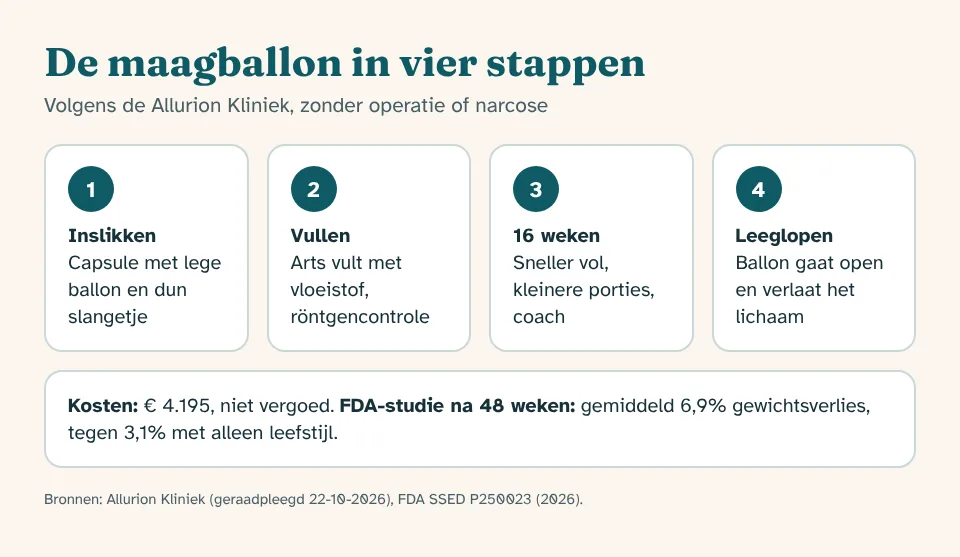
- You swallow a capsule; a doctor fills the balloon through a thin tube. After about 16 weeks the balloon deflates and your body passes it naturally (Allurion Kliniek).
- The clinic states as conditions: aged 18 to 65, a BMI of 27 or higher, not pregnant and no swallowing problems.
- That works out at €22.99 per day over the 6 months of coaching. The programme costs €4,195 and is not reimbursed (Allurion Kliniek). Health insurer DSW writes that the gastric balloon does not meet the current state of science and practice.
- In the American registration study, participants lost on average 6.9% of their weight after 48 weeks, compared with 3.1% with a lifestyle programme alone. Serious side effects occurred in 3% (FDA, 2026).
How a gastric balloon works
The Allurion gastric balloon is folded up inside a capsule, with a thin tube attached. You swallow the capsule. Once it is in your stomach, the doctor fills the balloon with fluid through the tube. Using an X-ray, the doctor checks whether the balloon is in the right position and properly filled. The tube is then removed. According to the clinic, no endoscopy, surgery or anaesthesia is needed.
The filled balloon takes up about a third of your stomach. As a result, you feel full sooner and eat smaller portions. After about 16 weeks the balloon opens, deflates and leaves your body naturally. Those 16 weeks are therefore a period in which it is easier to eat smaller portions. What you learn about eating and exercise during that time determines what happens afterwards.
Who a gastric balloon is intended for
The Allurion Kliniek states four conditions: you are aged 18 to 65, your BMI is 27 or higher, you are not pregnant and you have no swallowing problems. If you do not know your BMI, calculate it with the BMI calculator that stores nothing.
In 2026 the American FDA approved the balloon for a narrower group: adults aged 22 to 65 with a BMI of 30 to 40 who have already tried at least once to lose weight without success, and always together with a lifestyle programme. The FDA also lists situations in which the balloon is not suitable, such as:
- swallowing problems or abnormalities of the oesophagus;
- previous surgery on the stomach or oesophagus, including weight loss surgery or a gastric band;
- Crohn's disease or a previous bowel obstruction;
- a recent inflammation or ulcer in the stomach or oesophagus;
- blood thinners, an eating disorder or an alcohol or drug addiction;
- pregnancy or breastfeeding.
At the intake, the doctor assesses whether the balloon is safe for you. If you are unsure whether a gastric balloon or another route is a better fit, first take the weight loss test with personal advice.
What research shows
The clinic writes that you lose around 10 to 15% of your body weight in 16 weeks. In the American registration study AUDACITY, on which the FDA based its decision, participants received up to two balloons in ten months, together with a lifestyle programme. After 48 weeks they had lost on average 6.9% of their weight. The group with only the lifestyle programme lost 3.1%. Of the participants with a balloon, 58% lost at least 5% of their weight.
That difference between 16 and 48 weeks is important. After deflation, weight can go up again. What you lose permanently depends on the habits you build. That is why support is part of a gastric balloon.
Side effects and risks of a gastric balloon
According to the FDA summary, nausea, abdominal pain and vomiting were common. In 8 participants with a balloon (3%), there were serious side effects caused by the balloon, including two cases of a small hole in the stomach wall. Nobody died and there were no bowel obstructions. If you have severe or persistent abdominal pain after placement, keep vomiting or develop a fever, contact the clinic or a doctor immediately.
Gastric balloon, GLI, medication or surgery
A gastric balloon is one of the ways to lose weight with help. The table shows the differences from the routes that GPs and insurers recognise.
| Route | When | Duration | Reimbursed? |
|---|---|---|---|
| Combined lifestyle intervention (GLI) | BMI 25 to 35 with large waist circumference or condition, or BMI 35 or higher | 24 months | Yes, without compulsory excess (eigen risico) |
| Gastric balloon (Allurion) | Clinic: aged 18 to 65, BMI 27 or higher | Balloon about 16 weeks, coach 6 months | No, €22.99 per day over 6 months of coaching (total €4,195) |
| Weight loss medication | NHG: BMI 35 with condition or 40, after a year of GLI | As long as it works and suits you | Partly, under certain conditions |
| Weight loss surgery | BMI 40 or higher, 35 or higher with serious condition, or 30 or higher with poorly controlled type 2 diabetes | Operation and years of aftercare | Yes, compulsory excess (eigen risico) applies |
A gastric balloon is not an operation and does not stay in place. Weight loss surgery permanently changes your stomach. Which operations exist and when you are eligible can be read at the criteria for weight loss surgery. You can read more about the reimbursed programme via the GP (huisarts) at the GLI without compulsory excess.
Gastric balloon costs and insurance cover
Over 6 months of coaching, that is €22.99 per day. According to the clinic, the Allurion programme costs €4,195. This includes the medical intake, placement of the balloon, a lifestyle programme with a coach for nutrition and exercise, a Bluetooth scale and an app. According to the clinic, health insurance does not reimburse it. Health insurer DSW writes that the gastric balloon does not meet the current state of science and practice, and is therefore not covered as insured care.
Support during and after the balloon
According to the clinic, after placement a coach supports you intensively with nutrition and exercise for six months. According to the clinic, bariatric physician Dr Edo Aarts carries out the treatment. ZorgkaartNederland lists him as a surgeon, including at WeightWorks Clinics in Amersfoort.
After the balloon you can continue with personal support for overweight. If you would first like to know how much energy your body uses at rest, a measurement of your resting metabolism can help.
Would you like to talk about a gastric balloon?
Leave your details. A member of staff will call you to answer your questions and schedule an intake with the doctor. A phone call is not yet a registration for the treatment. Prefer to look for yourself first? On the Allurion Kliniek website you can read their own explanation.
Also compare the balloon with other routes: prescription weight loss medication, weight loss surgery in hospital and how the programme compares with online providers.
Frequently asked questions about the gastric balloon
What is a gastric balloon?
A gastric balloon is a soft balloon filled with fluid that sits in your stomach temporarily. It takes up space, so you feel full sooner and eat smaller portions. You swallow the Allurion balloon as a capsule and it passes out of your body by itself after about 16 weeks. It is an aid alongside better habits, not an operation.
How does the swallowable Allurion gastric balloon work?
You swallow a capsule containing an empty balloon, with a thin tube attached. The doctor fills the balloon with fluid through the tube and checks with an X-ray that it is in the right position. The tube is then removed. According to the Allurion Kliniek, no endoscopy, surgery or anaesthetic is needed.
How much weight do you lose with a gastric balloon?
That differs per person. The clinic mentions 10 to 15% of your body weight in 16 weeks. In the American registration study, participants lost on average 6.9% after 48 weeks, compared with 3.1% with a lifestyle programme alone. How much you lose permanently depends on what you learn about eating and exercise during that period.
How long does a gastric balloon stay in your stomach?
The Allurion balloon stays in your stomach for about 16 weeks. It then opens, empties and leaves your body naturally, according to the clinic. In the American study, participants received up to two balloons within ten months.
How much does a gastric balloon cost?
Over 6 months of coaching, that is €22.99 per day. According to the Allurion Kliniek, the Allurion programme costs €4,195. For this you get the intake, placement of the balloon, support from a coach, a Bluetooth scale and an app. Health insurance does not reimburse it. So also compare it with the combined lifestyle intervention (GLI), which is reimbursed via your GP (huisarts) without compulsory excess (eigen risico).
Is a gastric balloon covered by health insurance?
No. The Allurion Kliniek writes that the treatment is not covered. Health insurer DSW writes that the gastric balloon does not meet the established medical science and practice standard (stand van wetenschap en praktijk), and is therefore not part of insured care. Weight loss surgery is covered if you meet the criteria, as is the combined lifestyle intervention (GLI).
Is a gastric balloon dangerous?
Every treatment has risks. In the American registration study, 8 of the participants with a balloon (3%) had a serious side effect caused by the balloon, including two cases of a small hole in the stomach wall. Nausea, stomach pain and vomiting were common. So have yourself examined thoroughly at the intake and call a doctor immediately if you have severe stomach pain.
Who cannot have a gastric balloon?
The clinic mentions: younger than 18 or older than 65, a BMI below 27, being pregnant or having swallowing problems. The FDA also mentions, among other things, previous surgery on the stomach or oesophagus, Crohn's disease, a previous bowel obstruction, blood thinners, an eating disorder and breastfeeding. The doctor assesses this at the intake.
Is the Allurion gastric balloon approved?
The American FDA approved the Allurion balloon in 2026 for adults aged 22 to 65 with a BMI of 30 to 40 who had previously tried to lose weight without success. That is a narrower group than the clinic mentions. According to the clinic, health insurance does not cover the gastric balloon.
What is the difference between a gastric balloon and weight loss surgery?
A gastric balloon is temporary and is not placed surgically. Weight loss surgery (bariatric surgery) is an operation that permanently changes your stomach. Weight loss surgery is possible with a BMI of 40 or higher, 35 or higher with a serious condition, or 30 or higher with poorly controlled type 2 diabetes, if previous treatment did not help enough. For the balloon, the clinic states a BMI of 27 or higher; you pay for it yourself.
Does it hurt to swallow a gastric balloon?
You swallow a capsule; according to the clinic, no anaesthesia is needed for this. After filling, you may experience nausea, abdominal pain or vomiting. According to the FDA summary, these are common complaints. Discuss with the doctor beforehand how to deal with them.
Do you regain weight after a gastric balloon?
That is possible. After about 16 weeks the balloon deflates and the extra feeling of fullness is gone. In the American study, the average loss after 48 weeks was lower than what the clinic states for 16 weeks. What you keep off in the long term depends on the habits you build. According to the clinic, you get a coach for six months for this.
Can I combine a gastric balloon with weight loss medication?
The doctor decides this at the intake, based on your health and the medicines you use. If you already use a medicine such as semaglutide or tirzepatide, always mention it. You can also read more about support alongside medication at support alongside GLP-1 medicines.
Who places the gastric balloon at the Allurion Kliniek?
According to the Allurion Kliniek, bariatric physician Dr Edo Aarts carries out the treatment. ZorgkaartNederland lists surgeon E.O. Aarts at WeightWorks Clinics and the Allurion Kliniek in Amersfoort. The coaches then support you with nutrition and exercise.
How do I know if a gastric balloon is right for me?
Start with your BMI, your age and what you have already tried. Take the weight loss test on this site: it also shows the reimbursed routes, such as the GLI. If the gastric balloon is suitable, the doctor assesses at the intake whether it is safe for you. You can also call first with your questions.
Sources
- Allurion Kliniek: Allurion maagballon (accessed 22-10-2026)
- Allurion Kliniek: coaches en voorwaarden (accessed 22-10-2026)
- FDA: Summary of Safety and Effectiveness Data, Allurion Gastric Balloon System, P250023 (2026)
- DSW: Afbakening stand van wetenschap en praktijk (2023)
- ZorgkaartNederland: chirurg E.O. Aarts (accessed 22-10-2026)
- Nederlands Tijdschrift voor Leefstijlgeneeskunde: Huisarts wordt spelverdeler bij aangescherpte NHG-richtlijn (October 2025)
- Zorginstituut Nederland: Gecombineerde leefstijlinterventie (GLI) (29-05-2026)
Read more: weight loss
- Take the weight loss testPersonal advice in 5 minutes
- Why Overgewicht NederlandDoctor, coach and measurements, honestly compared
- Support with overweight€3.55 per day (€108 per month)
- Medical weight lossInjection, pill, GLI or surgery
- Weight loss with injectionsSupport alongside weight loss injections
- Weight loss with pillsPrescription weight loss pills
- Weight loss with PCOS (PMOS)Diet, medication and support
- Support with weight loss injectionsProtein, muscles and stopping
- Food noiseConstantly thinking about food
- Complex obesity careCare that looks along with you
- Personal supportMore personal contact
- Weight loss research programme€2.84 per day, 15 months
- Sign up for supportWe will call you within one working day