Medical weight loss: which route suits you?
Medical weight loss can take different forms: a lifestyle programme via your GP (huisarts), medication as an injection or tablet, bariatric surgery or support from a coach. Which route suits you depends on your BMI, your health and what you have already tried. On this page you can see all the routes side by side, what is covered by insurance in 2026 and what support adds.
Good to know: the support is provided by Overgewicht Nederland B.V. (Amersfoort). If you fill in the form, your details go to that organisation. Amounts as stated by the provider on 21-10-2026. More about this site and the programme.
In brief
- The combined lifestyle intervention (GLI) lasts 24 months and is covered without the compulsory excess (eigen risico) and without a personal contribution (Zorginstituut Nederland, 29-05-2026).
- According to the guideline, medication is an addition to a lifestyle programme, not a treatment on its own (Richtlijnendatabase, 10-07-2023).
- Liraglutide and naltrexone/bupropion are covered under certain conditions, after at least one year of GLI (Zorginstituut Nederland, 03-02-2026).
- Semaglutide and tirzepatide are not covered for obesity; advice is expected in early 2027 (Zorgkiezer, 20-10-2026).
- No medicines are prescribed or sold through this site. That works out at €3.55 per day. According to Overgewicht Nederland B.V., support costs €108 per month (provider's own information, 21-10-2026).
No advertising: this page is about routes and support. We name active substances. Brand names appear only in brackets so you can recognise them. In the Netherlands, advertising prescription medicines is prohibited. Whether a medicine suits you is something you decide together with your GP or specialist.
Routes for medical weight loss in 2026
Medical weight loss is an umbrella term. It means you lose weight with help from healthcare professionals, rather than on your own. Broadly speaking, there are four routes. You can also combine them, and they often follow on from each other: lifestyle first, then possibly medication, and with a high BMI sometimes surgery. Support from a coach can run alongside any route.
Important to know: in every route, lifestyle remains the foundation. Even with medication, Apotheek.nl writes that eating fewer calories and moving more are still needed (Apotheek.nl, 15-09-2026). A medicine or an operation helps, but it does not do the work on its own.
| Route | Who it is for | Covered in 2026 | What support adds |
|---|---|---|---|
| GLI via your GP | BMI 35+, or 25 to 35 with extra risk | Yes, without compulsory excess (eigen risico) | Longer or more frequent contact alongside the lifestyle coach |
| Weight loss injection | BMI 30+, or 27+ with a condition | Only liraglutide, under certain conditions | Help with side effects, protein, exercise and stopping |
| Weight loss pill | BMI 30+, or 27+ with a condition | Only naltrexone/bupropion, under certain conditions | Help with eating patterns and keeping it up |
| Weight loss surgery | BMI 40+, 35+ with a serious illness, or 30+ with poorly controlled type 2 diabetes | Yes, with a medical indication; compulsory excess applies | Preparation and long-term lifestyle |
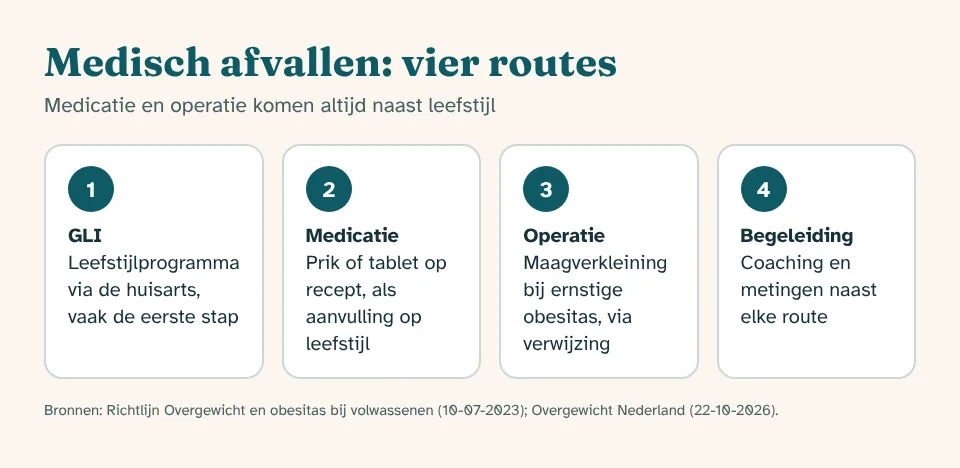
The GLI is a two-year programme in which a lifestyle coach helps you with eating, exercise, sleep and behaviour. Read more about the combined lifestyle intervention. Injections involve medicines such as semaglutide, tirzepatide and liraglutide; everything about them is on weight loss with injections. We discuss tablets such as naltrexone/bupropion and the semaglutide tablet under weight loss with tablets. You can read about surgery under types of bariatric surgery and what they involve.
Who is eligible for medical weight loss?
Whether you are eligible depends mainly on your BMI and on conditions linked to your weight, such as type 2 diabetes, high blood pressure, sleep apnoea or osteoarthritis. Your BMI is your weight in kilos divided by your height in metres squared. If you weigh 95 kilos and are 1.70 metres tall, your BMI is 95 divided by 2.89: about 32.9. You can work it out quickly with the BMI calculator that runs in your browser.
- GLI: BMI 35 or higher, or BMI 25 to 35 with a waist circumference of 88 cm or more (women) or 102 cm or more (men), or with a condition linked to your weight (Zorginstituut Nederland, 29-05-2026).
- Medication: according to the European registration, with a BMI of 30 or higher, or a BMI of 27 to 30 with at least one weight-related condition, always alongside a calorie-restricted diet and more exercise (EMA).
- Bariatric surgery: BMI 40 or higher, BMI 35 or higher with a serious weight-related illness, or BMI 30 or higher with poorly controlled type 2 diabetes (NHG-Standaard Obesitas, October 2025).
Insurance cover for medicines comes with stricter requirements than the registration itself. You can read more about that below. All the thresholds and examples are worked out under when you are eligible for treatment.
Medical weight loss via your GP
For almost every route, your GP (huisarts) is the starting point. There are two reasons for this. Your GP has an overview of your whole health: your medicines, your blood pressure, your blood sugar and what you have already tried. And covered care goes through your GP: without a referral (verwijzing), there is no covered GLI and no covered surgery.
According to the NHG-Standaard Obesitas of October 2025, treatment starts with lifestyle. Medication only comes into the picture after a year of lifestyle treatment with too little result. If your BMI is high, your GP can refer you to a bariatric centre, where a team will screen you. How to approach the appointment and what to bring is explained under preparing for your appointment with your GP.
When you book the appointment, say that you want to talk about your weight, so that there is enough time. Bring your BMI, your waist circumference, a list of your medicines and an overview of previous attempts. Do not expect to go home with a prescription after one visit. That is not unwillingness on your GP's part, but what the guideline agrees.
Medical weight loss with weight loss injections or pills
Weight loss medication for obesity comes as injections and as tablets. It is only available on prescription. The Dutch guideline calls it an addition to a lifestyle programme and advises against starting if supervised lifestyle treatment cannot be followed, because the weight loss is linked to the number of contact moments (Richtlijnendatabase, 10-07-2023).
Injections
According to the registration, semaglutide (Wegovy) and tirzepatide (Mounjaro) are injected once a week, liraglutide (Saxenda) once a day. Semaglutide as Ozempic is registered in the Netherlands as a diabetes medicine, not as a weight loss medicine (NOS, 18-08-2026). The differences, side effects and what studies show after stopping are on our page about weight loss injections.
Tablets
Naltrexone/bupropion (Mysimba) is a tablet whose dose you build up over four weeks. The semaglutide tablet has been approved in the EU since July 2026; ask your pharmacy or doctor whether it is available yet. Orlistat can be bought without a prescription by adults with a BMI of 28 or higher. You can read more about these medicines, and about drugstore pills with "GLP-1" in their name, which are not medicines, under weight loss pills and other tablets.
Side effects, stopping and safety
Stomach and bowel complaints are common. With semaglutide, according to Apotheek.nl, nausea, diarrhoea, constipation, abdominal pain or vomiting occur in 10 to 30 out of 100 people (15-09-2026). Weight can come back after stopping: in the STEP 1 extension, on average about two thirds of the weight lost came back one year after stopping semaglutide (Wilding et al., 2022). Never buy medicines online without a prescription. The IGJ warns against this, and reliable online pharmacies are listed on aanbiedersmedicijnen.nl. What support does alongside these medicines is explained under support alongside GLP-1 medication.
Medical weight loss with a gastric balloon
Besides injections, pills, the GLI and surgery, there is a temporary gastric balloon that you swallow as a capsule. It stays in your stomach for about 16 weeks and makes you feel full sooner. The Allurion Kliniek in Amersfoort, which, like the support programme on this site, belongs to Overgewicht Nederland B.V., states the conditions as being 18 to 65 years old and having a BMI of 27 or higher. Over 6 months of coaching, that is €22.99 per day. It costs €4,195 and is not covered by insurance. What research shows and what the risks are is explained under the gastric balloon: how it works, costs and risks.
Cost and insurance cover of medical weight loss
What you pay yourself depends on the route. Basic health insurance (basisverzekering) is the same throughout the Netherlands, so where you live makes no difference to the basic package. As of 21 October 2026:
- GLI: covered without the compulsory excess (eigen risico) and without a personal contribution (Zorginstituut Nederland, 29-05-2026).
- Liraglutide (Saxenda): covered with a BMI of 35 or higher with an additional illness, or a BMI of 40 or higher, after at least one year of GLI.
- Naltrexone/bupropion (Mysimba): covered with a BMI of 30 or higher, or 27 or higher with risk factors, after at least one year of GLI (Zorginstituut Nederland, 03-02-2026).
- Semaglutide (Wegovy) and tirzepatide (Mounjaro): not covered for obesity. The Dutch Health Care Institute (Zorginstituut) discussed them on 5 October 2026; advice is expected in early 2027, and nothing has been decided yet (Zorgkiezer, 20-10-2026).
- Bariatric surgery: covered by basic health insurance (basisverzekering) with a medical indication; you pay your compulsory excess (eigen risico). More under insurance cover for bariatric surgery.
You pay for medicines that are not covered yourself. The price differs per medicine and dose; ask your pharmacy. We do not give prices per brand on this site.
You pay for lifestyle support separately. Per day, that works out at €3.55. According to Overgewicht Nederland B.V., the programme costs €108 per month by direct debit, or €1,295 per year, for 12 months of support. Medicines are not included, so the price does not depend on which medicine or which dose you use. There is also a 15-month research programme for the same amount, with three extensive measurement sessions in Amersfoort. Nothing is known about insurers covering the programme; assume you will pay for it yourself.
With doctor, coach and psychologist
Monthly
€3.55 per day
€108 per month
- 12 months of support
- Direct debit, no large lump sum
- Total €1,296 over 12 months
Yearly
€3.55 per day
€1,295 in one payment
- 12 months of support
- One payment in advance
- Equivalent to €107.92 per month
Research programme
€2.84 per day
€1,295 for 15 months
- 15 instead of 12 months of support
- Three extensive measurement sessions in Amersfoort
- Equivalent to €86.33 per month
Amounts according to Overgewicht Nederland B.V., reference date 21-10-2026. The price per day is a conversion (total divided by the number of days in the term); you pay per month or per year. Medication comes on top. You will receive the exact terms, such as the term and cancellation, in writing before you start.
Measurements for medical weight loss in Amersfoort
Scales tell you how much you weigh, but not what that weight is made up of. That is especially important with medical weight loss. A joint advisory from four American organisations from 2025 warns that GLP-1 therapy can also cost muscle and bone mass, and names enough protein and strength training as priorities (The Obesity Society et al., June 2025).
According to the provider, you can have two measurements done in Amersfoort, also separately from the research programme. With an InBody measurement of fat and muscle, bioimpedance is used to estimate your fat mass and fat-free mass. This measurement is mainly useful for tracking your own progress, measured under the same conditions; for exact figures it is less suitable than a DEXA scan (Merrigan et al., 2022). With a measurement of your resting metabolism, you can see how much energy your body uses at rest. This measurement uses indirect calorimetry, the gold standard for measuring how much you burn at rest. The cost of a single measurement is not known on the reference date.
What support adds to medical weight loss
Whichever route you choose, you are still the one who eats, moves and keeps going. A coach helps you with that. According to the provider, the Overgewicht Nederland B.V. team is specially trained in support alongside GLP-1 medication and in PCOS, and almost half of the coaching sessions are about hormones and the menopause in women. If that applies to you, also read about weight loss during menopause or PCOS and overweight. For people with several conditions there is complex obesity care.
What you can expect
- Twelve months of attention to your eating pattern, exercise, sleep and stress.
- Help coping with side effects in your daily life, in consultation with your doctor.
- Attention to protein and preserving muscle, with measurements in Amersfoort if you want them.
- A plan for when a medicine stops or the GLI comes to an end.
What you should not expect
A prescription, dosage advice or a choice of medicine. Those belong with your doctor. Nor will anyone promise you a fixed number of kilos. With any offer, check that the support does not stop after a short starter period: research shows that weight often comes back after stopping medication. How the sessions will work is something you agree on in the introductory conversation.
Questions for the introductory conversation
- How does the support fit with my GLI or my medication?
- How often do I speak to my coach, and how?
- When are measurements in Amersfoort useful for me?
- How does cancelling work after the first period?
On subscriptions, the ACM says the first fixed term may be at most one year and that after that you can always cancel with a notice period of at most one month (ACM, 29-07-2025). Ask how this is arranged for this programme. The full programme is described under twelve months of support for overweight.
Choose your route and add support alongside it
Sign up for an introductory conversation and discuss how support fits alongside the route you choose with your GP.
Sign up for support with medical weight loss Go to your GP first
We value your privacy
Other forms of support
Weight loss during menopause
Your hormones change, and so does your body. Support that takes this into account.
PCOS and overweight
Insulin resistance and a cycle that does not cooperate: targeted support.
Support alongside weight loss injections
Semaglutide, tirzepatide or liraglutide: protein, muscles, side effects and stopping.
Support with GLP-1
Using semaglutide or tirzepatide? Coaching on nutrition, muscles and stopping.
Food noise and cravings
Always thinking about food? Psychological support alongside lifestyle.
Complex medical situation
Diabetes, heart problems, medicines or previous surgery: care that keeps an eye on things.
Extra personal support
More contact, a dedicated coach and quick availability. Let us know what you are looking for.
Take part in research
15 months of support with three extensive measurements in Amersfoort.
Questions you may have about medical weight loss
Adverts promise a lot. On these pages you can read, question by question, what the guidelines and studies say, with source and date.
- Does weight loss medication really work?
- Figures: how much weight you lose with medication
- Medication as an aid alongside behaviour
- Medical help with weight loss without shame
- Obesity as a chronic condition
- After many attempts: what can be different now
- Preventing the yo-yo effect
- Keeping weight off in the long term
- Weight after stopping medication
- Protecting your muscles while losing weight
- Who does what: coach, doctor and dietitian
- Cost of medical weight loss per day
- Privacy and safety with weight loss help
- Checklist for an online weight loss clinic
- Comparing weight loss programmes fairly
- What weight loss does for your health
- Medical weight loss for men
- What a proven programme really means
- How much medical support you can expect
- Weight loss is more than a treatment
- What a lifestyle coach does for you
- How an online-only clinic works
- Starting without a fixed contract: what to look out for
- Questionnaire or conversation at the intake
- What a weight loss app can and cannot do
- Dealing with setbacks and bad weeks
- What 'up to' means in weight loss figures
- How much muscle you lose when losing weight
Medical weight loss: by town within 75 km of Amersfoort
For each town you will find the municipality's figures, the distance to the measurement location in Amersfoort and the questions people there ask.
- Medical weight loss in Amersfoort
- Medical weight loss in Soest
- Medical weight loss in Leusden
- Medical weight loss in Bunschoten
- Medical weight loss in Nijkerk
- Medical weight loss in Baarn
- Medical weight loss in Woudenberg
- Medical weight loss in Zeist
- Medical weight loss in De Bilt
- Medical weight loss in Hilversum
- Medical weight loss in Barneveld
- Medical weight loss in Veenendaal
- Medical weight loss in Utrecht
- Medical weight loss in Almere
- Medical weight loss in Ede
- Medical weight loss in Apeldoorn
- Medical weight loss in Amsterdam
- Medical weight loss in Arnhem
- Medical weight loss in Nijmegen
- Medical weight loss in Haarlemmermeer
- Medical weight loss in 's-Hertogenbosch
- Medical weight loss in Alphen aan den Rijn
- Medical weight loss in Zaanstad
- Medical weight loss in Haarlem
- Medical weight loss in Deventer
- Medical weight loss in Leiden
- Medical weight loss in Zoetermeer
- Medical weight loss in Alkmaar
- Medical weight loss in Zwolle
- Medical weight loss in Dordrecht
- Medical weight loss in Rotterdam
- Medical weight loss in Tilburg
Compare at a glance
| What do you get? | Overgewicht Nederland | Goodweigh | Wellis | Yazen |
|---|---|---|---|---|
| Consultation with a doctor by phone or video | Yes: | No: | Partly: | Not mentioned: |
| Gastric balloon as a route | Yes: | Not mentioned: | Not mentioned: | Not mentioned: |
| Unlimited contact via chat | Not mentioned: | Yes: | Not mentioned: | Not mentioned: |
| Everything via chat, without phone calls | No: | Yes: | Yes: | Partly: |
yes no (according to the provider itself) partly not mentioned. Reference date 22-10-2026. View the cost calculator
Frequently asked questions about medical weight loss
What is medical weight loss?
Medical weight loss is losing weight with help from healthcare. It involves a lifestyle programme via the GP (huisarts), prescription medication, weight loss surgery or a combination of these, often with extra support. The difference from a diet is that a doctor takes your health into account and monitors the steps. Which route suits you depends on your BMI, your health and what you have already tried.
Is semaglutide (Ozempic) a medicine for medical weight loss?
No. Ozempic is registered in the Netherlands as a diabetes medicine, not as a weight loss medicine, according to the IGJ via the NOS (18-08-2026). That is why we do not discuss it on this site as a route to losing weight. Which medicines have a place in treating obesity, and when, is explained under weight loss medication according to the NHG-Standaard. Whether a treatment suits you is something to discuss with your GP (huisarts); no medicines are prescribed or sold through this site.
Can you lose weight medically with pills instead of injections?
Yes, there are tablets for obesity, but they are not the same for everyone. Naltrexone/bupropion (Mysimba) is on prescription and is covered under certain conditions. The semaglutide tablet has been approved in the EU since July 2026; ask your pharmacy whether it is available yet. Orlistat is available without a prescription. You choose which form suits you with your doctor. More under weight loss pills and other tablets.
Is weight loss surgery covered as a route for medical weight loss?
Yes, with a medical indication, weight loss surgery is covered by basic health insurance (basisverzekering). You do pay your compulsory excess (eigen risico). If your insurer does not have a contract with the centre, part of the bill may be for you to pay. You are eligible with a BMI of 40 or higher, 35 with a serious illness or 30 with poorly controlled type 2 diabetes, after a referral (verwijzing) from your GP (huisarts).
Can I pay for medical weight loss monthly?
For the support, yes. That works out at €3.55 per day. According to Overgewicht Nederland B.V., you pay €108 per month by direct debit, or €1,295 for the whole year. Medicines are separate and you pay for them at the pharmacy, with or without insurance cover. The GLI via your GP (huisarts) costs you nothing extra. In the introductory conversation, ask how cancelling after the first period is arranged.
Where can I go if my GP does not prescribe weight loss medication?
First ask why. Often the reason is that you have not yet followed a year of lifestyle treatment, or that a medicine does not suit your health. This follows from the NHG Standard (NHG-Standaard). You can then start the combined lifestyle intervention (GLI) or continue with support from a coach. Never buy medicines without a prescription via online shops or social media: the IGJ and hospitals warn about counterfeit weight loss pens.
Can I lose weight medically with tirzepatide (Mounjaro)?
Tirzepatide (Mounjaro) is registered in the EU for weight management with a BMI of 30 or higher, or 27 with a condition. It is an injection you give once a week, only on a doctor's prescription. In primary care it is advised against (Farmacotherapeutisch Kompas, accessed 25-09-2026). It is not covered for obesity in 2026; the Dutch Health Care Institute (Zorginstituut) expects to give advice in early 2027. Whether it suits you is something you decide with your doctor. More under weight loss injections and the medicines.
How long do you use medication for medical weight loss?
You decide that with your doctor, and it differs from person to person. The guideline has a stopping rule: if after 12 weeks on the highest tolerable dose you have lost less than 5%, you stop taking liraglutide, orlistat or naltrexone/bupropion. Studies show that weight often comes back after stopping. That is why it pays to build habits that last while you are using it.
Is medical weight loss the same as losing weight with weight loss injections?
No, weight loss injections are just one part. Medical weight loss also includes the combined lifestyle intervention (GLI) via the GP, prescription tablets, weight loss surgery and lifestyle support. For many people, it actually starts without medication, with a lifestyle programme. According to the NHG Standard (NHG-Standaard), an injection only comes into the picture after a year of lifestyle treatment with too little result.
What is the difference between a GLI and losing weight with medication?
The combined lifestyle intervention (GLI) is a 24-month lifestyle programme without medication, covered without compulsory excess (eigen risico). With medication, you also get a prescription medicine. The guideline sees medication as an addition to a lifestyle programme, not a replacement. They often follow each other: first the GLI, then possibly a medicine, and the lifestyle part continues.
What is measured during medical weight loss in Amersfoort?
In Amersfoort, according to the provider, you can have an REE measurement and an InBody measurement done. The REE measurement estimates your energy use at rest using indirect calorimetry. The InBody estimates your fat mass and fat-free mass and is mainly useful for following your own progress. That way you can see whether you are mainly losing fat or also muscle. What a single measurement costs is not known on the reference date.
How much weight do you lose with medical weight loss?
That varies greatly per person and per route, so no one can promise you in advance. In the STEP 1 extension, participants on semaglutide plus lifestyle lost an average of 17.3% after 68 weeks; a year after stopping, about two thirds of that had returned, a net 5.6% (Wilding et al., 2022). These are group averages from research, not an expectation for you. Discuss with your GP what is achievable for you.
Can I lose weight medically during menopause or with PCOS?
Yes, the same routes apply to both groups. The PCOS guideline recommends a GLI programme in case of overweight. According to the provider, the team at Overgewicht Nederland B.V. is trained in PCOS, and almost half of the coaching sessions are about hormones and the menopause. Whether medication suits you is something you decide with your doctor. In pregnancy or if you wish to become pregnant, the package leaflets of several medicines advise against use.
Can I choose which route I take for medical weight loss?
You have a say, but you do not decide alone. Your GP (huisarts) assesses your BMI, your health and previous attempts against the guideline, and that determines which routes are open and what is reimbursed. Within that scope, you choose together. You can always choose coaching support yourself, alongside any route. Do tell your GP that you are following that support.
What does medical weight loss do to my muscles?
When you lose weight, you do not only lose fat; muscle mass can also decrease. A joint advisory from four American organisations from 2025 warns that GLP-1 therapy can cost muscle and bone mass and names enough protein and strength training as priorities. How much that is in your case varies. With an InBody measurement in Amersfoort, you can follow your own progress, measured under the same conditions.
Sources
- Zorginstituut Nederland: Gecombineerde leefstijlinterventie (GLI) (29-05-2026)
- Zorginstituut Nederland: Forse kostenstijging medicijnen en leefstijlprogramma voor obesitas (03-02-2026)
- Zorgkiezer: Mounjaro en Wegovy in het basispakket? (20-10-2026)
- Richtlijnendatabase: Overgewicht en obesitas bij volwassenen, effectiviteit medicatie (10-07-2023)
- Huisarts en Wetenschap: NHG-Standaard Obesitas herzien (13-10-2025)
- Richtlijnendatabase: Richtlijn PCOS, obesitas en gewichtsreductie (18-07-2023)
- Apotheek.nl: Semaglutide (15-09-2026)
- Zorginstituut Nederland: Zorg bij overgewicht en obesitas (accessed 25-09-2026)
- Zorgwijzer: Budgetpolis stopt, maar beperkingen blijven (25-11-2025)
- EMA: Mounjaro, overzicht van het geneesmiddel (02-2026)
- EMA: Saxenda (31-07-2025)
- EMA: Mysimba, productinformatie (accessed 21-10-2026)
- EMA: Alli (orlistat), samenvatting (05-2012)
- Novo Nordisk via BioSpace: EU-goedkeuring semaglutide-tablet (15-07-2026)
- NOS: IGJ over reclame en registratie van afslankmiddelen (18-08-2026)
- NL Times: Ziekenhuizen waarschuwen voor nagemaakte afslankmiddelen (01-07-2026)
- Rijksoverheid: Aanpak vervalste medicijnen (09-05-2025)
- Wilding et al.: STEP 1-extensie, Diabetes Obes Metab (2022)
- The Obesity Society et al.: Nutritional Priorities to Support GLP-1 Therapy for Obesity (06-2025)
- Merrigan et al.: InBody vergeleken met DXA, Journal of Exercise and Nutrition (2022)
- Indirecte calorimetrie als gouden standaard voor REE (30-08-2023)
- ACM: Annuleren en opzeggen (29-07-2025)
- Overgewicht Nederland B.V.: programme and price statement (21-10-2026)
Read more: weight loss
- Take the weight loss testPersonal advice in 5 minutes
- Why Overgewicht NederlandDoctor, coach and measurements, honestly compared
- Support with overweight€3.55 per day (€108 per month)
- Gastric balloonSwallowed, 16 weeks, not reimbursed
- Weight loss with injectionsSupport alongside weight loss injections
- Weight loss with pillsPrescription weight loss pills
- Weight loss with PCOS (PMOS)Diet, medication and support
- Support with weight loss injectionsProtein, muscles and stopping
- Food noiseConstantly thinking about food
- Complex obesity careCare that looks along with you
- Personal supportMore personal contact
- Weight loss research programme€2.84 per day, 15 months
- Sign up for supportWe will call you within one working day