Bariatric surgery: what you need to know
Weight loss surgery (maagverkleining) is an operation for severe obesity in which the surgeon makes the stomach smaller and sometimes changes the route food takes through the intestine. In the Netherlands it mainly involves three operations: sleeve, bypass and mini bypass. The pathway runs via your GP (huisarts) to a specialised centre, where you are screened first and receive aftercare for years after the operation.
In brief
- Your GP (huisarts) can refer you with a BMI of 40 or higher, 35 or higher with a serious weight-related condition, or 30 or higher with poorly controlled type 2 diabetes, if previous treatment did not help enough (NHG-Standaard Obesitas, October 2025).
- In the Netherlands, over 10,000 first operations are carried out each year, in 20 centres (DATO, annual report 2024).
- In 2024, serious complications occurred in an average of 1.4% of all people operated on (DATO, annual report 2024).
- In the first 1 to 2 years, you lose on average 25 to 30% of your weight (Thuisarts; Richtlijn Chirurgische behandeling van obesitas).
Who is weight loss surgery for?
Bariatric surgery, as doctors call it, is intended for people with severe obesity for whom lifestyle treatment and possibly medication have not achieved enough. In the step-by-step model it is the last step, not the first. You can see how those steps fit together in the treatment ladder from lifestyle to surgery.
The GP (huisarts) follows the NHG guideline (NHG-Standaard) of October 2025. In addition, you must be 18 or older and willing to change your lifestyle permanently. During screening, the treatment team checks whether there are reasons that would make an operation too dangerous. A tip many people don't know: according to the surgeons' guideline, losing weight before the operation is not a mandatory requirement (Richtlijn Chirurgische behandeling van obesitas, 2020). You can find all the criteria and a short check on the page with the criteria for weight loss surgery.
Worked example
Suppose you are 1.68 metres tall and weigh 120 kilos. Your BMI is 120 divided by 2.82 (1.68 × 1.68) = 42.5. Based on your BMI, you would then be eligible, provided previous treatment did not help enough. With 25% weight loss you lose 30 kilos: you then weigh 90 kilos, with a BMI of 31.9. At 30% that is 36 kilos: you weigh 84 kilos and your BMI is 29.8. Your result may be higher or lower than this average.
Sleeve, bypass and mini bypass compared
All three operations are almost always done as keyhole surgery under general anaesthetic. They don't just work because less fits in your stomach. Your hormones for hunger and feeling full also respond differently. You choose which operation suits you together with the team; according to the Dutch guideline, there is no operation that is best for everyone.
| Feature | Gastric sleeve | Gastric bypass | Mini bypass (OAGB) |
|---|---|---|---|
| What happens? | The surgeon removes about three quarters of the stomach; what remains is a narrow stomach tube | A small pouch at the top of the stomach goes directly to the small intestine, with two connections | Like the bypass, but with one connection |
| Intestinal route changed? | No | Yes | Yes |
| Acid reflux | Most often | Least; often improves | In between |
| Type 2 diabetes | Good effect | Probably slightly better effect | Probably slightly better effect |
| Mortality around the operation | 0,05% | 0,09% | Not reported separately |
| Ongoing points of attention | Reflux, deficiencies without vitamins | Dumping, deficiencies, risk of a twisted bowel | More frequent nutritional problems and deficiencies |
The mortality figures come from a large international analysis (Robertson et al., 2021). If you suffer a lot from heartburn after a sleeve, the team can sometimes still perform a bypass later. The reverse is not possible: with a sleeve, part of the stomach has been removed.
The pathway from GP to aftercare
For an operation covered by insurance, the pathway almost always goes like this:
- Talk to your GP (huisarts) or practice nurse (POH). You talk about your weight, your symptoms and previous attempts to lose weight. Tips for that conversation can be found at asking your GP for a referral for weight loss surgery.
- Referral (verwijzing) via ZorgDomein. You choose a centre together. The GP sends your details along, such as your BMI, medical history, medication and recent lab results.
- Waiting time. This varies greatly: from 1 to 142 days per centre (ZorgkaartNederland, accessed 25-09-2026). Compare the waiting times for weight loss surgery per hospital and clinic.
- Screening. A team including an internist, dietitian, psychologist and nurse checks whether an operation suits you. This is also the moment for all your questions.
- Preparation and operation. You learn how eating works after the operation. The operation itself is keyhole surgery of about an hour.
- Aftercare at the centre. Years of support from, among others, a dietitian, psychologist and exercise coach, with blood tests.
Important to know: aftercare after weight loss surgery is not GP care. The NHG and LHV deliberately did not include it in the 2025 guideline, because there are no agreements or funding for it (VoedingOnline, 14-10-2025). So the aftercare is the responsibility of the centre that operates on you. How long it lasts differs per centre; WeightWorks (a partner of this site), for example, mentions five years. Check this with each centre before you choose.
What the operation costs and what your insurer pays is explained in insurance cover for weight loss surgery and your compulsory excess. If the operation is covered, it costs you no more than your compulsory excess (eigen risico): €385 in 2026 and €400 in 2027.
What surgery achieves
Of all treatments, surgery on average produces the most weight loss, and it lasts the longest. But it remains an average, and part of the weight often comes back in the long term.
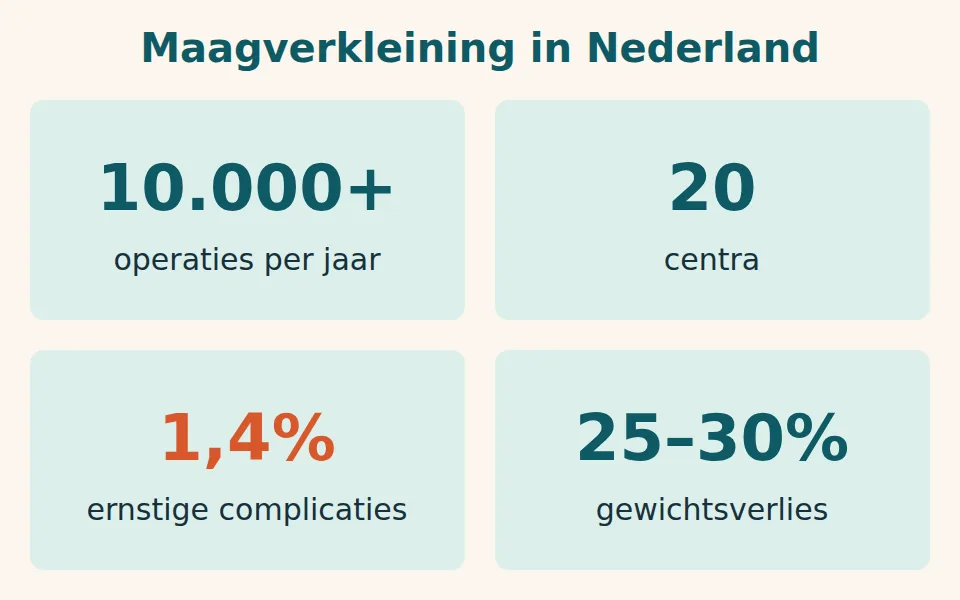
- Weight: 25 to 30% lighter in the first one to two years, on average (Thuisarts; guideline). After 5 years, the large majority in the Netherlands is still more than 20% lighter (DATO, annual report 2023).
- Type 2 diabetes: twelve months after the operation, about 7 in 10 people no longer have diabetes (Thuisarts).
- Life expectancy: in the Swedish SOS study, people who had surgery lived on average about 3 years longer than people with usual care (Carlsson et al., 2020).
Are you in doubt between surgery and medication? Then also read about weight loss medication and the stopping rule. A medication mainly works as long as you take it; an operation is largely permanent.
Risks and life afterwards
Weight loss surgery is a major operation, not a minor procedure. Every operation is recorded in the national DATO quality register. Per centre, the share of serious complications in 2024 ranged from 0.0 to 2.3% (DATO, annual report 2024). The risk of dying around the time of the operation is about 0.08%, or 1 in 1,250 (DATO, annual report 2023).
Shortly after the operation
Think of a leaking staple line, bleeding after surgery or a blood clot (thrombosis). That is why you stay in hospital briefly after the operation and get instructions on when to call immediately.
In the longer term
- Deficiencies: you take vitamins and minerals for life and have your blood checked.
- Dumping: especially after a bypass, you may get symptoms after eating sugary food, such as sweating, dizziness or stomach pain.
- Twisted bowel: after a bypass, this affected about 8 in 100 people in research cited by the guideline. Severe stomach pain after a bypass? Call your treatment team or the out-of-hours GP service (huisartsenpost) immediately.
- Gallstones: due to the rapid weight loss.
- Emotions: your body and your relationship with food change. Support and peers help with this.
Loved ones play a big role after an operation. For them there is information for family and friends around an operation. And if you want to know how it went for others, read experiences of people after weight loss surgery.
Videos: what the pathway looks like
This information video from Stichting Bariatrie Groep Nederland shows in a few minutes what you can expect from the pathway.
In the TV series "Dik Tevreden", the Catharina Ziekenhuis in Eindhoven followed four patients for a year. The hospital stresses that the series also shows complications and does not make anything look better than it is.
Videos show other people's experiences, not a prediction for you. Discuss it with your GP.
Am I eligible? View the waiting times
Surgery is not the only route. Also compare a gastric balloon you swallow, medical weight loss without surgery and coaching before and after weight loss surgery.
Frequently asked questions about weight loss surgery
Is weight loss surgery the same as bariatric surgery?
Yes, bariatric surgery is the medical name for operations to treat severe obesity, and weight loss surgery (maagverkleining) is the everyday name. If the main issue is type 2 diabetes, you may also hear the term metabolic surgery. You can see which types there are in the comparison table of weight loss surgeries.
Why do I have to take vitamins for life after bariatric surgery?
Because you eat less and your body absorbs some nutrients less well, especially after a bypass. These include vitamin B12, iron, calcium and vitamin D. Without supplements, deficiencies develop, sometimes only after years. That is why daily vitamins and blood tests are part of life after surgery, even if you feel well.
How long does the operation itself take?
The operation itself is keyhole surgery of about an hour under general anaesthetic. You usually stay in hospital for one night afterwards. The time before it, with the waiting time, screening and preparation, is many times longer. How long you wait varies greatly per centre; see the waiting times table for all centres.
What is the difference between a gastric bypass and a mini bypass?
A standard bypass has two connections to the intestine, a mini bypass has one. In French research, weight loss after two years was similar, but deficiencies and diarrhoea were more common after a mini bypass. Which one suits you best is something you discuss with the team. What comes before it is described in the criteria for weight loss surgery.
How much weight do you lose after bariatric surgery?
On average 25 to 30% of your weight in the first one to two years. If you weigh 110 kilos, that is on average 27.5 to 33 kilos. Some of it often comes back in the long term. Work out your own starting point with the BMI calculator on your phone and discuss your goal with the team.
Does type 2 diabetes go away after bariatric surgery?
For many people it does, at least temporarily. According to Thuisarts, about 7 in 10 people no longer have diabetes a year after surgery. For some it comes back later, so check-ups remain necessary. With poorly controlled type 2 diabetes, surgery is possible from a BMI of 30; see the obesity treatments by BMI.
How long is the aftercare after bariatric surgery?
It differs per centre; it involves several years of support. WeightWorks (a partner of this site) mentions five years, other centres use their own periods. Vitamins and blood tests remain necessary for life. Ask the centre what happens after the aftercare ends and who will then check your blood.
Which operation is better if you have acid reflux?
With acid reflux symptoms, a gastric bypass is usually a more obvious choice than a sleeve. According to the Dutch guideline, a sleeve more often causes reflux and a bypass often improves those symptoms. The mini bypass is in between. The treatment team weighs this up together with your other health problems.
Can bariatric surgery be reversed?
A sleeve cannot, because about three quarters of the stomach is removed. With a bypass, too, you should assume it is a permanent procedure: any adjustment means another operation. Take your time to weigh up the choice, also against the other obesity treatments.
How many people get a serious complication?
In 2024, a serious complication affected on average 1.4% of people operated on in the Netherlands, according to the DATO annual report. Per centre this ranged from 0.0 to 2.3%. Serious means that an extra procedure was needed or that it was life-threatening. Discuss your own risk with the team during the screening.
Can I get pregnant after bariatric surgery?
Yes, but the advice is usually to wait about eighteen months, so that your weight stabilises first. During the period of rapid weight loss, your body takes in fewer nutrients. Discuss a wish to have children with the treatment team in advance, so that your vitamins and check-ups can be adjusted accordingly.
What if I gain weight again after surgery?
Then you are not the only one and help is available. The centre looks at eating habits, support, medication or sometimes a second operation together with you. Get in touch in good time and don't be ashamed. Also read how others dealt with this in experiences with obesity.
What is dumping syndrome?
Dumping is a set of symptoms that occur when food, especially sugar, enters the intestine too quickly. You may feel weak, dizzy or sweaty, or get stomach pain and diarrhoea. It mainly happens after a bypass. Small portions, eating slowly and few fast-acting sugars help. You can ask questions about this at an information evening with a doctor.
How long will I be out of action after the operation?
You usually stay in hospital for one night and are back at work after 2 to 4 weeks. With heavy physical work it takes longer. You build up your food from liquid to solid over about 4 weeks. The team gives you a schedule that matches your operation.
How safe are the Dutch bariatric centres?
Every operation is recorded in the DATO quality register. In 2024, the share of serious complications per centre ranged from 0.0 to 2.3%. Ask the centre for its own figures and how it organises aftercare. Whether your insurer covers the centre is explained under insurance cover for weight loss surgery.
Sources
- VoedingOnline – NHG-Standaard Obesitas 2025 (13-10-2025)
- Nederlands Tijdschrift voor Leefstijlgeneeskunde – Huisarts wordt spelverdeler bij aangescherpte NHG-richtlijn (October 2025)
- VoedingOnline – Nazorg na bariatrie is geen huisartsenzorg (14-10-2025)
- Richtlijnendatabase – Chirurgische behandeling van obesitas, algemene indicatiestelling (28-10-2020)
- Richtlijnendatabase – Chirurgische behandeling van obesitas, operatietechniek bij volwassenen (2020)
- Dutch Audit for Treatment of Obesity (DATO) – Jaarverslag 2024 (January 2026)
- Dutch Audit for Treatment of Obesity (DATO) – Jaarverslag 2023 (July 2024)
- Robertson et al. – Perioperative mortality in bariatric surgery: meta-analysis, British Journal of Surgery (2021)
- Robert et al. – YOMEGA study: mini bypass versus standard bypass, The Lancet (2019)
- Carlsson et al. – Life expectancy after bariatric surgery in the Swedish Obese Subjects study, NEJM (2020)
- Thuisarts – Ik denk na over een maagverkleining (accessed 25-09-2026)
- Thuisarts – Ik heb een maagverkleining gehad (accessed 25-09-2026)
- ZorgkaartNederland – Wachttijden volumereductieoperatie maag bij overgewicht (accessed 25-09-2026)
- Bariatrie Groep Nederland – Maagverkleining en nu? Aflevering 1 (18-06-2021)
- Catharina Ziekenhuis Eindhoven – Dik Tevreden, aflevering 1 (09-09-2014)
Further reading: treatments
- Obesity treatmentsLifestyle, medication or surgery
- Combined lifestyle intervention (GLI)Two years of support, covered
- Weight loss medicationWhen it is an option
- Am I eligible?The criteria in three questions
- Weight loss surgery waiting timesPer centre, updated monthly
- Insurance cover for weight loss surgeryBasic health insurance and compulsory excess